
Landlord Documents Checklist 2026 | What Landlords Need Before Letting
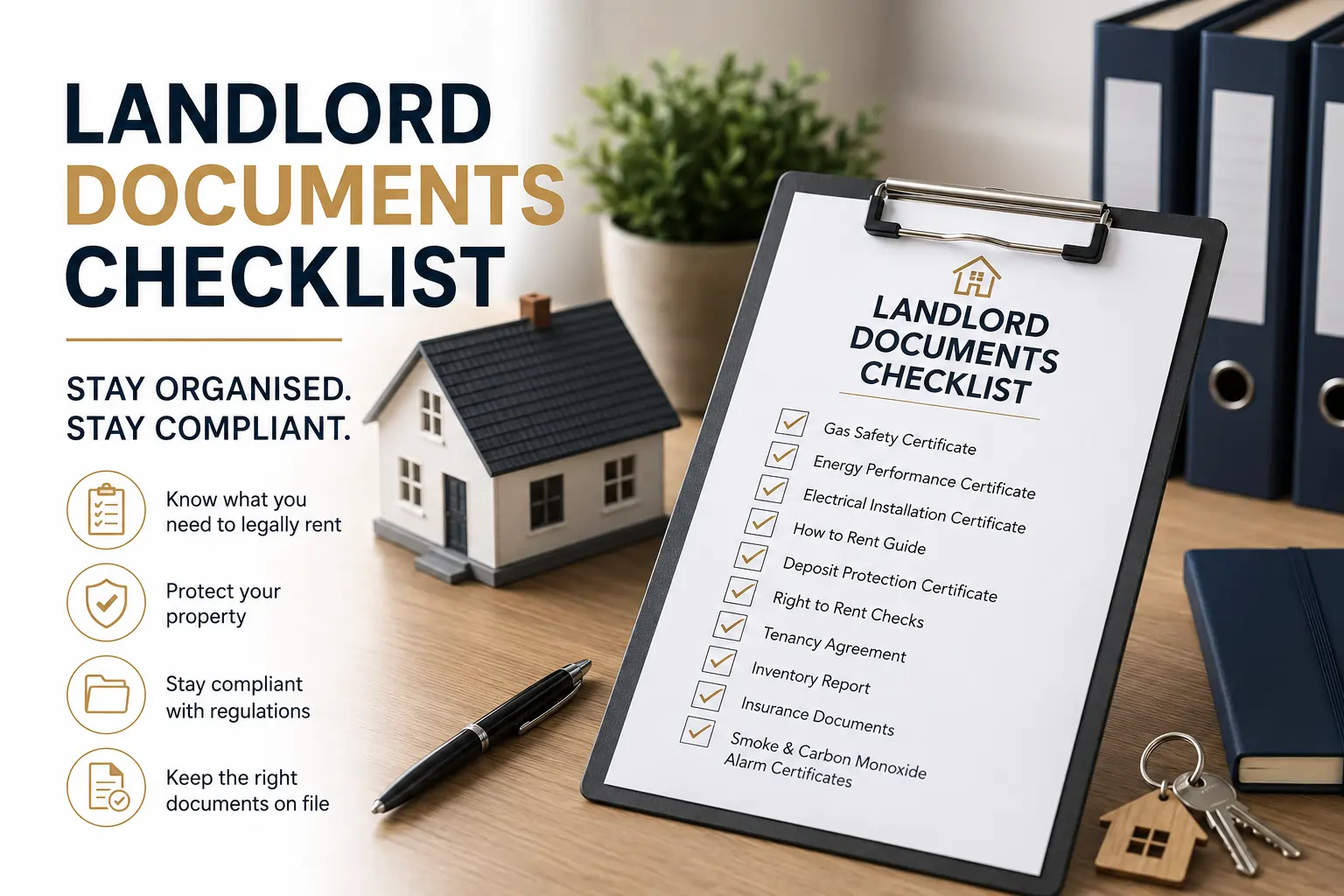
Good landlord paperwork is no longer just admin. In the private rented sector, the right documents can affect compliance, deposit protection, rent increases, possession strategy, tenant disputes, local authority enforcement, mortgage conditions and investment risk.
For landlords and property investors in England, the rules have become more evidence-led. The Renters’ Rights Act landlord guidance confirms major changes to tenancy structure, rent increases, pets, rental bidding and possession. Separately, GOV.UK’s landlord responsibilities guidance sets out core duties around safety, EPCs, deposit protection, Right to Rent checks and mortgage permissions.
This landlord documents checklist explains the key paperwork landlords should have before marketing a property, before a tenant moves in, during the tenancy, and before buying an investment property.
Important: This article is general guidance for landlords and property investors. It is not legal, tax, mortgage or financial advice. Rules differ across the UK, and this guide is focused mainly on landlords with rental property in England. Always check current GOV.UK guidance, local authority rules, lender conditions, lease restrictions and professional advice before making decisions.
Official sources used in this guide
This article is based on current official and regulatory guidance, including:
- GOV.UK landlord responsibilities
- GOV.UK Renters’ Rights Act overview for landlords
- GOV.UK assured periodic tenancies guide for landlords
- GOV.UK deposit protection schemes and landlords
- GOV.UK landlord safety responsibilities
- GOV.UK electrical safety standards guidance
- GOV.UK domestic private rented property MEES guidance
- GOV.UK landlord’s guide to Right to Rent checks
- GOV.UK HMO licensing guidance
Quick landlord documents checklist
The exact documents needed depend on the property, tenancy type, location and whether the property is a standard buy-to-let, leasehold flat, HMO, student let, supported housing arrangement or other specialist rental. However, most landlords should review the following paperwork.
| Document or record | Why it matters | When to check |
|---|---|---|
| Tenancy agreement or written tenancy information | Records the key terms, rent, parties and responsibilities. | Before tenancy starts |
| Renters’ Rights Act Information Sheet where required | Helps evidence compliance with updated tenancy information rules. | Before or during tenancy, depending on circumstances |
| Deposit protection evidence | Important for compliance, disputes and possession proceedings. | After deposit is taken and throughout tenancy |
| Gas safety record | Required where relevant gas appliances or flues are supplied. | Before move-in and annually |
| Electrical safety report | Electrical installations must be checked at required intervals. | Before letting and at renewal intervals |
| Energy Performance Certificate | Needed for letting and to assess MEES compliance. | Before marketing or letting |
| Right to Rent check evidence | Landlords in England should check occupiers’ right to rent where required. | Before occupation |
| Inventory and schedule of condition | Helps prevent disputes over damage, cleaning and deductions. | At check-in and check-out |
| HMO licence or local licence where required | Licensing breaches can create serious financial and enforcement risk. | Before letting as an HMO or in a licensing area |
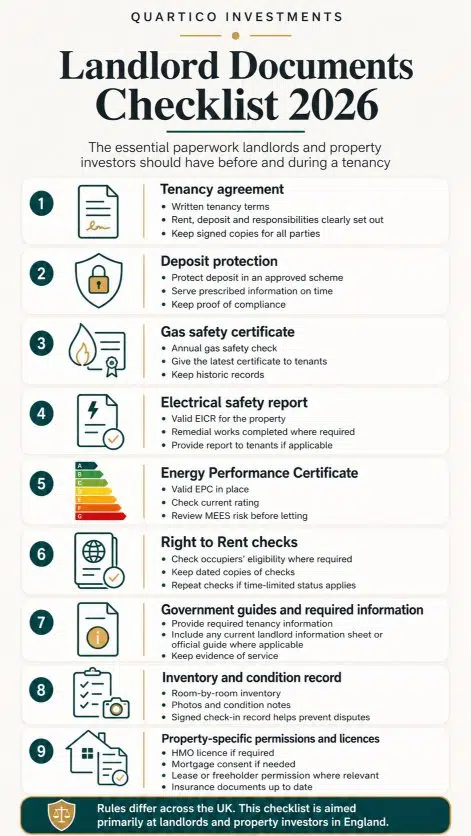
1. Tenancy agreement or written tenancy information
A tenancy agreement records the legal and practical terms between landlord and tenant. Under the Renters’ Rights Act framework, landlords need to be careful not to rely on outdated assured shorthold tenancy assumptions.
GOV.UK’s assured periodic tenancies guidance for landlords says landlords cannot create an assured shorthold tenancy and that assured tenancies now run on a rolling basis. The guidance also explains that if a tenancy is based on an oral agreement, landlords must give the tenant key terms in writing.
A landlord’s written tenancy record should usually include:
- the landlord’s name and contact details;
- the tenant or tenants;
- the property address;
- the rent amount and payment date;
- deposit details;
- who is responsible for bills;
- repair and access arrangements;
- house rules where relevant;
- any permitted occupiers;
- any property-specific restrictions, such as leasehold rules or HMO conditions.
For investors buying a tenanted property, reviewing the tenancy agreement is essential. You need to know who occupies the property, what rent is payable, whether the tenancy terms are clear, and whether the current documentation matches the seller’s claims.
2. Renters’ Rights Act Information Sheet and required information
Landlords should check whether they need to provide the official Renters’ Rights Act Information Sheet or other required written information. GOV.UK’s Renters’ Rights Act overview for landlords says landlords with a written tenancy record were required to give tenants the Renters’ Rights Act Information Sheet by 31 May 2026, and landlords with entirely verbal agreements had to provide written information about the key tenancy terms.
The safest practical approach is to keep clear evidence of:
- what information was given;
- which version of the document was provided;
- when it was served;
- how it was sent;
- who received it.
This may seem like a small admin point, but it matters. Compliance is increasingly evidence-led. If a tenant, local authority or court asks what was provided and when, the landlord should be able to produce a clear record.
3. Deposit protection certificate and prescribed information
If a landlord takes a tenancy deposit, they need to understand the deposit protection rules. GOV.UK’s deposit protection schemes and landlords guidance explains when deposits must be protected in a government-approved scheme. GOV.UK’s tenancy deposit protection guidance also explains that landlords must provide tenants with required information about the deposit scheme.
Landlords should keep:
- deposit scheme certificate or confirmation;
- prescribed information served on the tenant;
- evidence of the date the deposit was received;
- evidence of the date it was protected;
- copies of any deposit-related correspondence;
- check-in and check-out evidence to support any deductions.
Poor deposit paperwork can create problems far beyond the end-of-tenancy dispute. It may also affect a landlord’s ability to obtain possession in some circumstances. The Renters’ Rights Act guidance specifically links possession orders with whether deposit protection requirements have been met or resolved.
4. Gas safety record
Where gas appliances or flues are supplied, landlords need to keep the correct gas safety paperwork. GOV.UK’s landlord safety responsibilities guidance says landlords must make sure gas equipment they supply is safely installed and maintained by a Gas Safe registered engineer, arrange annual gas safety checks on appliances and flues, and give tenants a copy of the gas safety record before they move in or within 28 days of the check.
Landlords should keep:
- current gas safety certificate;
- historic gas safety records;
- engineer details;
- evidence the certificate was given to the tenant;
- records of remedial works;
- diary reminders for renewal dates.
For property investors, gas safety records should be checked before exchange where possible, especially when buying a tenanted property. Missing or expired certificates may indicate wider management issues.
5. Electrical Installation Condition Report
Electrical safety is another core landlord document area. GOV.UK’s electrical safety standards guidance says landlords must have the electrics in rented properties checked at least every 5 years by a properly qualified person and must give tenants proof that installations and equipment have been inspected, tested and checked.
Landlords should keep:
- current Electrical Installation Condition Report;
- records of any C1, C2 or FI remedial works;
- confirmation that required works were completed;
- contractor invoices and certificates;
- evidence of providing the report to tenants where required;
- renewal diary reminders.
Electrical paperwork matters for compliance, tenant safety, insurance and property due diligence. It is also particularly important for HMOs, older properties and properties that have undergone conversion or refurbishment works.
6. Energy Performance Certificate and MEES evidence
Landlords generally need an Energy Performance Certificate before marketing or letting a rental property. GOV.UK’s landlord responsibilities guidance lists providing an EPC as a landlord responsibility. GOV.UK’s domestic private rented property MEES guidance explains the minimum energy efficiency standard for domestic private rented property.
Landlords should keep:
- current EPC certificate;
- expiry date;
- current EPC rating;
- improvement recommendations;
- evidence of completed energy upgrades;
- valid exemption evidence where relevant;
- future retrofit cost estimates where investment risk is being assessed.
For investors, EPC is more than a compliance document. It can affect finance, refurbishment budgets, future letting risk and exit value. A property that looks profitable on paper may be less attractive if significant energy upgrades are needed.
7. Right to Rent checks
Landlords in England should check whether Right to Rent checks apply. GOV.UK’s landlord’s guide to Right to Rent checks explains how landlords, letting agents and homeowners should conduct Right to Rent checks when letting privately rented accommodation. GOV.UK also publishes a Right to Rent code of practice for landlords and agents.
Landlords should keep:
- evidence of the check completed;
- date the check was carried out;
- copies or records allowed by the official guidance;
- share code check results where applicable;
- diary reminders for repeat checks where time-limited status applies;
- records showing checks were carried out consistently and without discrimination.
This is an area where process matters. Landlords should avoid informal or inconsistent checks, because poor practice can create both compliance and discrimination risk.
8. Inventory and schedule of condition
An inventory is not just a nice-to-have document. It is one of the most useful pieces of evidence a landlord can keep.
A good inventory should include:
- room-by-room condition notes;
- photographs or videos;
- meter readings;
- keys issued;
- cleaning standard;
- furniture and appliances;
- garden or external areas;
- tenant signatures or evidence of check-in.
At check-out, the inventory helps compare the condition at the start and end of the tenancy. This can reduce disputes, support fair deposit deductions and help identify repairs that are the landlord’s responsibility.
For HMO landlords, inventories may need to distinguish between individual rooms and shared areas. Where properties are let room-by-room, records should be precise about which tenant is responsible for which space.
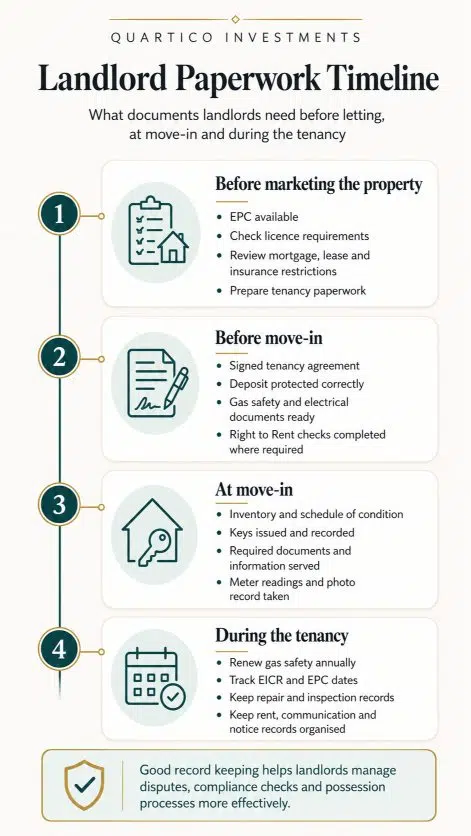
9. Repair, inspection and maintenance records
Landlords must keep rented properties safe and free from serious hazards. GOV.UK’s landlord responsibilities guidance explains that councils can inspect properties using the Housing Health and Safety Rating System and can take enforcement action if serious hazards are found.
Landlords should keep records of:
- tenant repair reports;
- inspection notes;
- photographs;
- contractor quotes;
- invoices;
- completion evidence;
- communications with tenants;
- access attempts where access was needed for repairs.
This is especially important where a tenant later alleges disrepair, damp, mould, electrical issues, pest problems or safety hazards. Good records do not remove the landlord’s repair obligations, but they help demonstrate what was reported, when action was taken and what was completed.
10. Rent records and rent increase paperwork
Rent records matter for cashflow, tax, arrears management and possession evidence. Under the Renters’ Rights Act framework, rent increases are also more process-driven.
GOV.UK’s Renters’ Rights Act overview for landlords says landlords who want to increase rent need to use Form 4A and give tenants at least 2 months’ notice under the Section 13 process. The guidance also says landlords cannot increase rent more than once a year and tenants can challenge above-market increases.
Landlords should keep:
- rent schedule;
- payment history;
- arrears records;
- rent increase notices;
- evidence of service;
- market rent comparables;
- tenant correspondence;
- payment plan records where relevant.
For investors, this is important during purchase due diligence. A seller may claim a rent level, but the buyer should check whether rent is actually being paid, whether arrears exist and whether rent increases have been handled correctly.
11. Possession-related documents and evidence
Section 21 no-fault eviction is no longer available for assured tenancies. GOV.UK’s Renters’ Rights Act guidance says landlords need a legal reason to evict, called a ground for possession, and must issue a Section 8 notice using one or more relevant grounds.
This makes evidence more important. If a landlord needs possession, they may need records supporting the ground relied upon.
Depending on the situation, useful documents may include:
- rent arrears schedule;
- payment reminders;
- tenant communications;
- inspection records;
- photographs of damage;
- antisocial behaviour complaints;
- police or council references where relevant;
- evidence of intention to sell or occupy where applicable;
- copies of notices served;
- proof of service.
Possession is not just about serving a notice. It is about being able to show why the legal ground applies and that the process has been followed correctly.
Quartico has published a separate guide to the wider reforms here: Renters’ Rights Act 2025: What Landlords Need to Know.
12. HMO licence and HMO management documents
HMO landlords need additional paperwork. GOV.UK’s HMO guidance says an HMO must have a licence if it is occupied by 5 or more people, and councils can also include other types of HMOs for licensing. Landlords should check directly with the relevant council before letting a property as an HMO.
HMO documents may include:
- mandatory HMO licence;
- additional HMO licence where required;
- selective licence where applicable;
- fire risk assessment;
- fire alarm and emergency lighting records;
- room size evidence;
- amenity standard checks;
- management arrangements;
- inspection records;
- tenant room agreements and shared area rules.
HMO paperwork is particularly important before purchase. A property advertised as an HMO may not be lawfully licensable, may need planning permission, may sit in an Article 4 area, or may require expensive works to meet standards.
Related Quartico guides:
13. Insurance, mortgage and lease permissions
Landlord compliance is not only about statutory documents. Investors also need to check whether the property can be legally and contractually let in the way intended.
GOV.UK’s landlord responsibilities guidance says that if a landlord has a mortgage on the property they want to rent out, they must get permission from the mortgage lender. Leasehold properties can also contain restrictions on subletting, HMOs, short-term letting, pets, alterations or business use.
Landlords should keep:
- buy-to-let mortgage offer and conditions;
- consent-to-let approval if relevant;
- landlord insurance policy;
- public liability cover details;
- rent guarantee or legal expenses cover where applicable;
- leasehold/freeholder consent where required;
- management company rules;
- special conditions for HMOs, supported housing or serviced accommodation.
For investors, this should be checked before completion. A property may look attractive, but if the lease, lender or insurer does not permit the intended use, the investment plan may fail.
14. Tax and ownership records
This checklist is focused on landlord compliance documents, not tax advice. However, landlords should keep clear records for accounting and tax purposes.
Useful records include:
- purchase completion statement;
- mortgage statements;
- rental income records;
- letting agent statements;
- repair invoices;
- insurance costs;
- service charge and ground rent statements;
- utility bills paid by the landlord;
- furnishing and replacement item costs;
- professional fees;
- company or ownership structure documents where relevant.
Quartico has also published further guidance here: How to Navigate UK Property Taxes.
15. Pre-purchase documents for property investors
Landlord documents are not only needed after purchase. They are part of pre-purchase due diligence.
Before buying a tenanted rental property, investors should ask for:
- existing tenancy agreement;
- rent payment history;
- arrears information;
- deposit protection evidence;
- gas safety record;
- electrical safety report;
- EPC;
- licence documents where relevant;
- repair and maintenance history;
- inspection records;
- notices served on or by tenants;
- evidence of disputes or complaints;
- lease, title and freeholder restrictions;
- planning or Article 4 position if HMO use is intended.
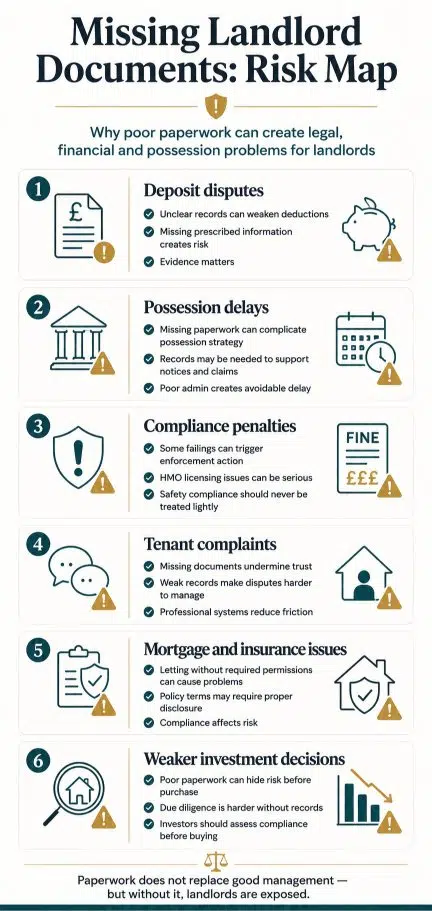
This is especially important where the investment relies on HMO conversion, student letting, supported housing, rent increases, refinancing or a quick resale. Missing paperwork can hide risk.
16. How long should landlords keep documents?
There is no single answer for every document. Some records need to be kept for statutory reasons, some for tax, some for tenancy disputes, and some for practical evidence if problems arise later.
As a practical approach, landlords should keep organised digital and paper records for:
- current tenancy documents for the whole tenancy;
- deposit documents until the deposit is fully resolved;
- safety certificates and renewal history;
- repair records for as long as disputes or claims could arise;
- tax and accounting records in line with accounting advice;
- licence documents for the whole licence period and beyond;
- possession and notice records where legal action has been considered or taken.
The safest approach is to use a clear folder structure for every property, rather than storing certificates, emails, invoices and notices across different inboxes and devices.
17. Suggested landlord document folder structure
For landlords managing multiple properties, a simple folder structure can reduce risk.
For each property, consider folders such as:
- 01 Purchase and title
- 02 Mortgage and insurance
- 03 Tenancy agreements
- 04 Deposit protection
- 05 Safety certificates
- 06 EPC and energy works
- 07 Right to Rent checks
- 08 Inventory and inspections
- 09 Repairs and maintenance
- 10 Rent records and arrears
- 11 Notices and possession
- 12 HMO or local licensing
- 13 Tax and accounts
This is not glamorous, but it is one of the simplest ways to make property investment more professional.
18. Landlord documents checklist before letting
Before marketing or letting a property, landlords should ask:
- Is the EPC valid and acceptable?
- Is the gas safety record current, if gas applies?
- Is the electrical safety report valid?
- Are smoke and carbon monoxide alarms dealt with?
- Is the tenancy agreement or written information suitable for the current law?
- Is the Renters’ Rights Act Information Sheet or required information ready where applicable?
- Is the deposit process ready?
- Will Right to Rent checks be completed correctly?
- Is an inventory arranged?
- Are mortgage, insurance and lease permissions in place?
- Is HMO or local licensing required?
- Are local authority rules checked?
19. What this means for property investors
For investors, documents are not just operational paperwork. They are part of risk assessment.
Missing documents can affect:
- purchase due diligence;
- mortgage suitability;
- insurance cover;
- tenant disputes;
- deposit deductions;
- possession timelines;
- local authority enforcement;
- HMO licensing;
- cashflow assumptions;
- exit strategy.
A property with weak paperwork may still be a good investment, but the risk needs to be understood before purchase. In some cases, poor documentation is a warning sign that the property has been informally managed, under-maintained or let in a way that does not match the investor’s plan.
Final thoughts: paperwork is part of professional landlord management
Landlord compliance is becoming more document-led. The landlords best placed to manage the changing private rented sector will be those who keep clear records, understand their responsibilities and check compliance before problems arise.
For property investors, the key lesson is simple: review the paperwork before you buy, keep records during the tenancy, and do not rely on informal assumptions when the law, lender, insurer or local authority may expect evidence.
Quartico helps investors assess property opportunities, compliance risk and long-term strategy in a changing rental market.
Speak to Quartico About Property Investment
Frequently asked questions
What documents does a landlord need before letting a property?
Most landlords should review the tenancy agreement or written tenancy information, deposit protection documents, gas safety record where applicable, electrical safety report, EPC, Right to Rent checks where required, inventory, safety records, insurance and any licence documents needed for the property.
Does every landlord need a gas safety certificate?
A gas safety record is required where relevant gas appliances or flues are supplied. If a property has no gas, the requirement may not apply in the same way, but landlords should still check their safety responsibilities.
How often do landlords need an electrical safety check?
GOV.UK guidance says landlords must have electrics in rented properties checked at least every 5 years by a properly qualified person.
Does a landlord need an EPC before letting?
Landlords generally need a valid EPC before marketing or letting a property, and should also check whether the property meets minimum energy efficiency standards or whether a valid exemption applies.
What deposit documents should landlords keep?
Landlords should keep deposit protection confirmation, prescribed information, evidence of when the deposit was received and protected, and evidence that the tenant was given the required information.
Do landlords still need a tenancy agreement after the Renters’ Rights Act?
Landlords and tenants should have a clear written record of the tenancy terms. Under the Renters’ Rights Act framework, landlords should avoid relying on old fixed-term assured shorthold tenancy assumptions.
What documents are important for HMO landlords?
HMO landlords may need HMO licence documents, fire safety records, room size evidence, amenity standard checks, inspection records, management arrangements, tenancy records and evidence of compliance with local authority requirements.
Why do landlord documents matter for property investors?
Documents help investors assess compliance, rent evidence, possession risk, safety standards, licensing, insurance, mortgage conditions and future investment risk before buying or refinancing a property.