
Section 8 Possession Grounds for Landlords | 2026 Guide

Section 21 has ended, but landlords can still regain possession where a valid legal ground applies. The Renters’ Rights Act changed the possession process for private landlords in England. Landlords can no longer rely on a no-fault Section 21 notice for assured tenancies. Instead, they must use the Section 8 process and identify one or more legal grounds for possession.
This guide explains the main Section 8 possession grounds for landlords, when Form 3A is needed, what evidence landlords should prepare, and why old Section 21 and Section 8 notice templates should be treated with caution after the reforms.
Important: This article is general guidance for landlords and property investors. It is not legal advice. Possession claims can be complex, and landlords should check current GOV.UK guidance, use the correct official form, and take professional legal advice before serving notice or starting court proceedings.
Official sources used in this guide
This article is based on current official government guidance and should be read alongside the latest GOV.UK publications:
- GOV.UK: Repossessing your privately rented property after 1 May 2026
- GOV.UK: Assured tenancy forms, including Form 3A
- GOV.UK: Form 3A official PDF
- GOV.UK: Form 3A guidance for private landlords
- GOV.UK: Grounds for possession guidance for landlords and letting agents
- GOV.UK: Renters’ Rights Act overview for landlords
Quick summary: Section 8 possession after the Renters’ Rights Act
The Renters’ Rights Act changed the possession process for private landlords in England. GOV.UK’s Renters’ Rights Act overview for landlords says landlords must issue tenants with a Section 8 notice using one or more of the grounds for possession.
| Issue | What landlords need to know | Practical point |
|---|---|---|
| Section 21 | No-fault possession is no longer the route for private assured tenancies. | Old Section 21 notice templates should not be relied on. |
| Section 8 | Landlords need a valid legal ground for possession. | The notice must identify the ground or grounds being used. |
| Form 3A | Private landlords should use the official GOV.UK Form 3A. | Do not use an old downloaded template without checking it is current. |
| Evidence | Possession is now much more evidence-led. | Keep rent records, documents, photos, notices and proof of service. |
| Court process | If the tenant does not leave, landlords may need to apply to court. | Notice alone does not physically remove a tenant. |
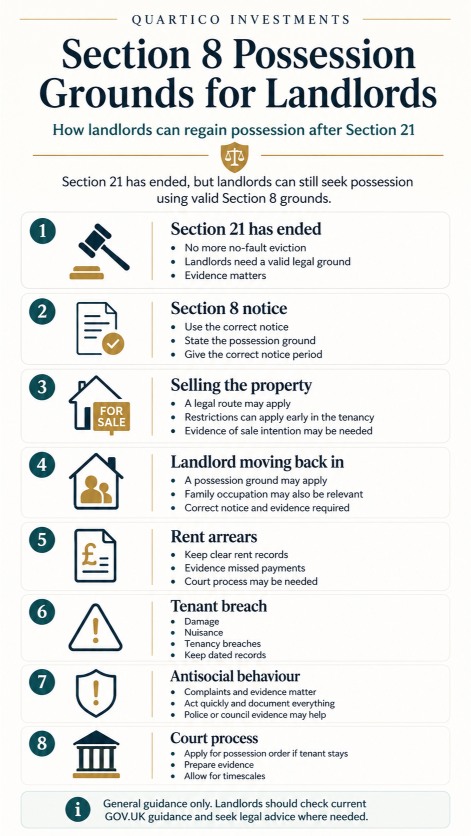
What changed after Section 21?
Before the Renters’ Rights Act reforms, many landlords relied on Section 21 to regain possession without needing to prove tenant fault. That route is no longer available for private assured tenancies after the reforms.
GOV.UK’s post-1 May 2026 repossession guidance explains the process landlords must follow when serving an eviction notice after the reforms. The key principle is that landlords need a valid possession ground and must use the correct notice process.
This does not mean landlords can never recover a property. It means the reason for possession matters. Selling, moving back in, rent arrears, serious breach, antisocial behaviour and some student HMO situations may still give landlords a route to possession, but the landlord must choose the correct ground and prepare suitable evidence.
What is a Section 8 notice?
A Section 8 notice is a formal notice telling the tenant that the landlord intends to seek possession using one or more legal grounds. The notice should explain which grounds are being used, why those grounds apply and when the landlord may start possession proceedings if the tenant does not leave.
For private landlords after the Renters’ Rights Act changes, the key official document is Form 3A. GOV.UK’s assured tenancy forms page provides the official Form 3A and guidance for private landlords.
A Section 8 notice is not the same as a court possession order. If the tenant does not leave after the notice period expires, the landlord may need to apply to court. The court will consider the possession ground, the evidence and whether the legal requirements have been met.
Section 8 notice template: should landlords use Form 3 or Form 3A?
This is an important point because many landlords still search for “Section 8 notice template”, “Section 8 form”, “Form 3 Section 8 notice” or “Section 8 notice template PDF”.
Private landlords should be careful. After the Renters’ Rights Act changes, the official GOV.UK form for many private landlords is Form 3A. GOV.UK’s assured tenancy forms page lists Form 3A official PDF and Form 3A guidance for private landlords.
Landlords should not rely on a random downloaded “Section 8 notice template” without checking whether it is current, official and suitable for the tenancy. Old templates may refer to outdated notice wording, old possession grounds or pre-reform assumptions.
Practical point: Quartico can help landlords and investors understand evidence, compliance and possession risk. However, the legal notice itself should come from the current official GOV.UK form or be prepared with professional legal advice.
Section 21 notice template: can landlords still use one?
Many landlords still search for a “Section 21 notice template”. That search demand is understandable, but landlords need to be careful.
For private assured tenancies after the Renters’ Rights Act changes, Section 21 no-fault eviction is no longer the possession route. Landlords should not assume that an old Section 21 template is still useful. Instead, they need to consider whether a valid Section 8 ground applies and whether Form 3A is the correct notice form.
For landlords and investors, this is one of the biggest practical changes. Possession strategy now starts with the reason for possession, not with a generic no-fault template.
Mandatory and discretionary possession grounds
Possession grounds can be mandatory or discretionary. This distinction matters.
With a mandatory ground, the court must usually make a possession order if the ground is proven and the legal requirements have been met. With a discretionary ground, the court can consider whether it is reasonable to make a possession order.
GOV.UK’s grounds for possession guidance explains the different grounds and notice periods. Landlords should check the exact ground carefully because notice periods and evidence requirements vary.
Selling the property
Landlords may still have a route to possession if they genuinely intend to sell the property. However, this is not the same as the old Section 21 process. The landlord needs to rely on the correct possession ground and should be able to evidence the intention to sell.
Evidence may include:
- valuation records;
- estate agent correspondence;
- marketing preparation;
- mortgage or financial reasons for sale;
- internal notes showing the timeline and decision-making process;
- evidence that the property is intended to be sold rather than simply re-let.
Landlords should also check whether any restrictions apply early in the tenancy. The government’s Renters’ Rights Act guidance explains that tenants benefit from a protected period at the start of a tenancy where landlords cannot use some landlord-circumstance grounds, such as selling or moving in.
Landlord or family moving back into the property
Another common reason for possession is where the landlord, or in some circumstances a close family member, genuinely needs to live in the property. Again, this requires the correct legal ground and evidence.
Useful evidence may include:
- the landlord’s written explanation of why the property is needed;
- family circumstances where relevant;
- documents showing a change in housing need;
- employment, separation, care or relocation evidence where relevant;
- evidence that the intention is genuine.
This is an area where landlords should be particularly careful. A possession ground should not be used as a pretext to remove a tenant and then re-let the property on different terms.
Rent arrears possession grounds
Rent arrears remain one of the most common reasons landlords consider possession. GOV.UK’s grounds for possession guidance explains arrears-related grounds, including grounds for significant arrears, any arrears and persistent late payment.
Landlords should keep clear rent records from the start of the tenancy. A rent arrears case can be weakened by poor records, inconsistent rent ledgers, unclear payment dates or a lack of evidence that the tenant was chased properly.
Useful rent arrears evidence includes:
- rent schedule;
- rent payment ledger;
- missed payment dates;
- bank records where appropriate;
- tenant reminders;
- arrears letters or emails;
- payment plan offers;
- records of any partial payments;
- benefit or third-party payment information where relevant.
For investors buying a tenanted property, arrears evidence should be reviewed before purchase. A headline rent figure is not enough. The key question is whether the rent is actually being paid and whether arrears or disputes already exist.
Persistent late payment
Some tenants may not always owe a large amount at one time but may repeatedly pay late. Persistent late payment can create cashflow pressure, management time and uncertainty for landlords.
Where persistent late payment is being relied on, landlords should keep a detailed chronology showing the pattern. This could include due dates, actual payment dates, reminders, warnings and any agreements made with the tenant.
It is not enough to simply say the tenant is unreliable. The landlord should be able to show the court a clear pattern of late or delayed payment.
Tenant breach and property damage
Landlords may be able to seek possession where the tenant has breached the tenancy agreement or allowed the condition of the property to deteriorate. These cases are usually evidence-heavy.
Evidence may include:
- the tenancy term that has been breached;
- inspection records;
- photographs or videos;
- contractor reports;
- repair invoices;
- tenant correspondence;
- witness statements where relevant;
- records showing the tenant was asked to remedy the breach.
Landlords should avoid relying on vague allegations. A stronger file will show what happened, when it happened, what evidence exists and what steps the landlord took.
Antisocial behaviour and nuisance
Antisocial behaviour can cause serious problems for neighbours, other tenants and landlords. It can also create pressure from local authorities, managing agents or freeholders.
Evidence may include:
- dated incident logs;
- complaints from neighbours or other tenants;
- police references where relevant;
- council or noise team correspondence;
- photos, videos or recordings where lawful and appropriate;
- witness statements;
- warnings sent to the tenant;
- records of attempts to resolve the issue.
Antisocial behaviour cases can be urgent, but landlords still need to follow the correct legal process. Where there is a serious risk, landlords should take professional advice quickly.
Student HMO possession issues
Student HMOs need particular care. Some student letting models historically relied on fixed academic-year cycles. After the Renters’ Rights Act reforms, landlords need to understand whether a specific student possession ground applies and whether the property and tenancy structure qualify.
Not every student property will qualify in the same way. Factors may include whether the property is an HMO, whether tenants are full-time students, whether the tenancy is joint or room-by-room, and whether the required notice and timing rules have been followed.
Student HMO landlords should keep:
- evidence of student status;
- tenancy structure records;
- joint tenancy documents where relevant;
- notices and evidence of service;
- advertising and academic-year records;
- HMO licence documents;
- room and amenity compliance records.
Related Quartico guidance: HMO Investments Guide and HMO Licensing and Article 4 Guide.
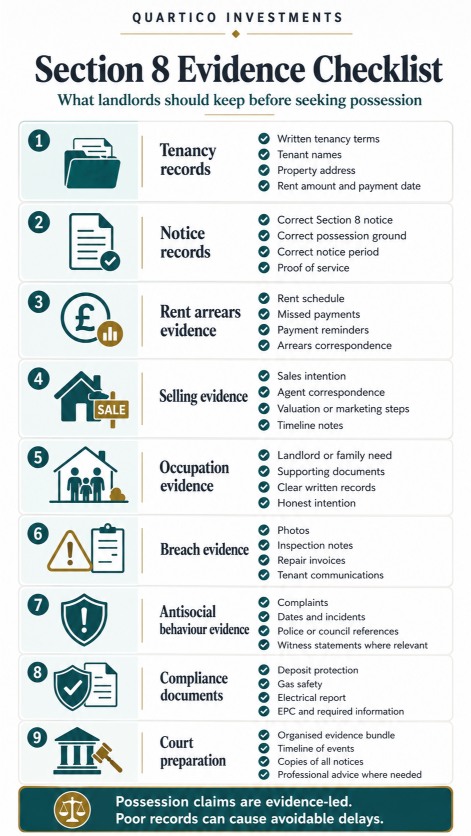
Evidence landlords should prepare before serving notice
Possession claims are evidence-led. Before serving notice, landlords should organise the file properly and check whether compliance documents are up to date.
A practical evidence bundle may include:
- tenancy agreement or written tenancy information;
- Renters’ Rights Act Information Sheet evidence where relevant;
- rent ledger;
- arrears schedule;
- deposit protection evidence;
- gas safety record where applicable;
- electrical safety report;
- EPC;
- inspection notes;
- photos or videos;
- tenant correspondence;
- complaints or witness statements;
- copies of notices;
- proof of service.
Landlords should also check that they are using the correct ground, the correct form and the correct notice period. A mistake at this stage can cause delay or weaken the claim.
Notice periods: why landlords need to check the ground carefully
Notice periods vary depending on the possession ground. Some grounds require longer notice periods, while others may have shorter notice periods. GOV.UK’s grounds for possession guidance should be checked before serving notice because using the wrong notice period can create problems later.
Landlords should avoid copying notice periods from old blogs, old templates or pre-reform documents. The safest approach is to check the current official guidance and the current Form 3A before taking action.
What happens if the tenant does not leave?
If the notice period expires and the tenant does not leave, the landlord may need to apply to court for a possession order. The court will then consider the possession ground, the evidence and whether the legal process has been followed correctly.
Landlords should not try to force the tenant out themselves. Unlawful eviction and harassment can create serious legal consequences. The proper route is notice, evidence and court process where required.
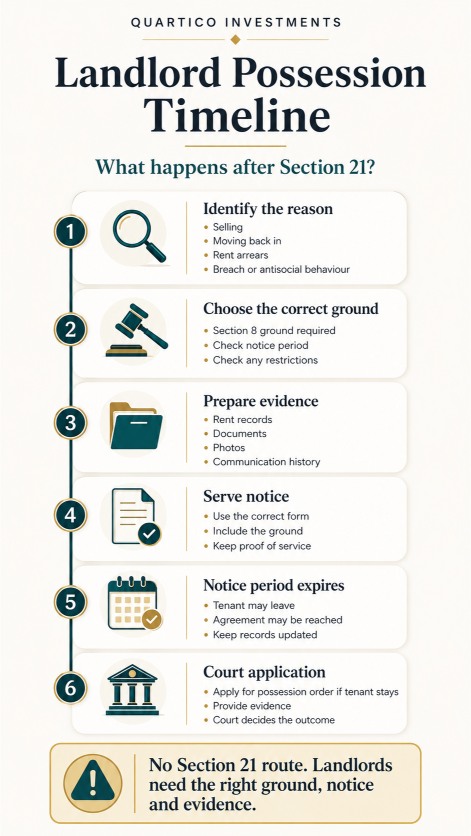
Landlord possession timeline after Section 21
The possession process should be handled in stages. Landlords should start by identifying the real reason for possession, choosing the correct ground, preparing evidence, serving the correct notice and then applying to court if the tenant does not leave.
Common landlord mistakes with Section 8 possession
Common mistakes include:
- using an old Section 8 notice template;
- using Form 3 instead of checking whether Form 3A applies;
- using a Section 21 template after the reforms;
- choosing the wrong possession ground;
- giving the wrong notice period;
- failing to keep proof of service;
- failing to organise rent arrears evidence;
- making allegations without supporting documents;
- ignoring deposit, safety or tenancy information issues;
- trying to pressure the tenant to leave outside the proper process.
The practical lesson is simple: landlords should not treat possession as a quick admin task. It is a legal process that needs the right form, the right ground and the right evidence.
Template and checklist ideas for landlords
Landlords often search for eviction templates because they want something quick and practical. That is understandable, but the legal notice itself should come from the current official GOV.UK form or be prepared with professional legal advice.
Safer supporting resources for landlords include:
- Section 8 evidence checklist;
- rent arrears schedule;
- possession document checklist;
- proof of service record;
- pre-possession compliance checklist;
- timeline of events template;
- tenant communication log;
- inspection and photo evidence log.
These resources can help landlords prepare properly without replacing the official legal notice. This is a safer approach than downloading a random “free Section 8 notice template” and assuming it is legally correct.
Pre-purchase possession risk for property investors
Possession risk is not only relevant after a problem arises. Investors should think about possession before buying a rental property.
Before buying a tenanted property, investors should check:
- who occupies the property;
- what tenancy type applies;
- whether the rent is being paid;
- whether arrears exist;
- whether notices have been served;
- whether there are disputes or complaints;
- whether the deposit was protected correctly;
- whether safety certificates are up to date;
- whether possession may be needed to sell, refinance, refurbish or change strategy;
- whether HMO or student letting rules affect the plan.
A property can look attractive on yield but carry hidden possession risk. That risk should be priced into the investment decision before completion.
Related Quartico guidance: Landlord Compliance Guide and Landlord Documents Checklist.
Final thoughts: possession is now evidence-led
The end of Section 21 does not mean landlords have no rights. It means landlords need to use the correct legal ground and be able to evidence why possession is justified.
For professional landlords and property investors, the new reality is clear. Possession planning should be built into compliance systems, tenancy records, rent management and investment due diligence. The better the records, the stronger the landlord’s position if a possession issue arises.
Quartico helps investors assess property opportunities, compliance risk and long-term strategy in a changing rental market.
Speak to Quartico About Property Investment
Frequently asked questions
Can landlords still evict tenants after Section 21?
Yes, landlords can still seek possession where a valid legal ground applies. However, they can no longer rely on Section 21 no-fault eviction for private assured tenancies after the Renters’ Rights Act reforms.
What form should private landlords use for a Section 8 notice?
Private landlords should check GOV.UK’s assured tenancy forms page and use the correct official form. After the reforms, GOV.UK provides Form 3A for private landlords seeking possession of privately rented property under an assured tenancy or assured agricultural occupancy.
Is Form 3 the same as Form 3A?
No. Landlords should not assume Form 3 and Form 3A are interchangeable. GOV.UK provides Form 3A guidance for private landlords. Always check the current official form before serving notice.
Can landlords use a free Section 8 notice template?
Landlords should be very careful with free templates. Old or unofficial templates may be out of date. The safest approach is to use the current official GOV.UK form or take professional legal advice.
What evidence is needed for rent arrears possession?
Useful evidence includes a rent schedule, payment history, missed payment dates, reminders, arrears letters, tenant correspondence, payment plan records and any relevant benefit or third-party payment information.
Can a landlord regain possession to sell the property?
A landlord may have a possession route where they genuinely intend to sell, but they must use the correct ground, follow the correct notice process and keep evidence of the intention to sell.
Can a landlord move back into a rented property?
A landlord may have a route to possession where they or a qualifying family member genuinely need to occupy the property, but the correct ground, notice period and evidence are required.
What happens if the tenant does not leave after a Section 8 notice?
If the notice period expires and the tenant does not leave, the landlord may need to apply to court for a possession order. A notice alone does not physically remove the tenant.
Should landlords still use a Section 21 notice template?
Landlords should not rely on old Section 21 notice templates for private assured tenancies after the Renters’ Rights Act reforms. Landlords should consider whether a valid Section 8 ground applies and use the correct official form.