

Birmingham is one of the UK’s most important regional property markets, and for the right investor, an HMO in Birmingham can offer strong rental demand, diversified income and attractive long-term potential.
However, buying an HMO in Birmingham is not the same as buying a standard buy-to-let. The city has a more controlled planning and licensing environment than many investors expect. Before buying, you need to understand Article 4, HMO licensing, local tenant demand, property condition, room sizes, financeability and your exit strategy.
This guide explains what investors should check before buying an HMO for sale in Birmingham, including planning, licensing, mortgages, social housing potential and due diligence.
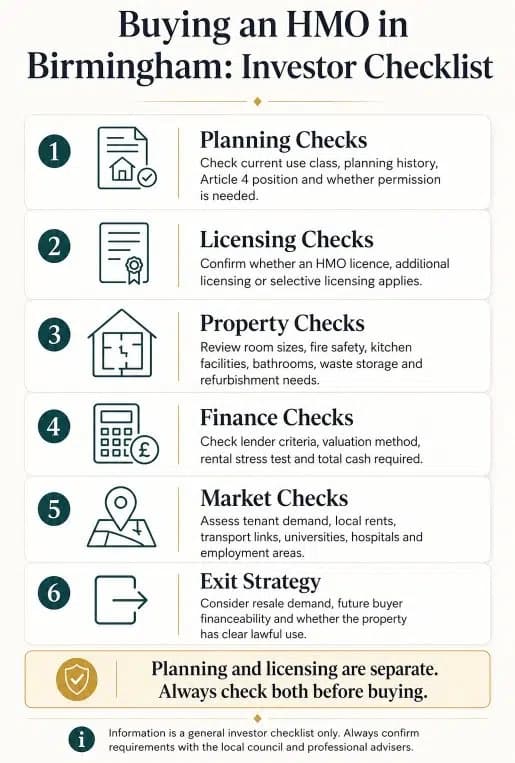
Why Investors Look at HMOs in Birmingham
Birmingham has several features that can make it attractive for HMO investors. It is a major university city, a large employment centre, a growing professional rental market and a key regional hub for transport, healthcare, education, finance, legal services and regeneration.
Unlike a standard single-let property, an HMO usually generates income from multiple rooms. This can improve gross rental income and reduce reliance on one tenant. For investors who want stronger income than a traditional buy-to-let, this is one of the main attractions of the HMO model.
Typical Birmingham HMO demand can come from:
- Young professionals
- Key workers
- Contractors
- Supported accommodation or social housing providers
- Tenants looking for affordable all-inclusive rooms
The key point is that Birmingham is not a market where investors should buy blindly. The opportunity can be strong, but compliance checks matter from the very beginning.
HMO for Sale Birmingham: What to Check First
When reviewing an HMO for sale in Birmingham, the first question should not simply be “what is the yield?” A high advertised yield means very little if the property has planning issues, licensing problems, undersized rooms or unrealistic rent assumptions.
Before looking at projected income, investors should check:
- Is the property already operating as an HMO?
- Does it have lawful HMO use?
- Does it have the correct licence?
- Is the licence valid and transferable, or will a new application be needed?
- How many occupants is the property legally suitable for?
- Do the room sizes meet minimum standards?
- Are fire safety and amenity standards already in place?
- Is the property in an area affected by Article 4?
- Can the property be financed with an HMO mortgage?
- Is there clear local rental demand for the intended tenant profile?
For a broader explanation of HMO licensing, Article 4, room sizes and use classes, read our HMO licensing and Article 4 guide .
Article 4 in Birmingham
Birmingham has a city-wide Article 4 Direction relating to HMOs. This is important because it affects whether a standard house can be converted into a small HMO without planning permission.
In many parts of England, changing a C3 dwellinghouse into a small C4 HMO may fall under permitted development rights. In Birmingham, investors should not assume that this applies. Where Article 4 removes those permitted development rights, a planning application is normally needed before changing a standard house into a small HMO.
For investors, this means there is a big difference between:
- Buying an existing lawful HMO in Birmingham
- Buying a standard house and hoping to convert it into an HMO
An existing lawful HMO may already have the planning position needed to operate. A conversion property may need planning approval before it can be used as an HMO. That planning risk should be understood before exchange, not after completion.
You can check the council’s planning position through the Birmingham City Council Article 4 information .
HMO Licensing in Birmingham
Planning permission and HMO licensing are separate. This is one of the most important points for investors to understand.
Planning asks whether the property is allowed to be used as an HMO in that location. Licensing asks whether the property is safe, suitable and properly managed as an HMO.
In England, mandatory HMO licensing generally applies where a property is occupied by five or more people from two or more separate households who share facilities. Birmingham also has additional HMO licensing, which can bring smaller HMOs into the licensing regime.
That means a three- or four-person HMO in Birmingham may still need a licence, depending on the current rules and property circumstances.
Investors should check:
- Whether mandatory HMO licensing applies
- Whether Birmingham’s additional licensing scheme applies
- Whether selective licensing applies in the specific area
- Whether the existing licence matches the advertised occupancy
- Whether any licence conditions affect future income
- Whether a renewal or new licence application will be needed after purchase
You can review the council’s HMO licensing information on the Birmingham City Council HMO licensing page .
Existing HMO vs HMO Conversion in Birmingham
For many investors, buying an existing HMO in Birmingham is lower risk than buying a normal house and converting it. That does not mean existing HMOs are automatically safe, but it can reduce planning uncertainty if lawful use is clear.
Buying an existing HMO
When buying an existing HMO, review:
- Existing HMO licence
- Licence expiry date
- Licensed occupancy
- Planning history
- Evidence of lawful HMO use
- Tenancy history
- Fire safety records
- Room measurements
- Utility setup
- Management arrangements
Buying a property to convert into an HMO
When buying a conversion property, review:
- Article 4 position
- Planning permission requirements
- Local HMO concentration policy
- Refurbishment cost
- Fire safety upgrade cost
- Room layout
- Kitchen and bathroom provision
- Waste storage
- Likely licensing requirements
- Mortgage lender appetite
The more work required after completion, the more important it is to build in contingency for cost, time and planning risk.
Best Areas in Birmingham for HMO Demand
Birmingham is not one single HMO market. Tenant demand varies by postcode, transport access, local employers, universities, property type and room quality.
Common areas investors may review include:
- Selly Oak and Bournbrook — often associated with student demand linked to the University of Birmingham.
- Edgbaston — a mixed market with student, professional and healthcare-related demand depending on the exact location.
- Aston and surrounding areas — potential demand from students, workers and city-access tenants.
- Digbeth and city-fringe locations — more relevant to professional renters and regeneration-led demand.
- Perry Barr and north Birmingham — may appeal to investors looking at affordability and transport-linked demand.
These are not automatic recommendations. The right area depends on the property, price, compliance position, tenant strategy and management route.
A strong HMO location usually has:
- Good transport links
- Access to employment areas
- University, hospital or city-centre demand drivers
- Comparable room rental evidence
- Low expected void risk
- Good resale demand from other investors
HMO Room Sizes and Property Standards
Room sizes are a critical part of HMO due diligence. A bedroom that works on an agent’s floor plan may not be suitable for licensing.
For licensed HMOs in England, national minimum sleeping room sizes are generally:
| Occupancy | Minimum sleeping room size |
|---|---|
| One person over 10 years old | 6.51m² |
| Two people over 10 years old | 10.22m² |
| One child under 10 years old | 4.64m² |
These are minimum standards, not necessarily best-practice room sizes. Local requirements can be stricter, and lenders, tenants and future buyers may all prefer larger, better-configured rooms.
Investors should also check:
- Fire doors
- Smoke alarms and heat detectors
- Emergency lighting where required
- Escape routes
- Kitchen facilities
- Bathroom provision
- Heating and ventilation
- Electrical and gas safety
- Furniture safety
HMO Mortgages in Birmingham
Most HMO purchases require specialist finance. A standard buy-to-let mortgage may not be suitable for a licensed or multi-let property.
HMO lenders often look at:
- Landlord experience
- Property value
- Number of bedrooms
- Whether the property is C4 or sui generis
- Planning status
- HMO licence position
- Rental stress testing
- Valuation method
- Whether the buyer is purchasing personally or through a limited company
A property that looks profitable on paper may fail a lender’s stress test if the borrowing is too high, the rent is unrealistic or the property does not meet the lender’s HMO criteria.
For a deeper explanation, read our HMO mortgage guide for UK and overseas property investors .
Social Housing HMOs in Birmingham
Some investors look at Birmingham for provider-backed or social housing HMO opportunities. These can be attractive where the property is leased to an operator or provider who manages occupancy, tenant placement and day-to-day operation.
However, provider-backed does not mean compliance-free. Investors still need to check:
- Whether the property is classed as an HMO
- Whether licensing is required
- Whether planning use is correct
- Who is responsible for compliance works
- Who pays for utilities, council tax, maintenance and repairs
- Whether the lease protects the investor if rules change
- Whether the income is genuinely net or only partially net
For investors who want a more hands-off structure, this model can be worth exploring carefully. You can learn more on our HMO social housing investments page .
Birmingham HMO Due Diligence Checklist
Before buying an HMO in Birmingham, investors should work through a structured due diligence process.
Planning checks
- Confirm whether the property is C3, C4 or sui generis.
- Check whether Article 4 affects the property.
- Review planning history and lawful use evidence.
- Check whether a new planning application may be required.
Licensing checks
- Check mandatory HMO licensing.
- Check Birmingham additional licensing.
- Check selective licensing for the specific area.
- Review licence conditions and licensed occupancy.
Property checks
- Measure bedrooms properly.
- Review fire safety compliance.
- Check kitchens, bathrooms and communal areas.
- Budget for refurbishment and compliance works.
Investment checks
- Check room-by-room rental evidence.
- Allow for bills, management, maintenance and voids.
- Stress test mortgage payments.
- Consider future resale demand.
Request Latest HMO Investments
Make an Enquiry
Common Mistakes When Buying an HMO in Birmingham
Assuming Article 4 does not matter
Article 4 can directly affect whether a C3 property can be converted into a C4 HMO. Always check before buying.
Confusing licensing with planning
An HMO licence does not automatically prove planning permission. Planning and licensing are separate.
Trusting advertised yield without checking legal occupancy
If the advertised income assumes six rooms but only five rooms are compliant, the investment case changes.
Ignoring additional licensing
Smaller HMOs can still need licensing where an additional licensing scheme applies.
Underestimating refurbishment costs
Fire safety upgrades, bathroom changes, kitchen improvements and room reconfiguration can materially affect returns.
Not considering the exit
A compliant, lawful HMO is usually easier to sell or refinance than a property with unclear planning or licensing status.
Is an HMO in Birmingham a Good Investment?
An HMO in Birmingham can be a good investment when the numbers are supported by the compliance position.
The strongest opportunities usually have:
- Clear lawful use
- Correct licensing
- Good room sizes
- Strong tenant demand
- Realistic rent assumptions
- Manageable refurbishment costs
- Financeability
- A sensible exit strategy
The weakest opportunities are often those where investors chase headline yield without checking planning, licensing and property standards.
For Birmingham, due diligence is not optional. It is the difference between buying a high-performing HMO and buying a compliance problem.
How Quartico Helps HMO Investors
At Quartico, we help investors assess property opportunities with both return and risk in mind.
For HMO investors, that means looking beyond advertised yield and reviewing the details that actually protect long-term performance:
- Tenant demand
- Licensing position
- Mortgage suitability
- Management route
- Net return
- Exit strategy
Whether you are comparing Birmingham with Manchester, Liverpool, Leeds or Sheffield, the right HMO investment should match your capital, income target, risk appetite and preferred level of involvement.
You may also want to compare Birmingham with our other HMO location pages:
- Manchester HMO investments
- Liverpool HMO investments
Frequently Asked Questions
Is Birmingham a good place to buy an HMO?
Birmingham can be a strong HMO market because it has student demand, professional tenant demand, major employers and large rental markets. However, investors must check planning, licensing, local demand and property suitability before buying.
Does Birmingham have Article 4 for HMOs?
Yes. Birmingham has a city-wide Article 4 Direction relating to HMOs. This means investors should check whether planning permission is needed before converting a standard C3 house into a small C4 HMO.
Do HMOs in Birmingham need a licence?
They may do. Mandatory HMO licensing generally applies to larger HMOs with five or more occupants from two or more households. Birmingham also has additional HMO licensing, so smaller HMOs may also need a licence.
Can an HMO have a licence but still have planning problems?
Yes. Licensing and planning are separate systems. A property may have an HMO licence but still need evidence of lawful HMO use or planning permission.
What should I check before buying an HMO in Birmingham?
Investors should check Article 4, planning history, HMO licence status, room sizes, fire safety, amenity standards, rental demand, mortgage suitability, management costs and exit strategy.
Is it better to buy an existing HMO or convert a house in Birmingham?
An existing lawful HMO may reduce planning risk, but it still needs full due diligence. A conversion can work, but it usually carries more planning, refurbishment, licensing and finance risk.
Can I get an HMO mortgage in Birmingham?
Yes, but HMO mortgages are specialist products. Lenders may assess landlord experience, planning status, licensing, room count, rental income, valuation and stress testing before approving the loan.
Can social housing HMOs work in Birmingham?
They can, depending on the property, provider, lease structure and compliance position. Investors should check who is responsible for licensing, maintenance, tenant placement, bills and ongoing management.