
HMO Licensing & Article 4 Guide for UK Property Investors

HMO investments can deliver some of the strongest rental yields in the UK property market, but they are also more regulated than standard buy-to-let properties.
Before buying an HMO, investors need to understand two separate issues: HMO licensing and planning permission. These are not the same thing.
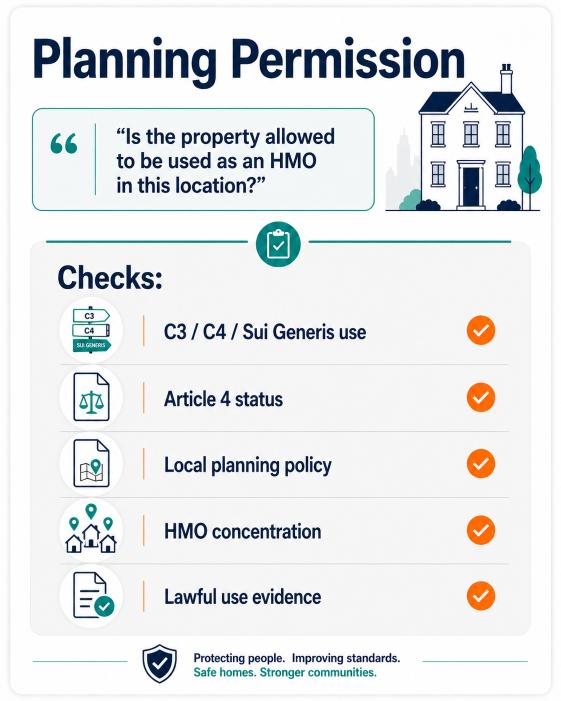
HMO licensing is about whether the property is safe, suitable and properly managed as a house in multiple occupation. Planning permission is about whether the property is allowed to be used as an HMO in that location.
A property may have an HMO licence but still have planning issues. Equally, a property may have planning permission but still need a licence before it can be legally occupied as an HMO.
For investors, this matters because licensing and Article 4 rules can affect income, refurbishment costs, mortgageability, valuation, resale value and long-term investment performance.
Speak to Quartico About HMO Investments
What Is an HMO?
An HMO, or House in Multiple Occupation, is generally a property occupied by people from more than one household who share facilities such as a kitchen, bathroom or toilet.
In investment terms, HMOs are popular because letting a property by the room can generate stronger rental income than letting it to a single household.
Common HMO tenant profiles include:
- Students
- Young professionals
- Key workers
- Supported accommodation residents
- Social housing or provider-backed occupants
- Contractor or workforce accommodation tenants
However, the more people who live in a property, the greater the responsibility on the landlord or operator to ensure the building is safe, suitable and legally compliant.
What Is HMO Licensing?
HMO licensing is the system local councils use to regulate shared housing. A licence helps ensure that an HMO is suitable for the number of occupants living there and that the person managing the property is considered fit and proper.
A council may check areas such as:
- Fire safety
- Room sizes
- Kitchen and bathroom facilities
- Waste storage
- Property condition
- Management standards
- Number of occupiers
- Safety certificates
- Whether the property is overcrowded
For investors, the licence is not just a piece of paperwork. It can directly affect the investment model. If a property is only licensed for five occupants, the income calculation should not be based on six.
When Does an HMO Need a Licence?
In England, mandatory HMO licensing generally applies where the property is occupied by:
- 5 or more people
- from 2 or more separate households
- sharing facilities such as a kitchen, bathroom or toilet
Some councils also operate additional licensing schemes, which can require smaller HMOs to be licensed even if they have only three or four occupants.
That means investors should never assume that a property does not need a licence simply because it has fewer than five tenants. The correct approach is to check the local council’s current licensing scheme before purchasing.
For official guidance, investors can check the GOV.UK HMO licence guidance.
Mandatory, Additional and Selective Licensing Explained
Mandatory HMO licensing
This applies to larger HMOs that meet the national criteria. For investors, this is the baseline licensing category to check first.
Additional HMO licensing
Additional licensing is introduced by local councils where they believe smaller HMOs need closer regulation. This can bring three- and four-person HMOs into the licensing regime.
For example, a four-bedroom professional HMO may not meet the national mandatory licensing threshold, but it could still need a licence if the local authority has an additional licensing scheme.
Selective licensing
Selective licensing usually applies to private rented properties in designated areas, not just HMOs. A single-let buy-to-let property may need a selective licence if it is in a selective licensing zone.
For HMO investors, this matters because a property may fall under more than one local control.
HMO Licensing vs Planning Permission
This is one of the most common areas of confusion for investors.
Licensing is about whether the property is safe, suitable and properly managed as an HMO.
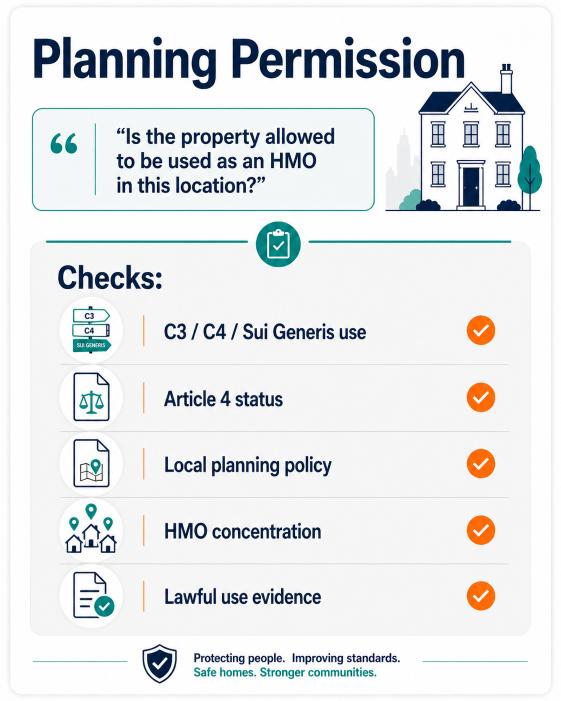
Planning permission is about whether the property is allowed to be used as an HMO in that location.
They are separate systems. A council issuing an HMO licence does not always mean the property has the correct planning status. Likewise, planning permission does not remove the need for a licence if the property meets licensing criteria.
A good HMO investment should have:
- The correct planning position
- The correct HMO licence or licensing pathway
- Compliant room sizes
- Suitable amenity provision
- Fire safety measures
- Clear management responsibility
- Realistic income assumptions based on legal occupancy
HMO Planning Use Classes: C3, C4 and Sui Generis
In England, residential property use classes are important for HMO investors.
C3 — Dwellinghouse
A standard family home is usually classed as C3.
C4 — Small HMO
A small HMO is usually a property occupied by 3 to 6 unrelated individuals who share basic amenities such as a kitchen or bathroom.
Sui Generis — Large HMO
A property occupied by 7 or more unrelated people usually falls outside the standard use classes and is treated as sui generis. This normally requires planning permission.
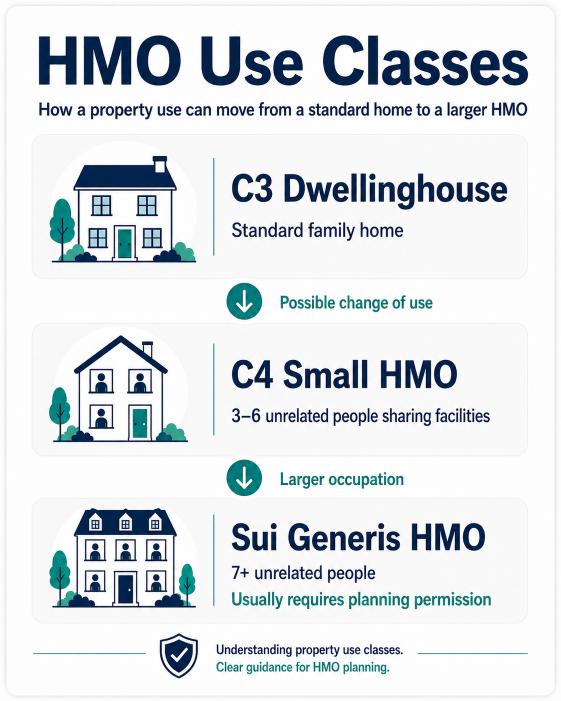
The key point for investors is simple: a small HMO may sometimes be created from a standard C3 house under permitted development rights, but this changes if the property is in an Article 4 area.
You can read more about use classes on the Planning Portal use classes guide.
What Is Article 4?
An Article 4 Direction is a planning control used by local councils to remove specific permitted development rights in a defined area.
For HMO investors, Article 4 usually matters because it can remove the automatic permitted development right to change a standard C3 dwellinghouse into a small C4 HMO.
In practical terms:
- Outside an Article 4 area, a C3 to C4 conversion may be possible without full planning permission.
- Inside an Article 4 area, planning permission is usually required before converting a C3 house into a C4 HMO.
Article 4 does not necessarily ban new HMOs. It means the investor must apply for planning permission, and the council will assess the application against local policy.
Why Article 4 Matters for HMO Investors
Article 4 can make or break an HMO investment.
In strong HMO markets, councils often introduce Article 4 directions to control the concentration of shared housing. This is common in areas with high student numbers, large professional rental markets or pressure on family housing.
For investors, Article 4 affects:
- Whether a conversion is possible
- How long the purchase and conversion process may take
- Planning risk
- Refurbishment timelines
- Lender confidence
- Future resale value
- Scarcity value of existing lawful HMOs
In some locations, Article 4 can actually increase the value of existing licensed and lawful HMOs because new supply is harder to create. However, buying a property in an Article 4 area without checking the planning status can be a serious mistake.
Existing HMO vs HMO Conversion
There is a big difference between buying an existing HMO and buying a normal house to convert into an HMO.
Buying an existing HMO
You should check:
- Current HMO licence
- Licence expiry date
- Licensed occupancy
- Planning history
- Lawful use evidence
- Room sizes
- Fire safety compliance
- Current tenancy or lease structure
- Whether the use has been continuous
- Whether the income matches the legal occupancy
Buying a property to convert into an HMO
You should check:
- Whether Article 4 applies
- Whether planning permission is needed
- Local HMO concentration policies
- Minimum property size requirements
- Parking policy
- Waste storage requirements
- Room layout
- Fire escape routes
- Likely refurbishment cost
- Local rental demand
- Lender appetite
The risk is usually higher with a conversion because the investor is relying on future permissions, future works and future tenanting.
Minimum HMO Room Sizes
HMO room sizes are a major part of compliance.
In England, national minimum sleeping room sizes for licensed HMOs are:
| Occupancy | Minimum sleeping room size |
|---|---|
| One person over 10 years old | 6.51m² |
| Two people over 10 years old | 10.22m² |
| One child under 10 years old | 4.64m² |
Rooms below 4.64m² must not be used as sleeping accommodation. When measuring a room, areas where the ceiling height is below 1.5m should not usually be counted.
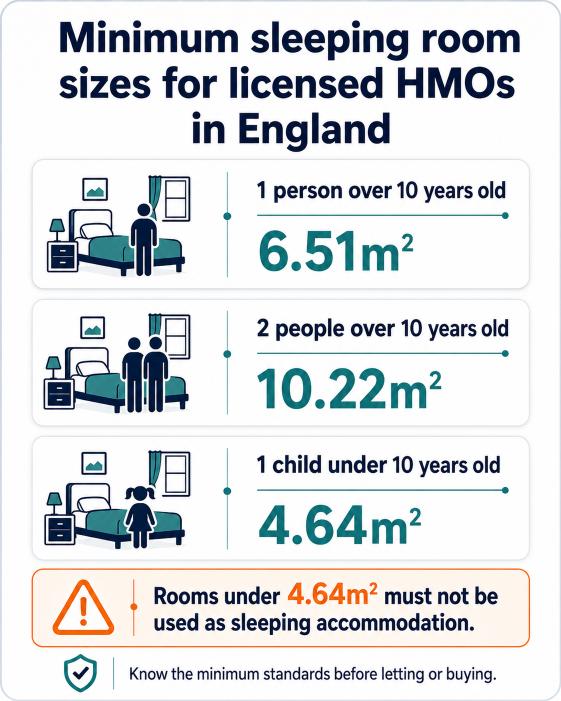
These are statutory minimums, not best-practice room sizes. Local councils can require higher standards through their licensing policies.
For investors, this means you should not rely only on a floor plan or agent brochure. Room sizes should be measured properly before finalising the investment case.
HMO Safety and Amenity Standards
A compliant HMO is not just about bedroom sizes.
Councils may also look at:
- Fire doors
- Smoke alarms
- Heat detectors
- Emergency lighting
- Escape routes
- Kitchen facilities
- Bathroom-to-occupant ratios
- Heating
- Ventilation
- Electrical safety
- Gas safety
- Furniture safety
- Waste storage
- Property management arrangements
Older terraced houses can often work well as HMOs, but they may need significant upgrades before they are suitable for multiple occupation.
This is why investors should always understand the true cost of compliance before focusing on headline yield.
Common HMO Licensing and Article 4 Mistakes
Mistake 1: Assuming a licence means planning is correct
An HMO licence and planning permission are different. You need to check both.
Mistake 2: Assuming all HMOs are legal because they are already tenanted
A property can be occupied as an HMO without having the correct licence or planning status. Existing occupation is not enough.
Mistake 3: Basing yield on too many rooms
If only five rooms are compliant, the return should not be calculated on six.
Mistake 4: Ignoring Article 4 before buying
Article 4 can make a planned conversion slower, harder or impossible depending on local policy.
Mistake 5: Not checking additional licensing
A three- or four-person HMO may still need a licence if the local council has introduced additional licensing.
Mistake 6: Forgetting about resale
A lawful, licensed HMO can be easier to sell than a property with unclear compliance. Planning certainty can improve exit options.
HMO Licensing for Social Housing and Provider-Backed HMOs
HMO licensing and planning rules still matter for provider-backed or social housing HMO investments.
Even if a property is leased to a housing provider, supported accommodation operator or contractor-backed provider, investors should still understand:
- Whether the property is classed as an HMO
- Whether a licence is required
- Who is responsible for maintaining compliance
- Who pays for required upgrades
- Who deals with council inspections
- Whether the lease requires the property to remain compliant
- What happens if the licence is refused, varied or reduced
This is especially important for hands-off investors.
A long lease or guaranteed rent structure can be attractive, but it does not remove the need for correct legal and compliance checks.
View HMO Social Housing Investments
How HMO Compliance Affects Returns
The strongest HMO investments are not always the ones with the highest headline yield.
A better investment is usually one where the return is supported by:
- Lawful use
- Correct licensing
- Strong local demand
- Realistic occupancy
- Good room sizes
- Sensible refurbishment cost
- Clear management responsibility
- Strong resale demand
- Lender-friendly structure
A non-compliant HMO may appear attractive on paper, but the risks can quickly reduce or remove the expected return.
Potential costs include:
- Licence application fees
- Planning application fees
- Fire safety works
- Room layout changes
- Kitchen or bathroom upgrades
- Legal advice
- Delays to letting
- Reduced occupancy
- Enforcement penalties
- Lower valuation
- Limited mortgage options
This is why HMO due diligence should always come before yield.
Quartico’s HMO Due Diligence Checklist
Before presenting or assessing an HMO investment, the key checks should include planning, licensing, property and investment due diligence.
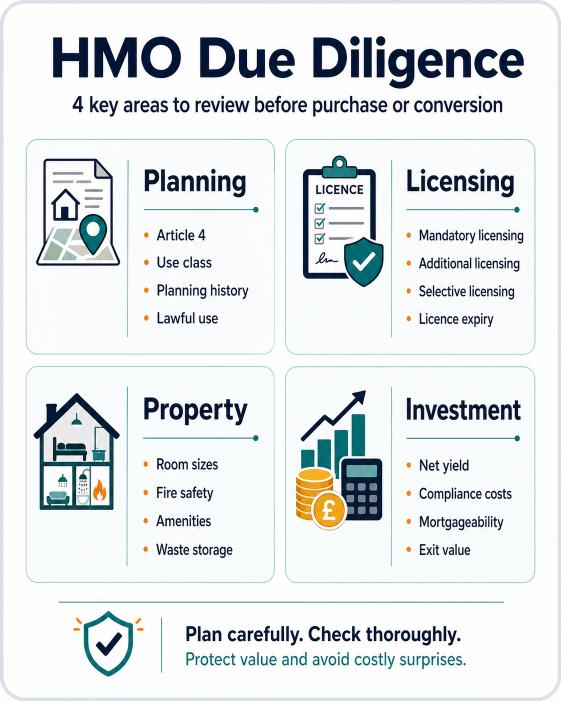
Planning checks
- Current use class
- Article 4 status
- Planning history
- Lawful use evidence
- C3, C4 or sui generis position
- Any previous refusals or enforcement issues
Licensing checks
- Mandatory licensing requirement
- Additional licensing requirement
- Selective licensing requirement
- Existing licence status
- Licence expiry date
- Licensed occupancy
- Licence conditions
Property checks
- Bedroom sizes
- Amenity provision
- Fire safety
- Waste storage
- Floor plan suitability
- Refurbishment requirements
- Energy performance
- Building condition
Investment checks
- Gross yield
- Net yield
- Compliance costs
- Management costs
- Mortgage suitability
- Exit value
- Comparable sales
- Local rental demand
- Tenant profile
This is the difference between buying an HMO and buying a properly structured HMO investment.
Should You Buy an HMO in an Article 4 Area?
Yes, sometimes — but only with the right evidence.
An Article 4 area is not automatically a bad investment location. In fact, many strong HMO markets have Article 4 directions because demand for shared accommodation is already high.
The key question is whether the property already has lawful HMO use.
An existing lawful HMO in an Article 4 area may be attractive because new competition is harder to create. A normal C3 house in an Article 4 area is more complicated because the investor may need planning permission before converting it.
The best approach is to check the planning position before making an offer, not after completion.
Final Thoughts: Compliance Comes Before Yield
HMO investments can be highly profitable, but they need to be structured correctly.
Licensing, Article 4, room sizes and planning status are not small details. They directly affect income, risk, finance and exit value.
For investors, the best HMO opportunities are not just high-yielding. They are:
- Legally sound
- Properly licensed
- Suitable for the intended tenant profile
- Located in areas with proven rental demand
- Supported by realistic net return calculations
- Backed by a clear management and exit strategy
At Quartico, we help investors assess HMO opportunities with both return and risk in mind.
Speak to Quartico Before Buying an HMO
Frequently Asked Questions
What is HMO licensing?
HMO licensing is the system used by local councils to regulate houses in multiple occupation. It helps ensure the property is safe, suitable for the number of occupants and properly managed.
When does an HMO need a licence?
In England, mandatory HMO licensing generally applies when a property is occupied by five or more people from two or more separate households who share facilities. Some councils also require smaller HMOs to be licensed through additional licensing schemes.
What is Article 4 for HMOs?
Article 4 is a planning control that removes permitted development rights. For HMOs, it often means that changing a standard C3 house into a small C4 HMO requires planning permission.
Does Article 4 ban HMOs?
No. Article 4 does not automatically ban HMOs. It means planning permission is required, and the council will assess the application under local planning policy.
Can a property have an HMO licence but no planning permission?
Yes. Licensing and planning are separate systems. Investors should check both before buying.
What is the difference between C3 and C4 use?
C3 is usually a standard dwellinghouse. C4 is a small HMO occupied by three to six unrelated individuals sharing basic amenities.
Do large HMOs need planning permission?
HMOs occupied by seven or more unrelated people are usually treated as sui generis and normally require planning permission.
What are the minimum HMO room sizes?
For licensed HMOs in England, the national minimum sleeping room sizes are 6.51m² for one person over 10, 10.22m² for two people over 10, and 4.64m² for one child under 10. Local councils may require higher standards.
Do social housing HMOs still need licensing?
They may do. The lease or provider arrangement does not automatically remove HMO licensing or planning obligations. The property structure, occupancy and local rules must be checked.
Is an HMO in an Article 4 area a bad investment?
Not necessarily. Existing lawful HMOs in Article 4 areas can be attractive because new supply may be restricted. The key is proving lawful use and understanding local planning policy.
Read Our Full HMO Investment Guide