

Buying an HMO in Manchester can be attractive for property investors, but it needs careful due diligence. Manchester has strong rental demand, a large professional population, major universities, transport links, regeneration areas and a long-established private rented sector. However, HMO investments are more regulated than standard buy-to-let properties.
Before buying an HMO for sale in Manchester, investors should understand the difference between rental demand, licensing, planning permission, Article 4 rules, room sizes, finance and long-term exit value.
This guide explains the key checks to make before buying or converting an HMO in Manchester.
Why Investors Look at HMOs in Manchester
Manchester is one of the UK’s most established regional property markets. For HMO investors, the city can be appealing because shared accommodation may suit a range of tenant profiles, including young professionals, graduates, students, key workers and people looking for more affordable rental options.
Unlike a standard single-let buy-to-let, an HMO is usually let by the room. This can produce stronger gross rental income, but it also brings additional management, compliance and refurbishment responsibilities.
For investors, the key question is not simply whether the headline yield looks high. The better question is whether the property is legally usable, financeable, manageable and suitable for the intended tenant profile.
What Is an HMO?
An HMO, or House in Multiple Occupation, is generally a property occupied by people from more than one household who share facilities such as a kitchen, bathroom or toilet.
In investment terms, this usually means a property with multiple individually let rooms rather than one household renting the whole property.
HMOs can work well in large cities, but they need proper due diligence because the rules are different from a standard buy-to-let.
Buying an Existing HMO vs Converting a House into an HMO
There are two main ways investors usually approach the Manchester HMO market:
- Buying an existing HMO that is already let or capable of being let as an HMO
- Buying a standard house and converting it into an HMO
Buying an existing HMO in Manchester
An existing HMO may reduce planning and conversion risk, but only if the correct evidence is in place. Investors should check whether the property has the right licence, lawful planning use, compliant room sizes and a realistic rental history.
Important checks include:
- Current HMO licence status
- Licence expiry date
- Licensed occupancy
- Planning history
- Evidence of lawful HMO use
- Room sizes and layout
- Fire safety compliance
- Current rental income
- Management arrangements
- Any previous enforcement issues
Converting a house into an HMO in Manchester
A conversion can sometimes create value, but the risk is usually higher. The investor may need planning permission, licensing approval, refurbishment works, fire safety upgrades and a suitable HMO mortgage product.
Before buying a property to convert, investors should check:
- Whether Article 4 applies
- Whether C3 to C4 planning permission is required
- Whether the room layout can work legally
- Whether the property can meet HMO safety standards
- Whether the numbers still work after refurbishment and compliance costs
- Whether a lender is likely to support the project
HMO Licensing in Manchester
HMO licensing is one of the most important checks before buying. Licensing is separate from planning permission. A property may need a licence even if the planning position is correct.
In England, mandatory HMO licensing generally applies when a property is occupied by five or more people from two or more separate households who share facilities. Some councils may also operate additional or selective licensing schemes that affect smaller HMOs or wider private rented properties.
Investors should always check the current local authority rules before buying. Licensing schemes, fees and requirements can change over time.
For a fuller explanation of licensing, planning and Article 4, read our HMO licensing and Article 4 guide .
Article 4 and Manchester HMOs
Article 4 is a planning control that can remove permitted development rights. For HMO investors, this usually matters because it may mean a standard C3 house cannot be converted into a small C4 HMO without planning permission.
This does not automatically mean HMOs are banned. It means the planning position must be checked before purchase.
Investors should not assume that a property can be converted into an HMO simply because nearby houses are used as HMOs. Planning rules can vary by street, ward and local policy area.
Planning Use Classes: C3, C4 and Sui Generis
HMO investors should understand the basic planning use classes:
- C3: a standard dwellinghouse, usually occupied by a single household
- C4: a small HMO, usually occupied by three to six unrelated individuals sharing facilities
- Sui generis: a larger HMO, usually occupied by seven or more unrelated people
The planning position matters because it can affect whether the property is lawful, mortgageable and saleable in the future.
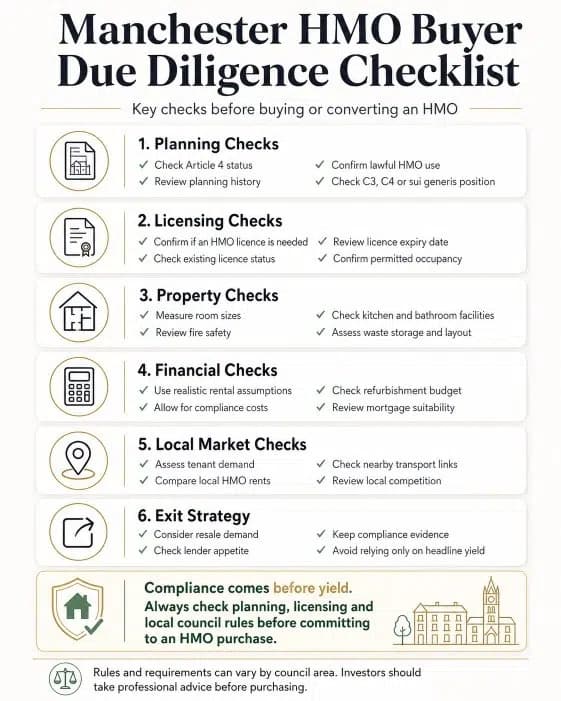
Manchester HMO Due Diligence Checklist
Before buying an HMO for sale in Manchester, investors should review the opportunity across six areas: planning, licensing, property condition, finance, local market demand and exit strategy.
1. Planning checks
- Check whether the property is C3, C4 or sui generis
- Review the planning history
- Check Article 4 status
- Ask for evidence of lawful HMO use where relevant
- Check for enforcement notices or previous refusals
2. Licensing checks
- Confirm whether an HMO licence is needed
- Check existing licence details
- Review licence conditions
- Confirm the maximum permitted occupancy
- Check whether any additional or selective licensing scheme applies
3. Property checks
- Measure room sizes properly
- Check fire doors, alarms and escape routes
- Review kitchen and bathroom provision
- Check waste storage and external space
- Assess refurbishment and compliance costs
4. Financial checks
- Use realistic rent assumptions
- Allow for voids and management costs
- Include maintenance and compliance costs
- Check mortgage availability
- Compare gross yield with realistic net yield
5. Local market checks
- Assess tenant demand in the immediate area
- Compare room rents with similar properties
- Review transport links and employment centres
- Check local competition
- Consider whether the tenant profile matches the property
6. Exit strategy
- Consider resale demand
- Check whether lenders support similar HMOs
- Keep planning and licensing evidence
- Understand whether value depends on HMO use
- Avoid relying only on headline yield
HMO Finance in Manchester
HMO mortgages are usually more specialist than standard buy-to-let mortgages. Lenders may look closely at the borrower’s experience, property layout, licence status, planning position, valuation method and rental stress test.
A property that looks strong on rental income may still be difficult to finance if the planning or licensing position is unclear.
For more detail, read our HMO mortgage guide for UK and overseas investors .
Social Housing and Provider-Backed HMOs in Manchester
Some investors look at HMO properties linked to social housing, supported accommodation or provider-backed lease models. These can offer a different risk and management profile, but they still require careful checks.
A provider lease does not automatically remove HMO licensing, planning or safety obligations. Investors should understand who is responsible for compliance, repairs, inspections, occupancy and ongoing management.
To understand this structure in more detail, see our HMO social housing investment guide .
Common Mistakes When Buying an HMO in Manchester
Assuming the property is legal because it is already tenanted
An occupied HMO is not automatically a compliant HMO. Investors should check licence, planning and room-size evidence.
Relying only on headline yield
Headline yield can look attractive, but net yield after management, compliance, maintenance and voids is more important.
Ignoring Article 4
Article 4 can affect whether a standard house can be converted into an HMO. This should be checked before making a purchase commitment.
Not checking the licence occupancy
If a licence allows five occupants, the investment case should not be based on six rents.
Underestimating refurbishment costs
Fire safety works, room layout changes, bathrooms, kitchens and management systems can all affect the final return.
Is an HMO in Manchester a Good Investment?
An HMO in Manchester can be a good investment when the property is correctly located, legally compliant, well managed and supported by realistic rental assumptions.
However, not every HMO for sale in Manchester is a good opportunity. The strongest investments are usually those where the planning, licensing, finance and exit strategy are clear from the start.
Compliance should come before yield. A high-yielding property with weak evidence can create problems later with lenders, valuers, councils and future buyers.
Frequently Asked Questions
Are HMOs in Manchester a good investment?
They can be, but it depends on the property, location, planning position, licence status, room sizes, rental demand, management costs and exit strategy. Investors should assess the full investment case rather than relying only on headline yield.
Do HMOs in Manchester need a licence?
Many HMOs need a licence, especially larger HMOs occupied by five or more people from two or more households. Smaller HMOs may also need a licence depending on local schemes. Investors should check the current council requirements before buying.
Does Article 4 affect HMO conversions in Manchester?
Article 4 can affect whether a standard house can be converted into a small HMO without planning permission. Investors should check the planning position before buying a property for conversion.
Should I buy an existing HMO or convert a house into an HMO?
An existing HMO may offer a clearer route if the licence and planning evidence are in place. A conversion may create value but usually carries more planning, refurbishment, finance and compliance risk.
Can overseas investors buy HMOs in Manchester?
Yes, overseas investors can buy UK property, but finance, tax, legal checks and management arrangements may be more complex. Specialist mortgage and legal advice is usually important.
What should I check before buying an HMO in Manchester?
Key checks include planning use, Article 4 status, HMO licence, licence occupancy, room sizes, fire safety, refurbishment costs, rental demand, mortgage suitability and resale value.