
HMO Mortgage Guide for UK and Overseas Property Investors

HMO mortgages are specialist buy-to-let mortgages designed for properties rented to multiple unrelated tenants who share facilities such as a kitchen, bathroom or communal living space.
For property investors, HMOs can offer stronger rental income than standard single-let buy-to-let properties. But they are also more complex to finance. Lenders usually look more closely at the property, the borrower, the licence position, planning status, rental income, management arrangements and overall investment risk.
In a higher-rate lending environment, the key question is not simply whether an investor can get an HMO mortgage. The better question is whether the property still works after lender stress testing, compliance costs, management fees, void periods, refurbishment costs and refinancing risk.
This guide explains how HMO mortgages work, what lenders usually look for, how rental stress tests affect borrowing, and what investors should check before financing an HMO investment property.
Speak to Quartico About HMO Investments
What Is an HMO Mortgage?
An HMO mortgage is a specialist mortgage for a House in Multiple Occupation. In simple terms, it is used when a property is rented to multiple people from different households who share facilities.
Most standard buy-to-let mortgages are designed for single-let properties, where one household rents the whole property under one tenancy. HMOs are different because income is usually generated room by room, there may be multiple tenancy agreements, and the property may need additional licensing, safety measures and management.
Because of this, many mainstream buy-to-let lenders will not finance an HMO under a normal buy-to-let product. Instead, the investor may need a dedicated HMO mortgage from a specialist lender.
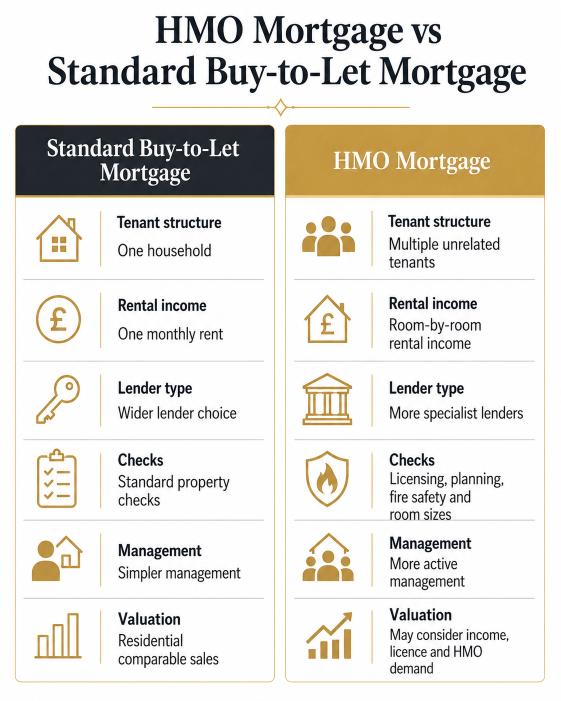
HMO Mortgage vs Standard Buy-to-Let Mortgage
The main difference is risk. From a lender’s perspective, an HMO can produce higher rental income, but it also carries more operational and regulatory risk than a standard single-let property.
| Area | Standard buy-to-let mortgage | HMO mortgage |
|---|---|---|
| Tenant structure | Usually one household | Multiple unrelated tenants or households |
| Rental income | Usually one monthly rent | Often room-by-room rental income |
| Lender pool | Wider range of lenders | More specialist lender market |
| Compliance checks | Standard rental property checks | Licensing, planning, fire safety and room layout may be checked |
| Management | Usually simpler | More intensive property and tenant management |
| Valuation | Often comparable residential value | May depend on property, licence, income and local market |
For investors, this means HMO mortgages should not be treated as standard buy-to-let mortgages with a different name. The property has to stack up as a specialist investment.
Who Needs an HMO Mortgage?
You may need an HMO mortgage if you are buying, refinancing or converting a property that will be occupied as a house in multiple occupation.
This can include:
- Student HMOs
- Professional house shares
- Key worker accommodation
- Supported accommodation HMOs
- Provider-backed or social housing HMOs
- Large HMOs with seven or more occupants
- Existing licensed HMOs
- Properties being converted from single-let houses into HMOs
The exact mortgage route depends on the property, the number of occupants, the licensing position, the planning use class, the borrower profile and whether works are needed before the property can be occupied.
How Much Deposit Do You Need for an HMO Mortgage?
Deposit requirements vary by lender, borrower, property type and market conditions. As a general planning assumption, many investors should expect to need a larger deposit for an HMO than for a standard buy-to-let property.
For many HMO mortgage applications, a deposit of around 25% or more is a sensible starting assumption. Larger HMOs, first-time HMO landlords, unusual properties, heavy refurbishment cases or more complex tenant models may need a larger deposit.
However, this is not a fixed rule. Some lenders may consider higher loan-to-value options in certain cases, while others may be more conservative. The final position depends on the lender’s criteria at the time of application.
| Scenario | Typical deposit planning assumption |
|---|---|
| Smaller HMO with experienced landlord | Often around 25%+, depending on lender |
| Larger or sui generis HMO | Often higher due to added complexity |
| First-time HMO investor | May need a stronger deposit and clearer management plan |
| Heavy refurbishment or conversion | May require bridging finance first, then refinance |
| Provider-backed or lease-backed HMO | Depends on lease terms, provider strength and lender appetite |
The key point is that deposit should not be viewed in isolation. A larger deposit may improve lender choice, reduce risk and create more room for the property to pass rental stress testing.
How Lenders Assess HMO Mortgage Affordability
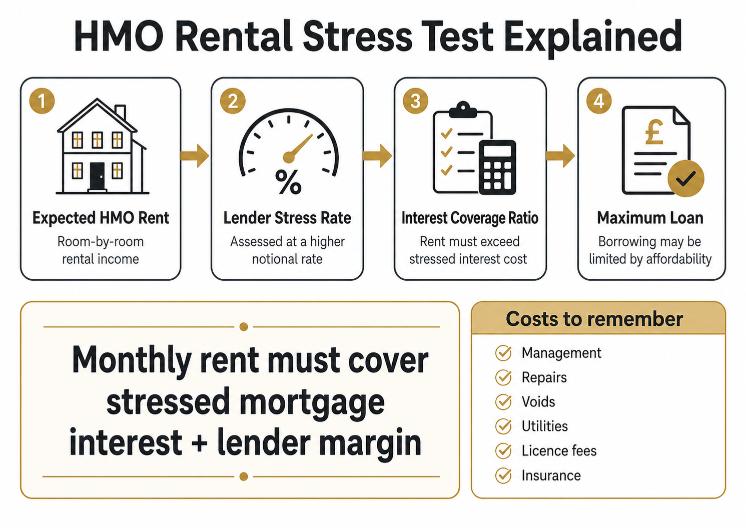
HMO lenders usually assess affordability using the expected rental income from the property. But they do not simply compare the rent to the current monthly mortgage payment.
Instead, lenders typically apply a rental stress test. This helps them check whether the rent would still cover the mortgage if interest rates rose or if the mortgage was assessed at a higher notional rate.
The Bank of England’s Prudential Regulation Authority expects buy-to-let lenders to assess affordability using rental income and interest coverage ratio calculations. Investors can read the official supervisory statement here: Bank of England buy-to-let underwriting standards.
In plain English, this means the rent usually needs to exceed the stressed mortgage interest cost by a lender-specific margin.
What Is an HMO Rental Stress Test?
A rental stress test checks whether the property’s rental income is strong enough to support the mortgage under the lender’s affordability rules.
For example, a lender may look at:
- The expected monthly rent
- The loan amount requested
- The interest rate or stress rate used for the calculation
- The required interest coverage ratio
- Whether the borrower is an individual or limited company
- Whether the property is a standard buy-to-let or HMO
- Likely costs such as management, repairs, voids, licensing and insurance
HMOs can often produce stronger rent than standard single lets. However, lenders may also apply stricter assumptions because HMOs are more specialist.
Why Interest Rates Matter for HMO Investors in 2026
Interest rates remain one of the most important factors in HMO investment planning. At the time of writing, the Bank of England lists Bank Rate at 3.75%, with inflation above the 2% target. Investors can check the latest official rate here: Bank of England Bank Rate.
For HMO investors, the practical impact is simple: higher borrowing costs can reduce net yield, reduce maximum borrowing, and make refinancing more sensitive.
This is why investors should avoid judging an HMO only by its gross rent. A proper HMO investment case should include:
- Mortgage interest cost
- Stress-tested affordability
- Management fees
- Utility costs if bills are included
- Maintenance and repairs
- Licence fees
- Compliance upgrades
- Insurance
- Void periods
- Future refinance assumptions
Headline yield is useful, but net cash flow after finance and compliance costs is what determines whether the investment really works.
Limited Company HMO Mortgages
Many UK property investors buy HMOs through a limited company, often a special purpose vehicle, because of tax planning, portfolio structure and lending flexibility. However, a limited company structure is not automatically better for every investor.
A lender will usually assess:
- The company structure
- The directors and shareholders
- Personal guarantees
- Borrower experience
- Property type
- Rental income
- Deposit source
- Exit strategy
- Any existing portfolio borrowing
Limited company HMO mortgages can be useful, but investors should take tax and mortgage advice before choosing the ownership structure.
You can also read Quartico’s guide here: Limited Company Buy-to-Let Guide for Property Investors.
Can First-Time Landlords Get an HMO Mortgage?
Some first-time landlords may be able to get HMO finance, but the lender options can be more limited.
Many lenders prefer borrowers who already have landlord experience because HMOs require more active management than standard rental properties. The more complex the HMO, the more important experience becomes.
A first-time landlord may need to strengthen the application with:
- A larger deposit
- A professional managing agent
- Clear evidence of rental demand
- A well-supported valuation
- A compliant property layout
- Planning and licensing clarity
- Strong personal income or asset backing
- A clear business plan
For a new investor, buying a fully operational, compliant HMO can sometimes be easier to finance than buying a house that still needs planning permission, refurbishment and licensing before it can trade as an HMO.
HMO Remortgages and Refinancing
Many HMO investors use refinancing as part of their strategy. For example, an investor may buy a property, improve it, licence it, let it room by room, and then remortgage based on the improved rental income or revised valuation.
However, refinancing is not guaranteed. Lenders will usually want to see that the property is legally and operationally stable.
Before relying on a refinance, investors should check:
- Whether the HMO licence is in place
- Whether planning use is clear
- Whether the property is fully tenanted
- Whether the rent is sustainable
- Whether the works are complete
- Whether the valuation supports the target loan
- Whether the property passes the lender’s rental stress test
- Whether the lender accepts the tenant profile or lease structure
The mistake is assuming that a future refinance will definitely happen. A better approach is to plan the exit before buying.
Bridging Finance for HMO Conversions
Some HMO projects are not suitable for a normal mortgage on day one. This is common where the property needs refurbishment, conversion works, planning permission, licensing or fire safety upgrades before it can operate as an HMO.
In these cases, investors may consider bridging finance or development-style short-term finance. The bridge funds the purchase and works, then the investor refinances onto a longer-term HMO mortgage once the property is complete and income-producing.
This can work well, but it adds risk. Bridging finance is usually short term and can be more expensive than a long-term mortgage.
Before using bridging finance, investors should understand:
- The full cost of borrowing
- The refurbishment budget
- The planning and licensing timeline
- The realistic rental income after works
- The exit lender’s likely criteria
- The valuation risk
- The contingency fund required
- The consequences if the refinance is delayed
A bridge should not be used just because the headline HMO yield looks attractive. It should be used only when the exit strategy is clear and realistic.
Licensing and Planning Checks Lenders Care About
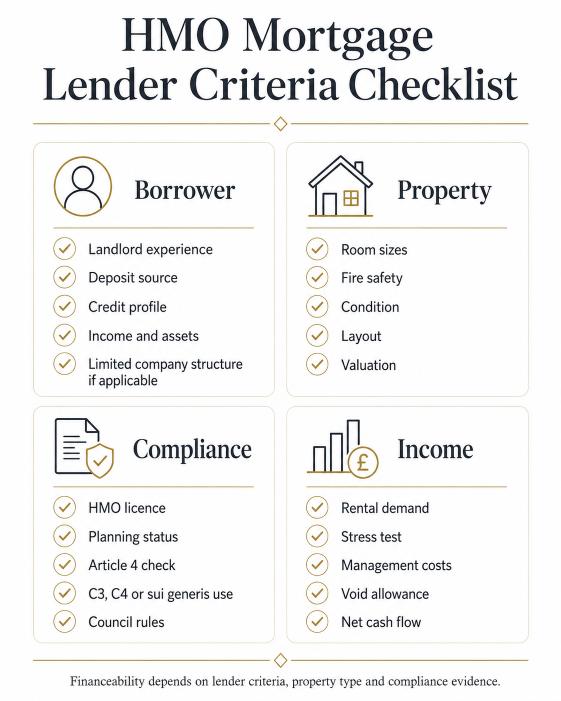
HMO mortgage lenders are not only interested in rent. They also want to know whether the property can legally operate as an HMO.
In England and Wales, a large HMO generally needs a licence. Investors should also check whether the local council operates additional or selective licensing schemes. Official guidance is available here: GOV.UK HMO licence guidance.
Planning is separate from licensing. A property may have an HMO licence but still have planning issues. This is especially important in Article 4 areas, where converting a standard C3 house into a C4 HMO may require planning permission.
For planning use classes, investors should understand:
- C3: standard dwellinghouse
- C4: small HMO with three to six unrelated occupants
- Sui generis: larger HMO use, usually seven or more occupants
You can read more about use classes here: Planning Portal use classes guide.
For a deeper guide on this topic, read: HMO Licensing & Article 4 Guide for UK Property Investors.
HMO Valuation Methods
HMO valuations can be more complicated than standard buy-to-let valuations.
Depending on the property, lender and valuer, the valuation may consider:
- Comparable residential sales
- Comparable HMO sales
- Room-by-room rental income
- Licensing status
- Planning status
- Property condition
- Local demand
- Quality of refurbishment
- Whether the HMO use is lawful and sustainable
Investors should be careful with income-based assumptions. Just because a property produces high rent does not automatically mean it will be valued on a commercial investment basis.
This is especially important when planning a refinance. The refinance valuation may be lower than the investor expected if the valuer gives more weight to comparable residential sales or if the property has weak compliance evidence.
Common Reasons HMO Mortgage Applications Fail
Many HMO mortgage problems are avoidable. Common reasons applications fail include:
- The property does not have the correct HMO licence
- The planning position is unclear
- The property is in an Article 4 area with no evidence of lawful HMO use
- Room sizes are too small
- Fire safety works are incomplete
- The borrower has limited landlord experience
- The property does not pass rental stress testing
- The valuation is lower than expected
- The deposit source is not acceptable to the lender
- The refurbishment plan is under-costed
- The lease or tenant structure is not acceptable to the lender
The best way to reduce risk is to check the finance position before committing to the purchase.
Documents Investors Usually Need for an HMO Mortgage
Every lender is different, but HMO mortgage applications often require more evidence than a basic buy-to-let mortgage.
Useful documents may include:
- Proof of identity and address
- Proof of income
- Bank statements
- Deposit evidence
- Existing portfolio schedule
- Tenancy agreements
- Rental income evidence
- HMO licence or licence application evidence
- Planning permission or lawful use evidence
- Floor plans
- Room measurements
- Refurbishment schedule
- Fire safety documentation
- Management agreement, if using an agent
- Company documents, if buying through a limited company
The cleaner the evidence, the easier it is for the broker, lender and valuer to understand the investment.
How HMO Mortgage Costs Affect Net Yield
HMOs can produce strong gross yields, but investors should focus on net yield and net cash flow.
Mortgage-related costs can include:
- Interest payments
- Arrangement fees
- Broker fees
- Valuation fees
- Legal fees
- Refinance costs
- Early repayment charges
- Bridging finance costs, if applicable
Other HMO costs may include:
- Licence fees
- Fire safety works
- Management fees
- Utilities
- Council tax, where applicable
- Broadband
- Cleaning of communal areas
- Repairs and maintenance
- Furniture and replacement items
- Void allowance
- Insurance
This is why a property that looks excellent on gross rent may be less attractive after the full cost stack is included.
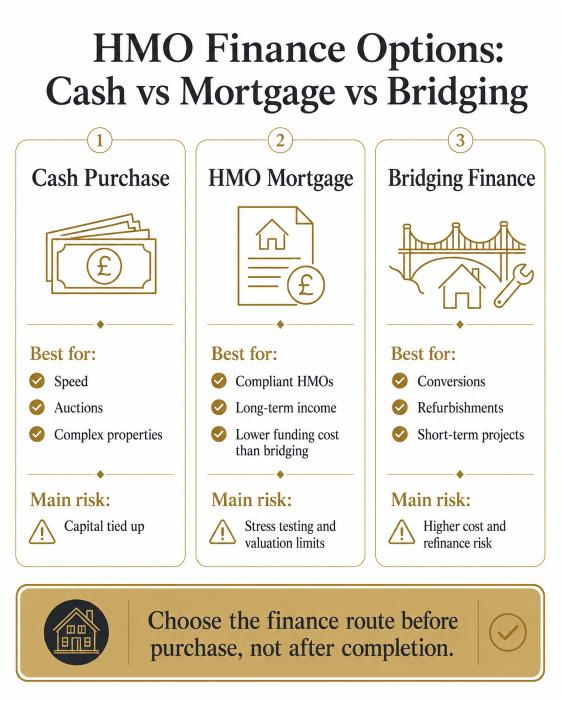
Should You Buy With Cash, Bridging Finance or an HMO Mortgage?
There is no single best answer. The right route depends on the investor’s capital, experience, risk appetite and the condition of the property.
| Finance route | When it may fit | Main risk |
|---|---|---|
| Cash purchase | Useful for speed, auctions or complex properties | Capital tied up until refinance or sale |
| Standard HMO mortgage | Suitable for mortgageable, compliant or near-compliant HMOs | Stress testing and valuation may limit borrowing |
| Bridging finance | Useful for conversions, refurbishments or short-term projects | Higher cost and refinance risk |
| Refinance after works | Useful after increasing rental income and compliance position | Exit valuation or lender criteria may not match expectations |
The finance route should be chosen before purchase, not after completion.
HMO Mortgages for Social Housing and Provider-Backed HMOs
Some investors look at HMOs where the property is leased to a provider, supported accommodation operator or social housing-related tenant organisation.
These can be attractive because the model may offer longer lease terms or more predictable income. However, they can also be more specialist from a lending perspective.
Lenders may want to understand:
- Who the provider is
- The length of the lease
- Break clauses
- Repairing obligations
- Who manages the tenants
- Who is responsible for licensing
- Who pays utilities and council tax
- Whether the rent is sustainable
- Whether the property can be re-let if the provider leaves
- Whether the HMO use is lawful and properly documented
A long lease does not remove the need for correct licensing, planning and finance checks.
For more on this investment route, see: HMO Social Housing Investments.
Quartico’s HMO Mortgage Due Diligence Checklist
Before buying or refinancing an HMO, investors should complete a proper mortgage and compliance review.
Property checks
- Is the property already operating as an HMO?
- How many occupants is it suitable for?
- Are the room sizes compliant?
- Is the layout suitable for the intended tenant profile?
- Are fire safety measures already in place?
- Are there any major refurbishment works required?
Licensing and planning checks
- Does the property need a mandatory HMO licence?
- Does the council operate additional licensing?
- Does selective licensing apply?
- Is the property in an Article 4 area?
- Is the use C3, C4 or sui generis?
- Is there evidence of lawful HMO use?
Mortgage checks
- Which lenders will consider the property?
- Does the borrower have enough deposit?
- Does the rent pass stress testing?
- Is the tenant profile acceptable to the lender?
- Is the lease structure acceptable, if provider-backed?
- Is the borrower applying personally or through a limited company?
- Is a bridge needed before long-term finance?
Investment checks
- Gross yield
- Net yield
- Net monthly cash flow
- Refurbishment budget
- Compliance budget
- Void allowance
- Management cost
- Exit value
- Refinance plan
This is the difference between buying a high-yield HMO on paper and buying a financeable, compliant HMO investment.
Final Thoughts: Finance Should Be Checked Before the Offer
HMO mortgages can help investors access higher-yielding property opportunities, but they require more preparation than standard buy-to-let finance.
The strongest HMO investments usually have:
- Clear planning status
- Correct licensing
- Strong rental demand
- Compliant room sizes
- Realistic refurbishment costs
- Professional management
- Strong rental stress test performance
- A clear refinance or exit strategy
For investors, the best approach is to check the mortgage position, compliance risk and net yield before committing to the purchase.
At Quartico, we help investors assess HMO opportunities with both return and risk in mind.
Speak to Quartico About HMO Investment Opportunities
Frequently Asked Questions
What is an HMO mortgage?
An HMO mortgage is a specialist buy-to-let mortgage for a House in Multiple Occupation. It is used where a property is rented to multiple unrelated tenants or households who share facilities.
Is an HMO mortgage different from a buy-to-let mortgage?
Yes. HMO mortgages are usually more specialist than standard buy-to-let mortgages because lenders assess licensing, planning, room layout, rental income, management and borrower experience more closely.
How much deposit do I need for an HMO mortgage?
Deposit requirements vary by lender and property. Many investors should plan for around 25% or more, although larger HMOs, complex properties or first-time HMO investors may need a larger deposit.
Can I get an HMO mortgage through a limited company?
Yes, many HMO investors use limited company structures. However, the right structure depends on tax, finance, ownership and long-term investment planning, so investors should take professional advice.
Can a first-time landlord get an HMO mortgage?
Some lenders may consider first-time landlords, but options can be more limited. A larger deposit, professional management and a compliant property can help strengthen the application.
Do I need an HMO licence before getting a mortgage?
It depends on the lender, the property and the stage of the purchase. Some lenders may need evidence of an existing licence, while others may consider a clear licensing pathway. Investors should always check the council’s licensing requirements before buying.
Does Article 4 affect HMO mortgages?
Yes. If a property is in an Article 4 area, lenders may want clarity on whether the property has lawful HMO use or whether planning permission is required.
Can I use bridging finance to convert a property into an HMO?
Yes, bridging finance is sometimes used where a property needs refurbishment, planning, licensing or conversion works before it can qualify for a long-term HMO mortgage. The exit strategy should be checked carefully before using a bridge.
Do HMO mortgages have higher rates than standard buy-to-let mortgages?
They can do, because HMOs are more specialist and can carry higher operational and regulatory risk. The actual rate depends on market conditions, lender criteria, deposit size, property type and borrower profile.
What can stop an HMO mortgage application from being approved?
Common issues include unclear planning status, missing HMO licensing, weak rental stress test results, low valuation, insufficient deposit, limited landlord experience, poor property condition or an unacceptable tenant or lease structure.