
Supported Housing Investment Guide: How It Works, Risks and Due Diligence

Supported Housing Investment Guide: How It Works, Risks and Due Diligence
Supported housing investment can provide much-needed homes for people who require care, support or supervision, but it is not a simple “guaranteed rent” property strategy. The investment can involve several organisations, specialist lease terms, Housing Benefit rules, property adaptations, regulatory requirements and significant provider or counterparty risk.
For property investors, the attraction is often a professionally managed property and a longer contractual income arrangement. However, the true risk depends on the legal agreement, the financial strength of the housing provider, the quality of the accommodation, local demand, benefit eligibility, repairing obligations, finance and the eventual exit strategy.
This supported housing investment guide explains how the model works, the difference between supported housing and supported living, who pays the rent, what investors should check in the lease, how regulation is changing, and the main risks to investigate before buying.
Important: This article provides general information for property investors. It is not legal, tax, mortgage, benefits, care or financial advice. Supported housing structures vary considerably. Investors should obtain independent legal, financial, valuation, tax and property advice before buying or entering a lease, management or nomination agreement.
Official sources used in this guide
This article is based on current official and regulatory guidance, including:
- DWP Housing Benefit guidance for supported housing claims
- Regulator of Social Housing report on lease-based specialised supported housing
- Government response on supported housing regulation and licensing
- GOV.UK Local Supported Housing Strategies guidance
- Regulator of Social Housing list of registered providers
- Regulatory judgements for individual social housing providers
- Care Quality Commission guidance on personal care
Supported housing investment: the key points
| Issue | What investors need to understand |
|---|---|
| Investment structure | The property may be subject to a lease, management agreement, nomination agreement or another contractual structure. |
| Rental income | The investor’s income depends on the agreement and the party legally responsible for paying rent. |
| Housing Benefit | Residents may be eligible for help with housing costs, but eligible rent is assessed and can be restricted. |
| Provider risk | A long lease is only as valuable as the provider’s ability and willingness to meet its obligations. |
| Property suitability | The accommodation must be suitable for the intended residents and meet relevant housing, fire, planning and accessibility standards. |
| Regulation | A new locally led licensing regime and National Supported Housing Standards are planned in England. |
| Finance and exit | Specialist use and lease terms may affect mortgage availability, valuation, refinancing and resale. |
What is supported housing?
Supported housing is accommodation provided alongside care, support or supervision to help residents live as independently as possible in the community.
The Department for Work and Pensions’ Housing Benefit guidance for supported housing claims describes supported housing as accommodation where residents require and receive care, support or supervision.
Supported housing can accommodate a wide range of people, including:
- people with learning disabilities;
- autistic people;
- people with physical or sensory disabilities;
- people with mental health needs;
- older people;
- people who have experienced homelessness;
- young people leaving care;
- people escaping domestic abuse;
- people recovering from addiction;
- people who need help moving towards independent living.
The needs of these groups can be very different. A property suitable for low-level tenancy support may not be suitable for residents who require extensive adaptations, 24-hour staffing or personal care.
Supported housing versus supported living
The terms “supported housing” and “supported living” are often used interchangeably in property marketing, but they are not always identical.
Supported housing is the broader category where accommodation is provided alongside care, support or supervision.
Supported living commonly refers to an arrangement where an individual lives in their own home and receives separate support or care intended to promote independence. The accommodation and care arrangements are usually contractually separate.
The Care Quality Commission explains that in supported living, the care is regulated where it amounts to a regulated activity, but the accommodation itself is not regulated by CQC. Its personal care guidance also says that there must be a real separation between the accommodation agreement and the provision of personal care for a supported-living personal-care service to be registered correctly.
For investors, the label used in sales material is less important than understanding:
- who owns the property;
- who is the legal landlord;
- who holds the tenancy with the resident;
- who manages the accommodation;
- who provides support;
- who provides any regulated personal care;
- who is contractually responsible for paying the investor.
What is specialist supported housing?
Specialised Supported Housing, often shortened to SSH, is a specific form of supported housing designed or adapted for people who require specialised services to live independently rather than in a care home.
The Regulator of Social Housing’s focus report describes SSH as housing where the level of ongoing support is high and approximately equivalent to that provided in a care home.
Specialist supported housing may involve:
- purpose-built or significantly adapted accommodation;
- wheelchair accessibility;
- specialist bathrooms or kitchens;
- assistive technology;
- staff accommodation or sleep-in rooms;
- enhanced fire safety systems;
- larger circulation spaces;
- location close to health, transport and community services.
These features can improve suitability for residents, but they can also increase acquisition, conversion, maintenance and exit costs.
What is supported exempt accommodation?
Supported exempt accommodation is not simply another marketing term. It is a category used within Housing Benefit rules and is a subset of supported housing.
Whether accommodation meets the definition depends on matters such as:
- the type of landlord;
- the landlord’s legal interest in the property;
- whether residents need care, support or supervision;
- whether that support is provided by the landlord or on its behalf;
- the contractual and operational structure.
Investors should not assume that a property qualifies simply because it is described as supported housing. The structure must meet the relevant rules, and the local authority assesses Housing Benefit claims.
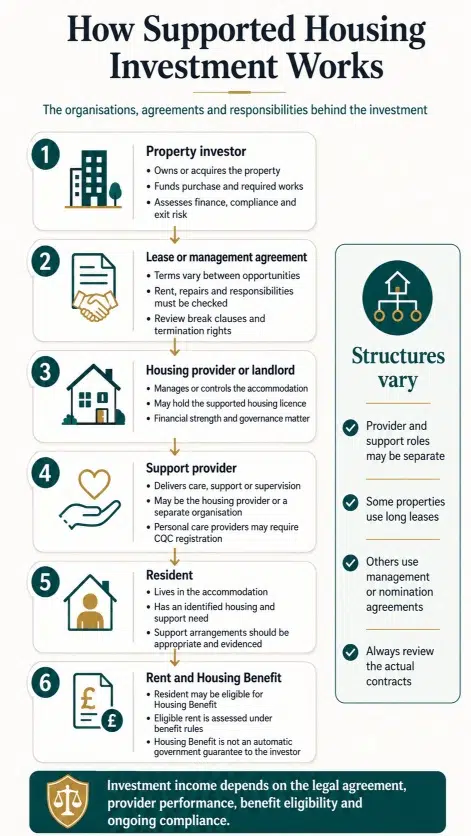
How does supported housing investment work?
There is no single supported housing investment model. Common structures can include:
- a property investor leasing the property to a housing provider;
- a housing provider taking a head lease and granting occupation rights to residents;
- a managing agent operating the accommodation on behalf of the landlord;
- a local authority, NHS body or commissioner arranging referrals;
- a separate support provider delivering support;
- a care provider delivering regulated personal care;
- rent being paid under the lease regardless of individual resident occupancy;
- rent depending partly or wholly on residents’ Housing Benefit claims.
A typical lease-based arrangement may appear to work as follows:
- The investor buys or converts the property.
- The investor grants a lease to a housing provider or operator.
- The provider houses residents who require support.
- A support provider supplies care, support or supervision.
- Residents may claim Housing Benefit towards eligible housing costs.
- The provider pays rent to the investor under the lease.
However, that simplified flow can conceal important differences. The provider may or may not be a registered provider of social housing. The support may be commissioned or non-commissioned. The property owner may retain substantial repair obligations. The provider may have break rights. Rent may depend indirectly on benefit receipts. Each transaction needs to be examined on its own terms.
Who pays the rent?
The answer depends on the legal structure.
The party contractually responsible to the investor may be:
- a registered provider of social housing;
- a housing association;
- a charity;
- a community interest company;
- a private supported-housing operator;
- a managing agent;
- the resident directly;
- another organisation under a nomination or management arrangement.
Investors should identify the exact legal counterparty named in the lease or agreement. A care provider, commissioner, local authority and housing provider may all be involved in a scheme, but that does not necessarily mean each is liable to pay the investor.
The central question is:
Who has signed the agreement, and what happens if that organisation stops paying?
Is supported housing rent guaranteed by the government?
No. Investors should not treat supported housing rent as automatically guaranteed by the government.
Residents in qualifying supported accommodation may be eligible for Housing Benefit towards their housing costs. However, the local authority assesses the claim, the accommodation category, the eligible rent and the resident’s circumstances.
DWP’s supported-housing guidance says eligible rent can include rent and eligible service charges. It also explains that local authorities can request a rent breakdown and may restrict rent where it is considered unreasonably high or where the accommodation is larger than the claimant needs.
Housing Benefit may form an important part of a scheme’s funding model, but it does not turn a weak housing provider into a risk-free tenant. The investor’s rent remains dependent on matters including:
- the contractual obligation in the lease;
- the provider’s finances;
- the eligibility and administration of residents’ claims;
- the reasonableness of rent and service charges;
- scheme compliance;
- occupancy and referrals;
- the provider continuing to operate.
Claims such as “government-guaranteed rent”, “government-backed income” or “risk-free supported housing” should therefore be treated cautiously.
The housing provider, operator and support provider
A supported housing scheme can involve several organisations with different responsibilities.
The property owner
The investor or freeholder owns the property and may grant a lease or management agreement. The owner may retain responsibility for structural repairs, insurance, major works, financing and statutory compliance, depending on the contract.
The housing provider
The housing provider may be the resident’s landlord and may be responsible for tenancy management, rent collection, repairs, safeguarding and housing management.
The managing agent
A managing agent may perform some or all of the landlord’s day-to-day functions. Under the government’s proposed licensing approach, the person managing or in control of the accommodation is expected to hold the supported-housing licence.
The support provider
The support provider helps residents live independently. This may involve budgeting, tenancy sustainment, appointments, daily routines, community access or other practical support.
The care provider
Where personal care is provided, the organisation carrying on that regulated activity generally needs to be registered with CQC. Housing support or social support alone may not amount to regulated personal care.
The commissioner or referral body
A local authority, NHS body, probation service, charity or other organisation may commission services or refer residents. A referral relationship can support scheme demand, but investors should check whether it is contractually committed or merely informal.
How to check a supported housing provider
The strength of the provider is central to the investment. A 20-year or 25-year lease has limited value if the provider cannot afford the rent, does not manage the scheme properly or exercises an early break right.
Investor checks should include:
- full legal name and company number;
- date of incorporation;
- filed accounts;
- cash position and reserves;
- debts and secured charges;
- directors and governance;
- group structure;
- existing schemes;
- experience with the proposed resident group;
- local-authority or commissioner relationships;
- regulatory findings;
- complaints, enforcement and litigation history;
- whether the provider is actually registered with the Regulator of Social Housing.
The Regulator of Social Housing publishes an updated list of registered providers. Investors can also check the regulator’s regulatory judgements and notices.
Being registered does not remove all risk, and not every supported-housing operator is a registered provider. Investors should verify the provider’s status rather than relying on phrases such as “housing association partner” or “approved provider” in marketing material.
Lease-based supported housing
Some supported housing investments use long leases granted by property owners to housing providers. The provider may agree to pay rent and manage the accommodation for an extended period.
Potential benefits can include:
- a defined contractual rental arrangement;
- less day-to-day tenant management for the investor;
- potentially longer lease terms;
- clearer allocation of some operating responsibilities;
- social impact through providing suitable homes.
However, the Regulator of Social Housing has repeatedly highlighted concerns around some lease-based specialised supported housing models. Its focus report identifies risks involving:
- long-term and inflexible leases;
- high lease costs;
- provider financial viability;
- weak governance;
- poor risk management;
- property quality;
- limited control over costs and obligations;
- arrangements that may not represent value for money.
Investors should not assume that a long lease automatically means secure income. The commercial quality of the lease depends on its clauses and the strength of the tenant covenant.
Lease clauses investors must check
Lease length
Longer is not always safer. A long lease may provide stability, but it can also lock the property into an inflexible structure that becomes difficult to finance, sell or repurpose.
Break clauses
Check whether the provider can terminate early, what notice is required and whether performance, funding, referrals or regulatory changes trigger break rights.
Rent review
Understand whether rent increases are fixed, index-linked, capped or subject to another mechanism. Test whether the provider can realistically afford future increases.
Repairs
The term “full repairing and insuring lease” or “FRI lease” should never be accepted at face value. Check precisely who is responsible for:
- structural repairs;
- roof and foundations;
- heating systems;
- lifts and specialist equipment;
- fire alarms and emergency lighting;
- adaptations;
- damage caused by residents;
- replacement of kitchens and bathrooms;
- reinstatement at the end of the lease.
Insurance
Confirm who arranges building insurance, who pays the premium and whether the intended supported-housing use is fully disclosed to the insurer.
Void responsibility
Check whether the provider pays rent regardless of occupancy or whether payments reduce when rooms are empty, referrals fall or benefit claims are delayed.
Default and termination
The lease should explain what happens if rent is unpaid, standards are breached, the provider loses registration, funding changes or the property can no longer be used as intended.
Assignment and change of control
Check whether the provider can assign the lease, subcontract management or undergo a change of ownership without the investor’s approval.
Hand-back condition
Investors should understand the required condition at lease expiry and who pays to remove adaptations or reinstate the property for conventional residential use.
Supported housing investment risks
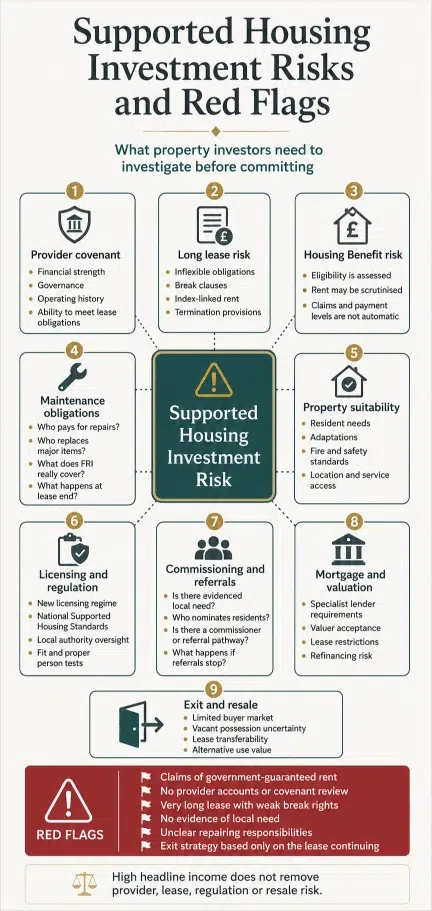
Provider failure
If the provider becomes insolvent, stops paying rent or withdraws from the scheme, the property owner may need to find a replacement provider, manage residents, deal with benefit issues or regain control of a specialist property.
Housing Benefit risk
Benefit claims can be delayed, reviewed or restricted. Service charges may be found ineligible, and local authorities can scrutinise whether rent is reasonable.
Referral and occupancy risk
A scheme can be physically complete but lack a reliable referral pathway. Investors should distinguish between evidenced commissioner demand and general statements that “there is a national shortage”.
Property-quality risk
Adaptations and high occupancy can increase maintenance. Poor-quality accommodation can cause enforcement, reputational damage and harm to residents.
Regulatory risk
Licensing, support standards, Housing Benefit rules and local authority oversight are changing. A model that works today may require additional investment or operational change later.
Mortgage risk
Some mainstream lenders may not accept specialist supported-housing use, long leases, corporate tenants, altered layouts or certain provider types.
Valuation risk
A valuer may assess the property on vacant possession, investment value, restricted-use value or another basis. The lease may not add the value suggested by the headline rental income.
Exit risk
The resale market may be limited to specialist investors. If the lease ends, the property may need costly works before it can be sold or let conventionally.
Concentration risk
Investors with several properties leased to the same provider may be heavily exposed to one organisation’s financial and operational performance.
Local need and commissioner evidence
A supported housing investment should be based on evidence that the right type of accommodation is needed in the right location.
The government’s Local Supported Housing Strategies guidance requires councils in England to assess supported-housing supply, unmet need and future demand and to publish strategies based on that evidence.
Before investing, check:
- whether the council has published a Local Supported Housing Strategy;
- the needs assessment for the intended resident group;
- whether the scheme is known to housing, social care or commissioning teams;
- whether a referral route exists;
- whether the location is suitable for services, transport and community access;
- whether similar schemes already operate nearby;
- whether supply already exceeds identified need;
- whether the provider has a nomination or commissioning agreement.
General national demand does not prove that a particular property in a particular street is suitable or needed.
Supported housing regulation in 2026
The Supported Housing (Regulatory Oversight) Act 2023 created the framework for stronger oversight of supported housing in England.
The government’s June 2026 consultation response confirms its intention to introduce:
- a locally led supported-housing licensing regime across England;
- National Supported Housing Standards;
- fit and proper person requirements;
- licensing conditions concerning accommodation and management;
- local-authority inspections and enforcement;
- closer links between licensing and Housing Benefit.
The government intends the licence to be held by the person managing or in control of the supported housing in each licensing district. This could be a head landlord or managing agent, depending on the arrangement.
Detailed licensing regulations and guidance are still to be published ahead of implementation. Investors should therefore avoid assuming the precise rules, costs or commencement date until the final regulations are available.
National Supported Housing Standards
The planned National Supported Housing Standards will set expectations for the support or supervision residents receive.
The government has said that:
- services providing regulated personal care must be appropriately registered with CQC;
- other support services will need to comply with the National Supported Housing Standards unless exempt;
- needs assessments will form part of the licensing structure;
- service managers and licence holders will be subject to suitability requirements;
- housing quality will be addressed through licensing conditions and existing housing standards.
Although an investor may not provide support directly, regulatory failure by the provider or scheme can still affect rent, occupancy, reputation and the continued use of the property.
Property standards and adaptations
Supported housing must be suitable for the needs of residents. Due diligence should include:
- planning use and lawful use;
- building regulations;
- fire-risk assessment;
- means of escape;
- fire alarm and emergency lighting systems;
- accessibility;
- room sizes;
- bathroom and kitchen provision;
- heating and ventilation;
- damp and mould risk;
- security;
- staff facilities;
- assistive technology;
- maintenance of specialist equipment;
- EPC and future energy-efficiency work.
Investors should seek specialist advice rather than assuming that a standard HMO conversion or ordinary buy-to-let specification will be suitable.
Does supported housing need HMO licensing?
Supported housing and HMO licensing can overlap. A supported housing property may also meet the legal definition of an HMO, depending on occupancy, facilities and management arrangements.
Investors should check:
- mandatory HMO licensing;
- additional HMO licensing;
- selective licensing;
- planning use;
- Article 4 directions;
- local supported-housing requirements;
- the planned national supported-housing licensing regime.
One licence or regulatory status does not necessarily remove the need for another.
Related Quartico guidance:
Mortgages for supported housing investment
Supported housing finance can be more specialist than conventional buy-to-let lending.
Lenders may consider:
- the property type;
- the intended residents;
- the provider;
- lease length;
- break clauses;
- repairing obligations;
- planning and licensing;
- property adaptations;
- valuation method;
- whether the property can return to conventional residential use;
- the investor’s experience.
Do not exchange contracts on the assumption that any buy-to-let mortgage will permit supported housing use. The intended use, lease and provider should be disclosed accurately to the lender and insurer.
Related guide: HMO Mortgages Guide.
Supported housing investment: potential advantages
Potential advantages may include:
- providing housing that meets an important social need;
- longer contractual arrangements in some opportunities;
- reduced day-to-day tenant management where the provider assumes responsibility;
- potentially more predictable income under a strong lease with a strong provider;
- professional housing and support management;
- demand linked to identified local need rather than purely discretionary consumer demand;
- portfolio diversification.
These benefits depend on the individual opportunity. They should not be treated as universal features of the sector.
Supported housing investment: disadvantages and risks
Potential disadvantages include:
- specialist legal and regulatory complexity;
- provider or counterparty failure;
- Housing Benefit and rent-reasonableness risk;
- long, inflexible leases;
- repair and reinstatement costs;
- limited mortgage options;
- uncertain valuation treatment;
- referral and occupancy risk;
- property adaptation costs;
- limited resale market;
- reputational risk where accommodation or support is poor;
- future licensing and standards costs.
Supported housing investment due diligence checklist
Investors should examine the provider, property, contracts, need, funding and exit as one connected investment. A strong-looking lease does not compensate for a weak provider, unsuitable property or lack of local demand.
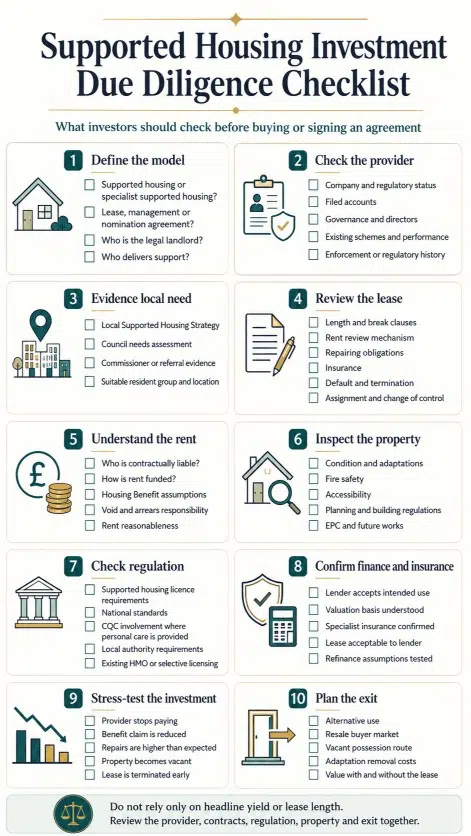
1. Define the model
- What type of supported housing is proposed?
- Is this supported living, SSH or supported exempt accommodation?
- Who owns, leases, manages and supports?
- Are housing and care contracts separate?
2. Check the provider
- Is the provider registered with RSH?
- What do its accounts show?
- Does it have sufficient reserves?
- What is its operating history?
- Are there regulatory notices or judgements?
- Has it successfully managed similar schemes?
3. Evidence local need
- Is the intended resident group identified?
- Does the council’s strategy show demand?
- Is a referral route evidenced?
- Is the scheme commissioned?
- Is the location suitable?
4. Review the lease
- Who is liable for rent?
- What are the break clauses?
- Who pays for structural and day-to-day repairs?
- How does rent review work?
- What happens on provider default?
- Can the lease be assigned?
- What condition must the property be returned in?
5. Test the benefit assumptions
- Why is the accommodation expected to qualify?
- What rent and service charges are assumed?
- Has the local authority reviewed the model?
- What happens if eligible rent is reduced?
- Who bears delays and shortfalls?
6. Inspect the property
- Is it suitable for the resident group?
- Are adaptations properly designed?
- Does it meet fire, planning and building standards?
- What major repairs are expected?
- What will specialist equipment cost to maintain?
7. Confirm licensing and regulation
- What existing local licences are required?
- Will HMO licensing apply?
- Is CQC registration relevant?
- Who is expected to hold the future supported-housing licence?
- Can the scheme meet future national standards?
8. Confirm finance and insurance
- Has the lender approved the precise use?
- Has the valuer reviewed the lease?
- Does the insurer cover supported housing?
- Can the property be refinanced?
- What happens if the provider changes?
9. Stress-test the investment
Model what happens if:
- the provider misses rent;
- Housing Benefit is reduced;
- rooms are vacant;
- repairs are higher than expected;
- the provider exercises a break clause;
- the scheme loses its referral route;
- licensing requires additional investment;
- the property cannot be refinanced.
10. Plan the exit
- Who would buy the property with the lease?
- Can vacant possession be obtained?
- Can the property return to standard residential use?
- What will reinstatement cost?
- What is the value without the lease?
- Is the exit dependent on one provider continuing indefinitely?
What happens if the provider fails?
Provider failure is one of the most important stress tests.
Possible consequences include:
- rent stopping;
- residents remaining in occupation;
- Housing Benefit arrangements needing to change;
- the owner having to identify a replacement provider;
- care or support disruption;
- mortgage covenant problems;
- insurance issues;
- urgent property-management responsibilities;
- difficulty obtaining vacant possession;
- reputational harm.
Investors should ask their solicitor what practical control they would have following provider default and how residents would be protected.
Supported housing investment exit strategy
A viable investment should have an exit that works with and without the existing provider.
Possible exit routes include:
- selling to another supported-housing investor;
- assigning or transferring the lease where permitted;
- re-leasing to another provider;
- returning the property to conventional residential use;
- selling with vacant possession;
- refinancing after a track record has been established.
Each route can be restricted by the lease, planning status, layout, adaptations, resident occupation, lender requirements and local demand.
Is supported housing investment suitable for every investor?
No. Supported housing may suit investors who:
- understand specialist property and legal structures;
- can obtain independent professional advice;
- can tolerate provider and regulatory risk;
- have sufficient reserves for unexpected costs;
- are comfortable with a potentially narrower resale market;
- value both financial return and social impact;
- are prepared to investigate the scheme rather than relying on marketing claims.
It may be less suitable for investors who need:
- immediate liquidity;
- simple mainstream mortgage options;
- a predictable conventional resale market;
- complete control over occupation and management;
- an investment requiring little legal or regulatory due diligence.
Final thoughts
Supported housing can deliver important social value and provide suitable homes for people who need care, support or supervision. It can also offer investors a different contractual model from conventional buy-to-let.
However, the investment should never be assessed only by headline yield, lease length or claims of guaranteed income. Investors need to understand the provider, the lease, Housing Benefit assumptions, local need, property suitability, regulation, finance and exit strategy.
The best-supported housing investment opportunities are those where the property meets a genuine need, the provider is capable and financially sound, responsibilities are clearly documented, the funding assumptions are credible, and the investment remains viable under realistic stress testing.
To explore current opportunities, visit Quartico’s Specialist Supported Housing Investment page.
Speak to Quartico About Supported Housing Investment
Frequently asked questions
What is a supported housing investment?
A supported housing investment is a property used to accommodate people who require care, support or supervision. The property may be leased to or managed by a housing provider, while a separate organisation may deliver support or personal care.
Is supported housing rent guaranteed by the government?
No. Residents may be eligible for Housing Benefit, but claims and eligible rent are assessed by the local authority. The investor’s rental income depends on the legal agreement and the financial and operational performance of the contracting provider.
What is specialist supported housing?
Specialist supported housing is accommodation designed or adapted for people with higher or specialised support needs who might otherwise require institutional or care-home accommodation.
What is the difference between supported housing and supported living?
Supported housing is the broad category of accommodation provided alongside support, care or supervision. Supported living commonly involves a person living in their own home under an accommodation agreement that is separate from their care or support arrangements.
Does a supported housing provider need to be registered?
Not every supported-housing operator is necessarily a registered provider of social housing. Investors should check the Regulator of Social Housing register and confirm the exact status of the proposed provider.
Does CQC regulate supported housing?
CQC regulates certain care activities, such as personal care, rather than the accommodation itself in a supported-living arrangement. Whether registration is required depends on the nature of the activity provided.
Are long supported-housing leases safe?
A long lease can provide contractual stability, but it can also create inflexibility. Its value depends on the provider covenant, break clauses, repairing obligations, funding assumptions, rent-review mechanism and exit terms.
Can Housing Benefit rent be reduced?
Yes. Local authorities assess eligible rent and service charges and may restrict amounts considered unreasonably high or otherwise ineligible under Housing Benefit rules.
Will supported housing require a licence?
The government intends to introduce a locally led licensing regime for supported housing in England. Detailed regulations and implementation guidance are still to be published, so investors should monitor current GOV.UK and local-authority guidance.
What should investors check before buying supported housing?
Investors should examine the provider, lease, repairing obligations, local need, referrals, benefit assumptions, property condition, planning, licensing, CQC implications, mortgage, insurance, valuation and exit strategy.