
Landlord Compliance Guide 2026: What Property Investors Need to Know

Landlord compliance is no longer a simple box-ticking exercise. The private rented sector in England is becoming more regulated, more evidence-led and less forgiving of informal letting practices. For property investors, compliance now affects far more than legal risk. It can influence cashflow, possession strategy, mortgage suitability, insurance, exit planning and whether a property is a sensible investment in the first place.
This landlord compliance guide explains the main rules private landlords and property investors need to understand in 2026, including the Renters’ Rights Act, tenancy documents, deposits, gas safety, electrical checks, EPC and MEES rules, Right to Rent checks, HMO licensing, rent increases, pets, possession planning and record keeping.
The focus is on landlords and investors with rental property in England. Rules in Wales, Scotland and Northern Ireland are different, so landlords with property outside England should check the relevant local framework.
Important: This article is general guidance for landlords and property investors. It is not legal, tax, mortgage or financial advice. Landlords should check the latest GOV.UK guidance, local authority rules, lender conditions and lease restrictions before making decisions.
Official sources used in this guide
This article is based on current official guidance from GOV.UK and should be read alongside the latest government publications:
- GOV.UK: Renting out your property — landlord responsibilities
- GOV.UK: Renters’ Rights Act overview for landlords
- GOV.UK: Landlord safety responsibilities
- GOV.UK: Deposit protection schemes and landlords
- GOV.UK: Electrical safety standards guidance
- GOV.UK: Domestic PRS Minimum Energy Efficiency Standard guidance
- GOV.UK: Landlord’s guide to Right to Rent checks
- GOV.UK: Houses in Multiple Occupation licensing
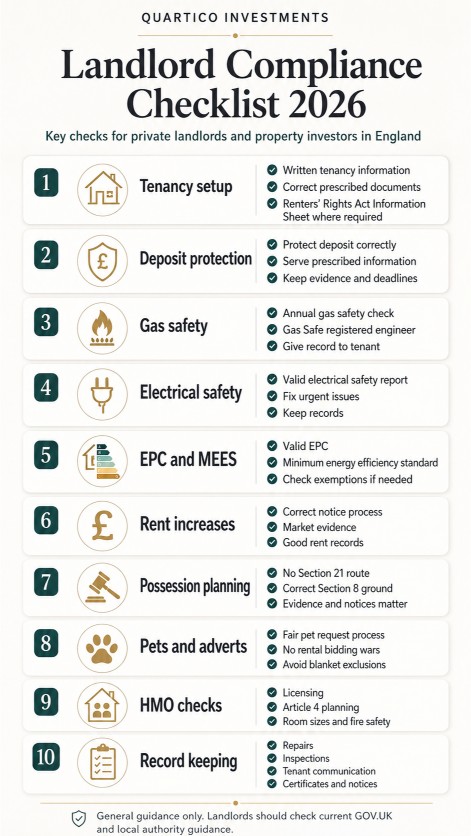
Quick landlord compliance checklist
Landlord compliance covers the whole letting lifecycle: before buying, before advertising, before signing a tenancy, during management, when increasing rent and when trying to regain possession.
| Compliance area | What landlords should check | Why it matters |
|---|---|---|
| Tenancy setup | Written tenancy information, Renters’ Rights Act requirements, prescribed documents and clear terms. | Weak paperwork can create disputes and make possession harder. |
| Deposit protection | Use a government-approved scheme and provide the required information. | Deposit mistakes can lead to penalties and possession problems. |
| Gas and electrical safety | Annual gas safety where relevant and electrical checks at required intervals. | Safety failures can trigger enforcement and serious liability. |
| EPC and MEES | Valid EPC, minimum energy efficiency standard and valid exemption where needed. | Poor energy performance can affect letting, retrofit costs and investment value. |
| HMO and licensing | Mandatory HMO licensing, additional licensing, selective licensing and Article 4 planning risk. | Licensing errors can be expensive and may undermine the investment strategy. |
| Possession and rent reviews | Section 8 grounds, evidence, notices, rent increase process and rent records. | The end of Section 21 means evidence and process matter more than ever. |
Why landlord compliance matters more than ever
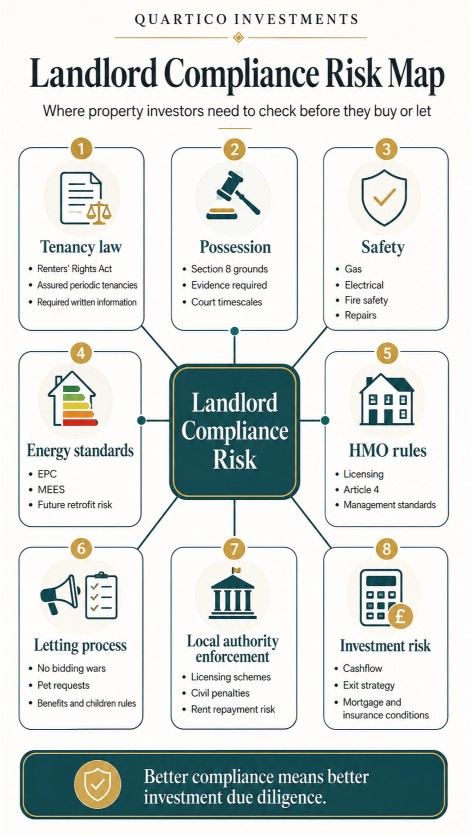
The private rented sector has moved into a more regulated phase. The Renters’ Rights Act has changed tenancy structure, possession, rent increases, pets, rental bidding and the way landlords need to communicate with tenants. At the same time, landlords still need to comply with long-standing safety, deposit, immigration, HMO, EPC and repair obligations.
For property investors, this changes how risk should be assessed. A property might look attractive on gross yield, but if it has an EPC problem, a licensing issue, an HMO planning problem, incomplete tenancy records or an uncertain possession route, the real risk may be much higher than the headline return suggests.
The practical message is simple: compliance due diligence should happen before completion, not after problems appear.
Renters’ Rights Act compliance
The Renters’ Rights Act has changed how landlords let out private rented properties in England. GOV.UK’s Renters’ Rights Act overview for landlords confirms that the changes came into effect on 1 May 2026.
The key changes include:
- the end of Section 21 no-fault evictions;
- the move from assured shorthold tenancies to assured periodic tenancies;
- new rules around rent increases;
- controls on rental bidding;
- new rules around rent in advance;
- a clearer process for pet requests;
- rules preventing blanket discrimination against tenants with children or on benefits;
- future phases for the Private Rented Sector Database and Ombudsman.
This means landlords need to update old tenancy templates, letting processes, rent review systems and possession assumptions. A landlord who still manages property as if Section 21 is available is carrying avoidable compliance risk.
Quartico has published a separate detailed guide here: Renters’ Rights Act 2025: What Landlords Need to Know.
Tenancy documents and written information
Good landlord compliance starts with good paperwork. Tenancy documents should clearly record the property, parties, rent, payment date, deposit, permitted occupiers, responsibilities, house rules and any special terms. They should also reflect the current legal position after the Renters’ Rights Act reforms.
Landlords should check whether tenants have received the correct written information and any required official information sheets. This matters because documentation errors can affect dispute handling, enforcement risk and possession proceedings.
Useful documents and records may include:
- the tenancy agreement or written tenancy information;
- Renters’ Rights Act information where required;
- deposit protection certificate and prescribed information;
- gas safety record;
- electrical safety report;
- EPC;
- Right to Rent check records;
- inventory and check-in report;
- rent schedule and payment records;
- inspection notes and repair records;
- copies of tenant correspondence and notices.
Deposit protection
Landlords who take a tenancy deposit must handle it correctly. GOV.UK’s deposit protection guidance for landlords explains that deposits must be placed in a government-approved tenancy deposit protection scheme where the rules apply.
The related GOV.UK guidance on information landlords must give tenants sets out the details landlords need to provide, including the property address, deposit amount, how it is protected and scheme contact information.
Deposit compliance is not just an administrative task. Under the Renters’ Rights Act framework, deposit mistakes can still affect possession. GOV.UK’s landlord overview explains that where a deposit was paid, a court will only give a possession order in certain circumstances, including where the landlord has complied with deposit scheme requirements or returned the deposit.
Landlords should keep clear evidence of:
- when the deposit was received;
- which scheme was used;
- when prescribed information was served;
- proof of service;
- deposit deductions agreed or disputed;
- any repayment or scheme dispute outcome.
Gas safety responsibilities
GOV.UK’s landlord safety responsibilities guidance says landlords must make sure gas equipment they supply is safely installed and maintained by a Gas Safe registered engineer, arrange an annual gas safety check for each appliance and flue where required, and give tenants a copy of the gas safety check record.
For landlords and investors, this means gas safety should be treated as a core management control. A missing or expired certificate is not something to sort out later. It can create safety risk, enforcement risk and problems in a dispute.
Before buying a tenanted property, investors should ask for current gas safety records and check whether there is a reliable process for annual renewal.
Electrical safety responsibilities
Landlords also need to manage electrical safety. GOV.UK’s electrical safety standards guidance says landlords must have electrics in rented properties checked at least every five years by a properly qualified person and give tenants proof that installations and equipment have been inspected, tested and checked.
For buy-to-let investors, this should be part of acquisition due diligence. An older property with dated wiring may still be mortgageable and lettable, but electrical remedial works can materially affect the true cost of the investment.
Landlords should keep:
- the latest electrical safety report;
- evidence that remedial works were completed;
- invoices and contractor details;
- diary reminders for renewal;
- copies provided to tenants or the local authority where requested.
Smoke alarms, carbon monoxide alarms and fire safety
Fire safety should not be treated as a one-off check. GOV.UK’s smoke and carbon monoxide alarm guidance says relevant landlords must ensure at least one smoke alarm is equipped on each storey where there is a room used as living accommodation, and a carbon monoxide alarm is equipped in any room used as living accommodation containing a fixed combustion appliance, excluding gas cookers.
Landlords should also check escape routes, furniture and furnishings, and any extra requirements that apply to HMOs. GOV.UK’s general safety responsibilities guidance highlights additional fire safety duties, including providing fire alarms and extinguishers where required in a large HMO.
For HMO investors, fire safety is especially important because licensing conditions, management regulations and local authority standards can be more detailed than for a single-family let.
EPC and MEES requirements
Energy performance is now a serious compliance and investment issue. GOV.UK’s domestic private rented property MEES guidance explains the minimum energy efficiency standard for privately rented domestic property and how landlords should comply.
In broad terms, private rented properties that require an EPC must usually meet the minimum required EPC standard or have a valid exemption. GOV.UK’s PRS energy standards exemptions guidance explains that properties requiring an EPC must have either an EPC rating of E or above, or a valid exemption.
For investors, EPC risk should be checked before purchase. A property with a weak EPC may need upgrades, and future standards may increase the importance of retrofit planning. The cost of insulation, heating upgrades, ventilation, windows or other energy improvements can change the investment calculation.
Good due diligence should ask:
- What is the current EPC rating?
- When does the EPC expire?
- Does the property meet MEES?
- Are there valid exemptions?
- What works are recommended?
- Could future standards require further spending?
Repairs, hazards and property condition
Landlords are responsible for keeping rented property safe and fit for occupation. GOV.UK’s landlord responsibilities guidance explains that landlords are responsible for repairs to the property structure and exterior, heating and hot water systems, basins, sinks, baths and other sanitary fittings, and for repairing damage caused by repair attempts.
Property condition matters for three reasons. First, poor conditions can harm tenants. Second, they can trigger local authority enforcement. Third, they can reduce investment value and increase voids, disputes and management costs.
Landlords should keep a clear repair log showing when problems were reported, what action was taken, who carried out the work and when the issue was resolved. This is especially important where damp, mould, heating, electrical issues, leaks or safety concerns are involved.
Rent increases and rent records
Rent increases are now more process-driven. GOV.UK’s rent increase guidance for assured periodic tenancies explains the revised process, including the use of Form 4A and the requirement to give the completed form to the tenant before the proposed rent increase starts.
Landlords should keep rent increases evidence-based. This means keeping records of comparable local rents, property condition, size, location, improvements and demand. If a tenant challenges an increase, the landlord will be in a stronger position if the proposed rent can be justified by market evidence rather than guesswork.
For investors, this matters because future rent growth assumptions should be realistic. A property that only works if rent rises sharply every year may be riskier than it looks.
Rental bidding, pets, benefits and children
Letting processes are also part of landlord compliance. GOV.UK’s rental bidding guidance says landlords and letting agents cannot ask for, encourage or accept offers higher than the advertised rent.
GOV.UK’s pet request guidance for landlords says tenants should ask in writing, landlords cannot refuse without a fair reason, and landlords normally have 28 days to respond in writing.
The Renters’ Rights Act also restricts blanket discrimination against tenants because they have children or receive benefits. Landlords can still make legitimate affordability and suitability decisions, but adverts and letting processes should avoid blanket exclusions such as “no DSS” or automatic rejection of families with children.
Landlords should review:
- property advert wording;
- letting agent instructions;
- viewing scripts and email templates;
- pet request procedures;
- affordability and referencing criteria;
- records of why applicants were accepted or rejected.
Possession and Section 8 evidence
Since Section 21 no-fault evictions can no longer be used, possession planning is now a core compliance issue. GOV.UK’s ending a tenancy guidance for landlords explains that landlords must have a valid reason, give notice in the correct way and use the relevant possession ground.
This does not mean landlords can never regain possession. It means they need the right legal ground and evidence. Grounds may relate to rent arrears, breach of tenancy, antisocial behaviour, sale of the property, landlord occupation or specific student HMO circumstances.
Investors should think about possession risk before buying. If the investment plan relies on vacant possession, refurbishment, sale, refinancing or conversion to another use, the possession route should be assessed carefully.
Right to Rent checks
Landlords in England must carry out Right to Rent checks before the start of a tenancy. GOV.UK’s landlord’s guide to Right to Rent checks explains how landlords, letting agents and homeowners should conduct checks when letting private rented accommodation.
Some tenants can use a share code, and GOV.UK provides an online service to check a tenant’s Right to Rent in England using a share code. British and Irish citizens may need to prove their status using other permitted methods.
For landlords, the practical point is that Right to Rent checks should be completed before the tenancy starts and recorded properly. This is particularly important for landlords letting to overseas applicants, students, workers relocating to the UK or tenants with time-limited immigration permission.
HMO licensing and Article 4 planning
HMO compliance is one of the highest-risk areas for property investors. GOV.UK’s HMO guidance explains that an HMO must have a licence if it is occupied by five or more people, and councils can also include other types of HMOs for licensing.
Landlords should also check local authority rules because additional HMO licensing, selective licensing and local planning restrictions can vary by area. Article 4 directions can remove permitted development rights for changing a family house into a small HMO, meaning planning permission may be required even where it would otherwise not be.
For investors, this is a major due diligence point. A property may look ideal for HMO conversion, but the strategy may fail if licensing, Article 4, minimum room sizes, fire safety, amenity standards or planning constraints have not been checked properly.
Quartico has published further HMO guidance here:
- HMO Investments Guide
- HMO Licensing and Article 4 Guide
- HMO Mortgages Guide
- HMO Social Housing Investments
Local authority licensing and enforcement
Landlords should not assume national rules are the whole picture. Local authorities can operate HMO licensing, additional HMO licensing and selective licensing schemes. They can also investigate property conditions, issue improvement notices, take enforcement action and impose civil penalties in certain circumstances.
Before buying or letting property, landlords should check the local council website for:
- mandatory HMO licensing requirements;
- additional HMO licensing schemes;
- selective licensing schemes;
- Article 4 directions;
- local HMO amenity standards;
- minimum room size rules;
- enforcement history or improvement notices;
- planning restrictions affecting intended use.
This is especially important for investors buying in cities with high rental demand, student populations or significant HMO activity.
Insurance, mortgage and lease restrictions
Compliance is not only about statute and local authority rules. Landlords also need to check private restrictions and commercial terms.
Examples include:
- mortgage conditions restricting letting type;
- HMO mortgage requirements;
- insurance exclusions for certain tenants or property uses;
- leasehold restrictions on subletting, pets or HMO use;
- freeholder consent requirements;
- management company rules;
- planning restrictions or covenants.
A property can be legally lettable in one sense but still breach a lease, mortgage condition or insurance policy. That is why compliance due diligence should include legal, lending and insurance checks as well as landlord regulations.
Record keeping: what landlords should keep
Good records are now one of the best protections a landlord has. They help with tenant disputes, deposit deductions, rent arrears, repairs, possession claims, licensing renewals, tax records and local authority enquiries.
Landlords should keep organised copies of:
- tenancy agreements and written tenancy information;
- Renters’ Rights Act information provided to tenants;
- deposit protection certificates and prescribed information;
- gas safety certificates;
- electrical safety reports;
- EPCs and MEES exemption records;
- Right to Rent checks;
- inventories and check-in/check-out reports;
- rent schedules and arrears records;
- inspection reports;
- repair logs and invoices;
- tenant complaints and landlord responses;
- notices served and proof of service;
- licence applications and licence conditions;
- insurance, mortgage and lease documents.
The best approach is to store records by property and by tenancy, rather than relying on email searches months or years later.
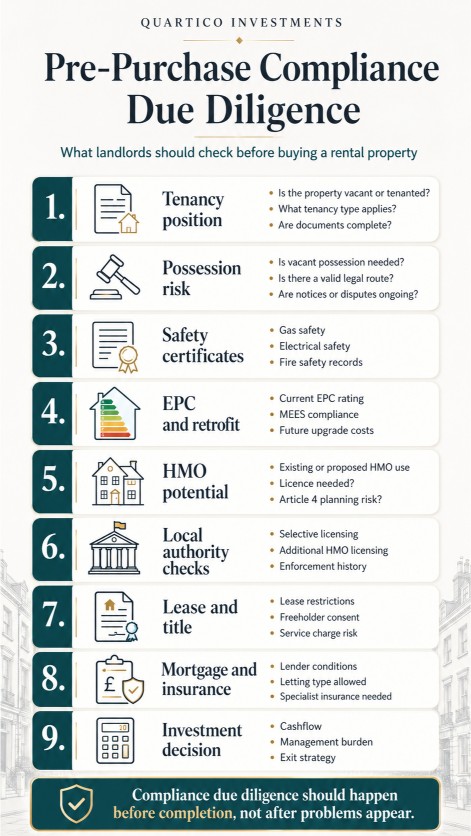
Landlord compliance before buying a property
For investors, compliance should be part of the purchase decision. It is not enough to ask whether a property can be rented. The better question is whether the property can be rented legally, profitably and with manageable risk.
Before buying, investors should check:
- whether the property is vacant or tenanted;
- what tenancy type applies;
- whether documents and certificates are complete;
- whether vacant possession is needed and realistic;
- whether there are arrears, disputes or notices;
- the current EPC rating and likely retrofit costs;
- whether local licensing schemes apply;
- whether HMO use is lawful and practical;
- whether planning consent or Article 4 issues apply;
- whether the lease, mortgage or insurance restricts the intended use;
- whether the rent is sustainable and evidence-based;
- whether management will be straightforward or intensive.
How compliance affects investment risk
A well-managed compliant rental property is usually easier to finance, insure, manage and sell. A poorly documented or non-compliant property can create hidden costs, delay possession, reduce refinancing options and damage investor confidence.
Common compliance-related investment risks include:
- unexpected upgrade costs;
- licensing delays;
- local authority enforcement;
- inability to use the intended HMO strategy;
- longer possession timescales;
- deposit disputes;
- rent increase challenges;
- higher management costs;
- insurance problems;
- reduced buyer demand on exit.
This is why professional investors should see compliance as part of due diligence, not merely ongoing administration.
Related Quartico guides
This guide sits alongside Quartico’s wider property investment and landlord education content:
- Renters’ Rights Act 2025: What Landlords Need to Know
- HMO Investments Guide
- HMO Licensing and Article 4 Guide
- HMO Mortgages Guide
- HMO Social Housing Investments
- How to Navigate UK Property Taxes
Final thoughts: good compliance is good investment discipline
Landlord compliance is often treated as a burden, but for serious property investors it should be seen as investment discipline. A landlord who understands tenancy rules, safety obligations, licensing, EPC risk, possession process and record keeping is in a stronger position than one who only looks at yield.
The direction of travel is clear. Landlords need better systems, better documents and better due diligence. That does not mean property investment is no longer attractive. It means the best opportunities are more likely to favour organised, professional and well-advised investors.
Quartico helps investors understand property opportunities, compliance risks and long-term strategy in a changing rental market.
Speak to Quartico About Property Investment
Frequently asked questions
What is landlord compliance?
Landlord compliance means meeting the legal, safety, tenancy, licensing, documentation and management requirements that apply when renting out property. It includes areas such as tenancy information, deposit protection, gas safety, electrical safety, EPCs, Right to Rent checks, repairs, HMO licensing and possession rules.
What are the main landlord legal requirements in England?
The main requirements include providing safe accommodation, protecting deposits where required, carrying out gas and electrical safety checks, providing an EPC, meeting repair obligations, checking Right to Rent, following Renters’ Rights Act rules, complying with licensing schemes and using the correct legal process for rent increases or possession.
Do landlords still need gas safety certificates?
Yes. Where the landlord supplies gas equipment, landlords must make sure it is safely installed and maintained by a Gas Safe registered engineer and arrange annual gas safety checks where required.
How often do landlords need electrical checks?
GOV.UK guidance says landlords must have electrics in rented properties checked at least every five years by a properly qualified person and give tenants proof that checks have been carried out.
Do landlords need an EPC?
Most privately rented domestic properties that require an EPC must meet the minimum energy efficiency standard or have a valid exemption. Landlords should check the current EPC rating and whether MEES applies before letting or buying a property.
Are HMO landlords subject to extra compliance rules?
Yes. HMO landlords may need a mandatory HMO licence, and some councils operate additional licensing or selective licensing schemes. HMOs can also be affected by Article 4 planning directions, room size rules, amenity standards and fire safety requirements.
What changed under the Renters’ Rights Act?
The Renters’ Rights Act changed the private rented sector in England from 1 May 2026. Key changes include the end of Section 21, the move to assured periodic tenancies, changes to rent increases, new rules on rental bidding, pet requests and rent in advance, and future phases for the PRS Database and Ombudsman.
Why does compliance matter before buying a rental property?
Compliance affects the real risk and cost of an investment. A property may need EPC upgrades, licensing, safety works, planning consent, electrical remedial work, lease consent, mortgage approval or a different possession strategy. These issues should be checked before completion.