
Supported Housing Provider Due Diligence Checklist

Supported Housing Provider Due Diligence: What Investors Should Check
A supported housing lease is only as strong as the organisation responsible for meeting it. Long lease terms, index-linked rent and claims of professional management can appear attractive, but they do not remove provider, governance, operational or financial risk.
Before buying a property or signing an agreement, investors should establish exactly which organisation will be responsible for the rent, housing management, repairs, compliance and resident welfare. They should then verify that organisation independently rather than relying on branding, a sales brochure or the length of the proposed lease.
This supported housing provider due diligence guide explains how to investigate a provider’s legal identity, regulatory status, accounts, directors, operational history, local demand, Housing Benefit assumptions, lease obligations and ability to withstand financial pressure.
Important: This article provides general information for property investors. It is not legal, financial, accounting, benefits, regulatory or investment advice. Investors should instruct suitable solicitors, accountants, surveyors, finance advisers and other professionals before purchasing property or entering a supported housing agreement.
Official sources used in this guide
- Regulator of Social Housing: register of social housing providers
- Regulator of Social Housing: regulatory judgements and enforcement notices
- Individual social housing providers and regulatory judgements
- Companies House: get information about a company
- Companies House register search guidance
- Charity Commission: search the charity register
- Care Quality Commission: find and review regulated care services
- GOV.UK: Local Supported Housing Strategies
- DWP Housing Benefit guidance for supported housing claims
- RSH focus report on lease-based specialised supported housing
- Government response on supported housing regulation
Quick supported housing provider due diligence checklist
| Check | What to investigate | Why it matters |
|---|---|---|
| Legal identity | Company name, number, address and contracting entity | The wrong group company may have little income or few assets. |
| Regulatory status | RSH registration, judgements and enforcement notices | Marketing descriptions do not prove registered-provider status. |
| Financial strength | Accounts, cash, reserves, debt, charges and lease exposure | A provider must be able to meet long-term rent and management obligations. |
| Governance | Directors, trustees, board oversight and connected companies | Weak governance can create financial, operational and safeguarding risk. |
| Operating history | Existing schemes, residents supported, landlord references and performance | A recently formed provider may have limited evidence of delivery. |
| Local need | Council strategy, referrals, commissioning and resident need | National demand does not prove a particular property is needed locally. |
| Agreement | Rent, repairs, breaks, defaults, assignment and termination | The real investment terms are in the contract, not the brochure. |
| Failure plan | Replacement provider, resident management and alternative use | Investors need a workable plan if the provider stops paying or operating. |
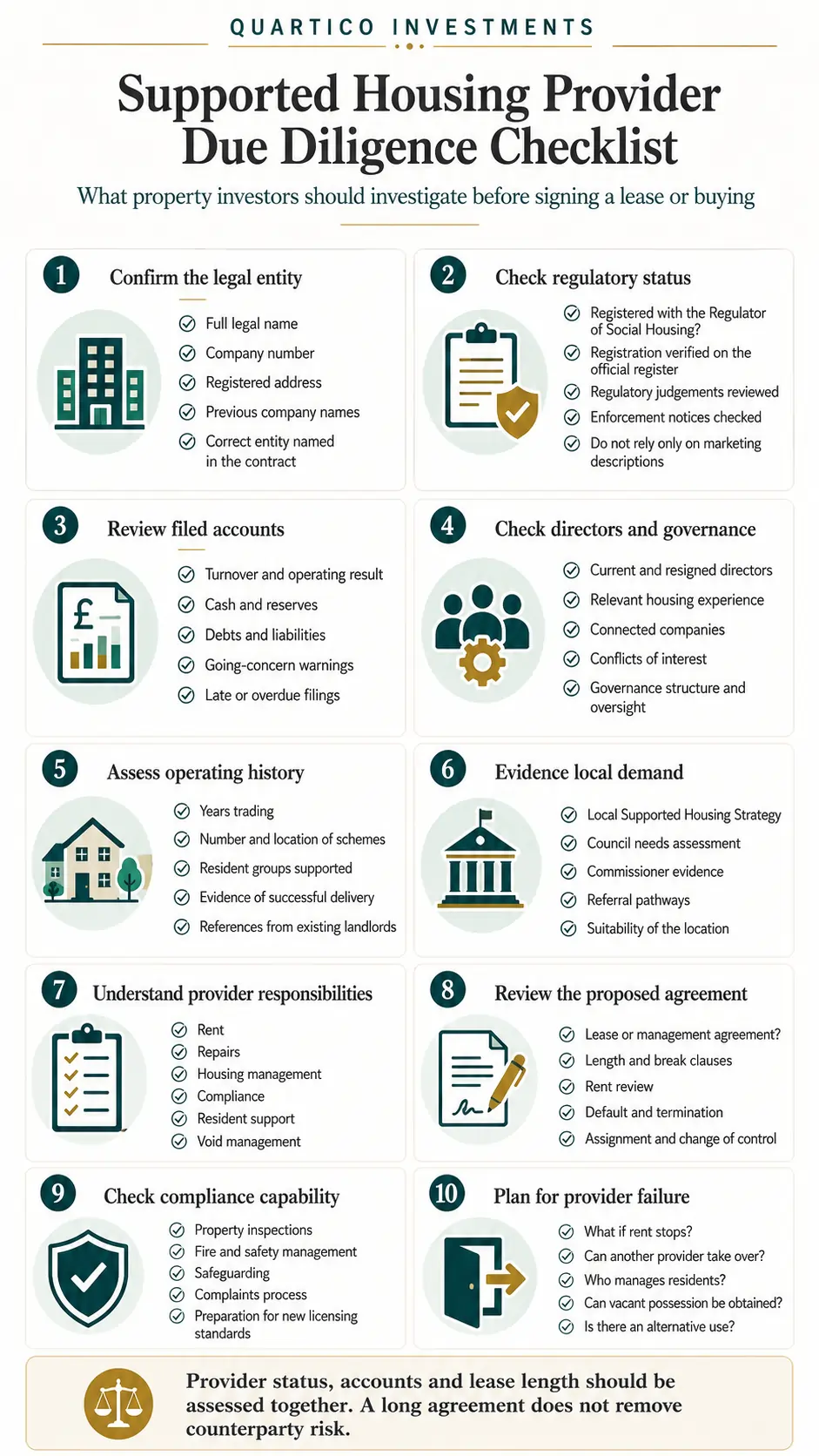
Why supported housing provider due diligence matters
In a conventional buy-to-let investment, the landlord may receive rent directly from the occupier and retain day-to-day control over the property. In some supported housing structures, the investor instead grants a lease or enters a management agreement with a housing provider or operator.
That organisation may agree to:
- pay rent to the investor;
- manage residents;
- maintain the property;
- carry out inspections;
- manage repairs and compliance;
- coordinate support providers;
- deal with Housing Benefit administration;
- maintain occupancy and referral relationships.
The investor’s financial return can therefore become heavily dependent on one organisation. If the provider is weak, poorly governed, undercapitalised or operationally incapable, a long lease may provide less protection than expected.
The Regulator of Social Housing’s focus report on lease-based specialised supported housing identifies substantial risks associated with some long-term and inflexible lease structures, including financial viability, governance, risk management and property quality.
For a wider explanation of the investment model, read Quartico’s Supported Housing Investment Guide.
1. Identify the exact legal counterparty
The first due diligence question is not simply “Who is the provider?” It is:
Which precise legal entity will sign the agreement and be responsible for paying the investor?
A group may operate using several companies, charities, community interest companies or trading names. The organisation shown in marketing material may not be the same company named in the lease.
Investors should record:
- the full registered company or charity name;
- company or charity number;
- registered office;
- date of incorporation;
- previous company names;
- trading names;
- group companies;
- the entity named in the lease or agreement;
- whether any guarantee is offered by another group entity.
Do not assume that two companies with similar names have the same financial resources. The contracting entity may be newly incorporated, lightly capitalised or separated from the organisation that holds the group’s main assets.
2. Check Companies House records
Companies House provides free public access to company information. Its company information service can show matters including:
- registered address;
- date of incorporation;
- current and resigned officers;
- filing history;
- accounts;
- confirmation statements;
- previous company names;
- mortgage charges;
- insolvency information.
Companies House records are a starting point rather than a complete credit assessment. Filed accounts may be abbreviated, historic or prepared under small-company reporting rules. Investors should ask a suitably qualified accountant to interpret the financial information where the provider’s covenant is central to the investment.
Points requiring further investigation can include:
- overdue accounts or confirmation statements;
- frequent changes of registered address;
- multiple recent director resignations;
- rapid changes of company name;
- outstanding or recently created charges;
- applications to strike the company off;
- very limited trading history;
- accounts that do not appear consistent with the scale of lease obligations proposed.
3. Verify Regulator of Social Housing registration
Some providers describe themselves using terms such as “housing association”, “registered housing provider” or “social housing partner”. Investors should verify the exact status independently.
The Regulator of Social Housing publishes an official register of social housing providers, updated monthly. Search using the exact legal entity and registration number rather than relying only on a trading name.
Check:
- whether the entity is currently registered;
- its registration number;
- the date it was registered;
- whether it is profit-making or non-profit;
- whether its status has changed;
- whether a related company, rather than the contracting company, is registered;
- whether any deregistration action has been announced.
Registration is relevant, but it should not be treated as an automatic financial guarantee. Investors still need to assess the provider’s accounts, governance, operational capability and proposed agreement.
4. Review regulatory judgements and enforcement notices
The Regulator of Social Housing publishes regulatory judgements and enforcement notices explaining how registered landlords are meeting regulatory standards.
Its regulatory publications may cover:
- governance;
- financial viability;
- consumer standards;
- rent requirements;
- serious regulatory concerns;
- enforcement action;
- inspection outcomes.
Search the regulator’s A-to-Z list of landlords using the provider’s legal name.
The absence of a published judgement should not automatically be interpreted as approval. Check what assessment has taken place and ask the provider to explain its regulatory position.
5. Check charity or community-interest status
Some supported housing organisations operate as registered charities, charitable companies or community interest companies.
For a charity, the Charity Commission register can provide information about:
- the charity’s legal name and number;
- trustees;
- activities and objectives;
- income and expenditure;
- financial reports;
- reporting status;
- regulatory action where published.
Investors should confirm that the organisation’s stated activity is consistent with its legal objects and that the correct entity is entering the transaction.
A charitable or community-focused structure does not remove commercial risk. The organisation still needs sufficient income, governance and operational capacity to meet the lease obligations.
6. Review the provider’s financial covenant
The provider covenant is its financial and operational ability to meet its obligations throughout the agreement.
Investors should review several accounting periods where available, rather than relying on one balance sheet or a single profitable year.
Areas to examine include:
- turnover and how it has changed;
- operating surplus or deficit;
- cash at bank;
- restricted and unrestricted reserves;
- short-term creditors;
- long-term debt;
- secured charges;
- lease liabilities and commitments;
- related-party transactions;
- auditor or accountant comments;
- going-concern disclosures;
- dependence on one contract, commissioner or funding source.
A provider may show growing turnover but still have weak cash reserves or substantial long-term commitments. Conversely, a small provider may be financially prudent but lack the scale to absorb operational shocks.
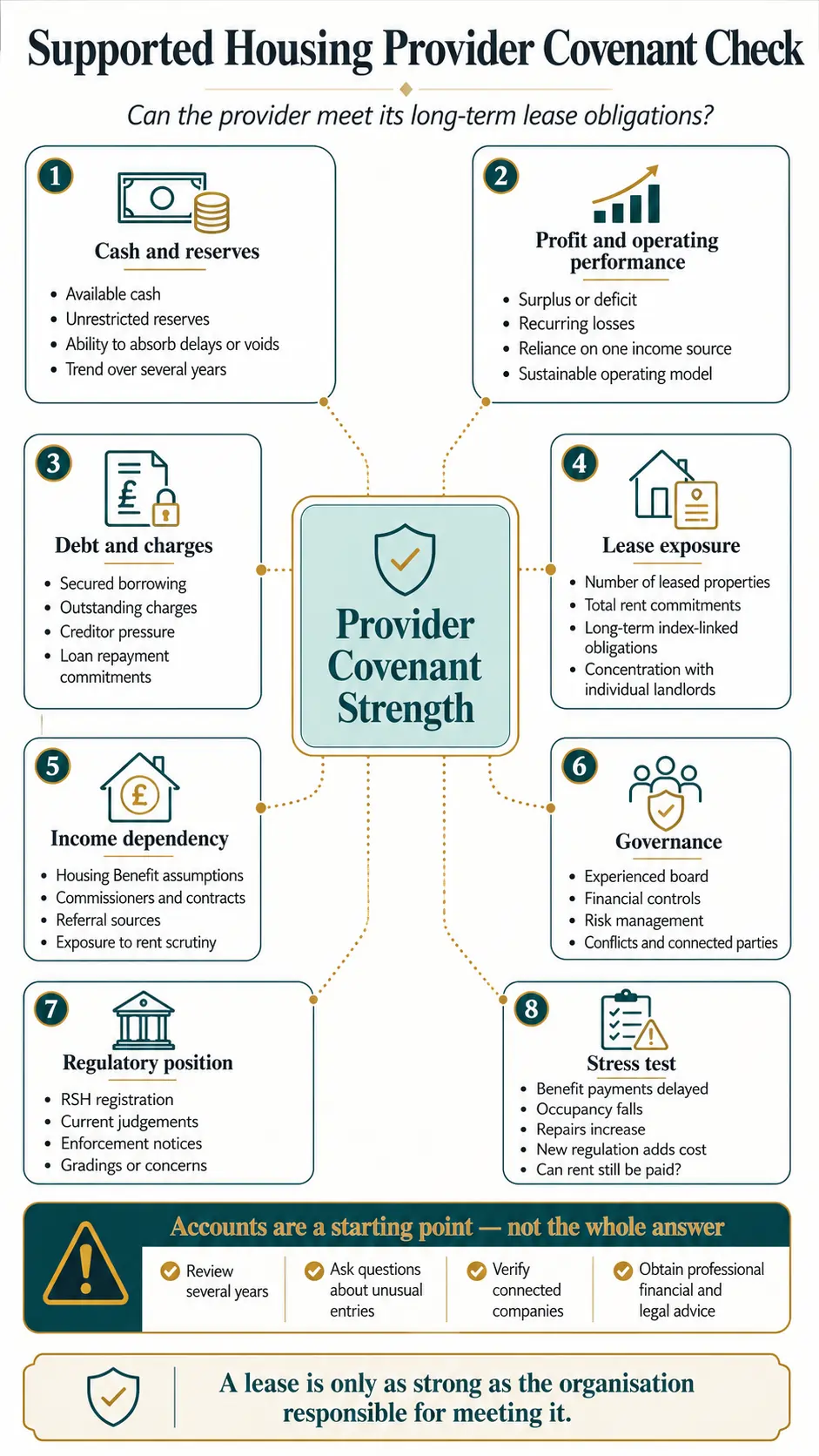
7. Compare lease commitments with provider resources
A provider’s existing and proposed lease obligations should be compared with its financial resources.
Ask the provider:
- how many properties it currently leases;
- the total annual rent it is committed to paying;
- how much of that rent is index-linked;
- how many new properties it expects to add;
- whether any leases are loss-making;
- whether properties have experienced benefit shortfalls;
- whether landlords have agreed rent reductions or concessions;
- how many providers, commissioners or referral routes support its income;
- what contingency funds are available.
A provider taking on leases faster than its systems, staff and cash reserves can support may create concentration and viability risk.
8. Investigate directors, trustees and governance
Good governance is particularly important where an organisation manages vulnerable residents, public funds and long-term property obligations.
Investors should examine:
- current and former directors or trustees;
- their relevant housing, care, finance and governance experience;
- length of service;
- recent board turnover;
- independence of the board;
- conflicts of interest;
- connected companies;
- relationships with developers, landlords, managing agents or support providers;
- whether major decisions receive independent scrutiny;
- whether the provider has clear risk-management and audit processes.
Connected-party relationships are not automatically improper, but they should be transparent. Investors should understand who benefits financially from acquisition, development, leasing, management, support and maintenance contracts.
9. Assess the provider’s operating history
Investors should ask for evidence that the provider has successfully managed schemes similar to the proposed property.
Useful information includes:
- how long the organisation has operated;
- number of existing properties and residents;
- locations of existing schemes;
- resident groups supported;
- average occupancy;
- referral sources;
- staffing structure;
- complaints and safeguarding arrangements;
- property inspection systems;
- repair response times;
- landlord retention;
- schemes that have closed or been handed back.
A provider with experience in homelessness accommodation may not automatically have the specialist capability required for residents with learning disabilities, autism, mental health needs or complex physical adaptations.
10. Speak to existing landlords and partners
References supplied by the provider should be checked independently.
Questions for existing property owners can include:
- Has rent been paid in full and on time?
- Has the provider complied with repairing obligations?
- Have there been disputes over service charges or maintenance?
- Has the provider requested rent concessions?
- How well is the property inspected?
- How quickly are problems resolved?
- Has the provider attempted to exercise break rights?
- What condition is the property in?
- Would the landlord enter another agreement with the provider?
Where possible, investors should also seek evidence from commissioners, councils, referral partners, support organisations and professional advisers rather than relying exclusively on references selected by the provider.
11. Evidence local need and referral routes
A financially sound provider still needs a credible resident and referral model.
The government’s Local Supported Housing Strategies guidance requires councils in England to assess current supply, unmet need and future demand.
Investors should ask:
- What resident group will the property accommodate?
- What evidence shows that this accommodation is needed locally?
- Does the council’s supported housing strategy identify that need?
- Who will refer residents?
- Is the referral arrangement contractual or informal?
- Is the scheme commissioned?
- Has the council or Housing Benefit team reviewed the proposal?
- Are support services available locally?
- Is the property close to transport, healthcare and community facilities?
- What happens if the current referral route ends?
A general national shortage of supported housing does not prove that a particular scheme, resident group or location will receive referrals.
12. Review Housing Benefit assumptions
Housing Benefit may contribute towards eligible housing costs for residents in qualifying supported accommodation, but it should not be treated as automatic or as a direct government guarantee to the investor.
DWP’s supported housing claims guidance explains that local authorities assess matters including:
- the type of landlord;
- the accommodation category;
- the resident’s need for care, support or supervision;
- whether support is more than minimal;
- who provides or arranges the support;
- eligible rent;
- eligible and ineligible service charges;
- rent reasonableness.
The provider should be able to explain:
- which Housing Benefit category is expected to apply;
- how the assumed rent was calculated;
- what service charges are included;
- which costs are ineligible;
- what evidence the local authority may request;
- who bears delays or shortfalls;
- what happens if the local authority reduces eligible rent.
If the provider’s business model only works when every claim is paid at the highest assumed level, the investment should be stress-tested carefully.
13. Identify the support and care providers
The housing provider and support provider may be the same organisation or separate entities. Investors should understand the relationship and responsibility of each.
Ask:
- Who assesses resident needs?
- Who prepares support plans?
- Who employs support staff?
- Who funds the support?
- Is there a written agreement between the housing and support providers?
- What happens if the support contract ends?
- Is personal care provided?
- Does the relevant organisation hold any required CQC registration?
The Care Quality Commission provides a searchable register of regulated care services. CQC registration applies to regulated activities such as personal care, rather than automatically applying to the accommodation itself.
14. Examine safeguarding and resident-management capability
A provider’s responsibilities go beyond paying rent. Supported housing involves residents who may be vulnerable and who require appropriate housing management and support.
Review the provider’s:
- safeguarding policy;
- staff recruitment and background checks;
- training programme;
- incident-reporting system;
- complaints process;
- resident engagement;
- antisocial behaviour process;
- emergency arrangements;
- data protection;
- maintenance escalation;
- quality-assurance inspections.
Poor operational performance can affect resident welfare, local authority relationships, licensing, Housing Benefit, reputation and the provider’s ability to continue operating the scheme.
15. Review the provider’s lease obligations
The provider’s responsibilities must be defined in the actual lease or agreement.
Investors should check who is responsible for:
- rent and any index-linked increases;
- structural repairs;
- day-to-day repairs;
- damage caused by residents;
- heating systems;
- fire alarms and emergency lighting;
- specialist adaptations and equipment;
- insurance;
- licensing and regulatory compliance;
- council tax and utilities;
- voids and referrals;
- reinstatement when the agreement ends.
Descriptions such as “fully repairing”, “fully managed” or “nil void” should be verified against the legal wording. The contract may contain exclusions, caps, break rights, conditions or events that transfer costs back to the property owner.
16. Check break clauses, defaults and termination rights
A 20-year or 25-year headline lease term can be misleading if the provider has broad rights to terminate much earlier.
Check:
- landlord and provider break rights;
- notice periods;
- funding-related termination clauses;
- referral or occupancy conditions;
- regulatory-change provisions;
- what constitutes a default;
- time allowed to remedy a breach;
- insolvency provisions;
- loss of registration or licence;
- assignment and change-of-control clauses;
- whether another group company can replace the provider;
- the required condition of the property at hand-back.
Your solicitor should assess whether the agreement protects the investor as intended and whether the terms are acceptable to the lender and insurer.
17. Check readiness for supported housing licensing
The government intends to introduce a locally led supported housing licensing regime and National Supported Housing Standards in England.
The June 2026 supported housing regulation response sets out plans involving:
- licensing across England;
- fit and proper person requirements;
- management and accommodation conditions;
- National Supported Housing Standards;
- local authority inspections and enforcement;
- links between licensing and Housing Benefit.
Ask the provider:
- who expects to hold the licence;
- how its governance will meet the fit and proper person requirements;
- how it is preparing for national support standards;
- what systems exist for needs assessments and support planning;
- what additional staffing or property costs may arise;
- who bears those costs under the agreement.
18. Questions to ask before signing
Before committing, investors should ask the provider to answer questions in writing.
- Which legal entity will sign the agreement?
- Is that exact entity registered with RSH?
- Can you provide the latest accounts and management accounts?
- What are your total annual lease commitments?
- How many schemes do you currently operate?
- How many schemes have closed or been handed back?
- Who provides support and personal care?
- Who refers residents?
- What local need has been evidenced?
- Has the Housing Benefit model been discussed with the local authority?
- Who bears benefit delays or shortfalls?
- Who pays for structural and major repairs?
- What break clauses apply?
- What happens if the provider loses a contract, licence or registration?
- What is the replacement-provider plan?
- Can existing landlords be contacted independently?
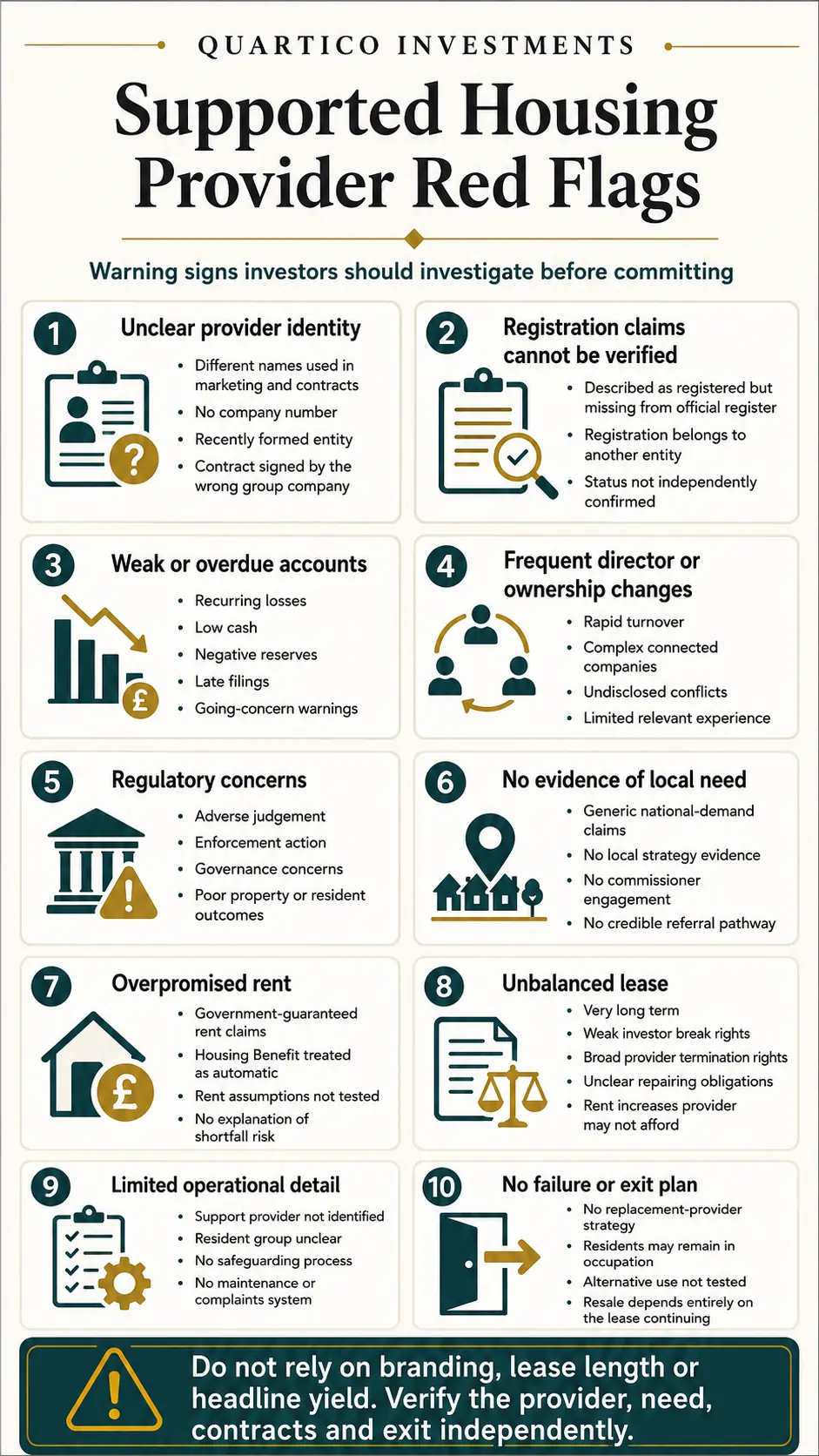
Supported housing provider red flags
Unclear legal identity
The company named in the agreement differs from the organisation promoted in the sales material, and the relationship is not clearly explained.
Unverified registration claims
The provider describes itself as registered or regulated, but the exact legal entity cannot be found on the relevant official register.
Very recent incorporation
A newly formed company proposes to take on substantial long-term rent obligations without an established trading or delivery history.
Weak or overdue accounts
Accounts show recurring deficits, limited cash, negative reserves, overdue filings or going-concern concerns.
Rapid expansion
The provider is taking on properties quickly but cannot demonstrate that staff, referrals, systems and financial reserves are growing at the same pace.
Frequent director changes
There has been rapid leadership turnover, complex connected companies or unclear governance.
No evidence of local need
The provider relies on broad national demand claims but cannot identify a local needs assessment, commissioner, referral pathway or council engagement.
Government-guaranteed rent claims
Housing Benefit is presented as automatic or as a direct government guarantee to the investor.
Unbalanced agreement
The investor is locked into a long agreement while the provider has broad termination rights or limited repair obligations.
No provider-failure plan
No clear answer is provided about residents, property management, rent or replacement arrangements if the provider stops operating.
What happens if the provider fails?
Provider failure can create a complicated situation because residents may remain in occupation even though the organisation responsible for rent or management has stopped performing.
Possible consequences include:
- rent payments stopping;
- repairs and inspections not being completed;
- support arrangements being disrupted;
- Housing Benefit claims needing to be reassessed;
- residents remaining in occupation;
- urgent safeguarding or management issues;
- mortgage or insurance covenant breaches;
- the need to appoint a replacement provider;
- difficulty obtaining vacant possession;
- adaptation or reinstatement costs.
Investors should ask their solicitor to explain:
- what legal control the owner would regain;
- whether the lease can be terminated;
- what rights residents retain;
- whether another provider can take over;
- who becomes responsible for management and safety;
- whether any guarantee or security can be enforced.
Can the provider offer security or a guarantee?
Depending on the transaction, investors may explore whether additional security is appropriate, such as:
- a parent-company guarantee;
- a rent deposit;
- a guarantor;
- financial reporting obligations;
- limits on assignment or change of control;
- rights to inspect provider records relevant to the property;
- early-warning obligations following financial or regulatory problems.
The practical and legal value of any guarantee depends on the strength of the guarantor and the wording of the document. A guarantee from another weak or asset-light company may provide little additional protection.
Full supported housing provider due diligence checklist
Legal entity
- Confirm legal name, number and address.
- Check previous names and trading identities.
- Identify group and connected companies.
- Confirm the entity named in the agreement.
Official registers
- Check RSH registration where claimed.
- Review regulatory judgements and enforcement notices.
- Check Charity Commission registration where relevant.
- Check CQC registration for regulated activities where relevant.
Financial review
- Review multiple years of accounts.
- Examine cash, reserves and liabilities.
- Review mortgage charges and debt.
- Understand total lease exposure.
- Ask for recent management accounts.
- Stress-test ability to meet rent obligations.
Governance
- Review directors and trustees.
- Check relevant experience.
- Investigate connected parties and conflicts.
- Assess board oversight and risk controls.
Operations
- Review existing schemes and resident groups.
- Check inspection and repair systems.
- Review safeguarding and complaints processes.
- Contact existing landlords independently.
Local demand
- Review the Local Supported Housing Strategy.
- Identify the commissioner or referral source.
- Confirm the intended resident group.
- Check the suitability of the location.
Housing Benefit
- Understand the expected claim category.
- Review rent and service-charge breakdowns.
- Identify who bears delays and reductions.
- Check whether assumptions have been tested locally.
Agreement
- Check rent, reviews and indexation.
- Review repairs and insurance.
- Examine break clauses and default provisions.
- Review assignment and change-of-control rights.
- Understand hand-back and reinstatement obligations.
Failure and exit
- Identify replacement-provider options.
- Understand resident occupation rights.
- Test conventional alternative use.
- Calculate reinstatement costs.
- Assess resale with and without the lease.
Internal links for further supported housing research
- Supported Housing Investment Guide: How It Works, Risks and Due Diligence
- Specialist Supported Housing Investment Opportunities
- HMO Social Housing Investments
- HMO Licensing and Article 4 Guide
- Landlord Compliance Guide
Final thoughts
Supported housing provider due diligence should never be reduced to checking whether an organisation has an impressive website or offers a long lease.
Investors need to verify the exact legal counterparty, examine its official registration, accounts, governance and operating history, understand the local need and referral model, and review every material obligation in the agreement.
The strongest supported housing investment opportunities are those where the provider is financially capable, operationally experienced, appropriately regulated, transparent about risk and able to evidence genuine local demand.
To understand the wider model, read Quartico’s complete supported housing investment guide.
Speak to Quartico About Supported Housing Investment
Frequently asked questions
How do I check whether a supported housing provider is registered?
Search the Regulator of Social Housing’s official register using the provider’s exact legal name. Check that the entity named in the lease is the same entity shown on the register.
Does RSH registration guarantee that a provider is financially safe?
No. Registration is an important check, but investors should still review accounts, regulatory judgements, governance, lease exposure, operating history and the terms of the proposed agreement.
What should investors check at Companies House?
Investors should review the company’s legal identity, incorporation date, accounts, filing history, officers, previous names, charges, insolvency information and connected companies.
How many years of provider accounts should be reviewed?
Investors should review several accounting periods where available, together with recent management accounts where appropriate. A qualified accountant should interpret the figures when provider covenant is central to the investment.
Why are cash and reserves important?
A provider may need to absorb Housing Benefit delays, voids, repair costs, staffing costs and regulatory changes while continuing to meet rent obligations.
What is provider covenant risk?
Provider covenant risk is the risk that the organisation responsible for rent or other lease obligations cannot or will not meet those obligations throughout the agreement.
Should investors contact existing landlords?
Yes. Existing landlords may provide useful evidence about rent payments, repairs, communication, property condition, disputes and whether the provider has complied with previous agreements.
Why does local supported housing need matter?
National demand does not prove that a particular property is suitable or needed. Investors should look for local needs evidence, commissioner engagement and credible referral routes.
Is Housing Benefit guaranteed for supported housing providers?
No. Local authorities assess each claim, the accommodation category, resident need, support arrangements, eligible rent and service charges. Claims and payment levels are not automatic.
What happens if a supported housing provider fails?
Rent may stop while residents remain in occupation. The property owner may need to address management, repairs, safeguarding, replacement-provider arrangements, lender conditions and the legal position of residents.