

Liverpool remains one of the most important HMO investment markets in the North West, but investors need to approach the city carefully.
Strong rental demand, a large student population, professional tenant demand and relatively affordable property prices can make Liverpool attractive for HMO investors. However, the city also has important planning and licensing rules that must be checked before buying.
For investors, the key issue is not simply whether a property could generate a strong gross yield. The real question is whether the HMO is legally usable, correctly licensed, financeable, manageable and suitable for the intended tenant profile.
This guide explains the main checks to make before buying an HMO in Liverpool, including Article 4, planning permission, HMO licensing, property standards, finance, local demand and exit strategy.
Why Liverpool Appeals to HMO Investors
Liverpool has long been a popular city for HMO investment because it combines several attractive investment features.
- Large student population
- Young professional rental demand
- Major hospitals and public sector employers
- Growing city-centre employment
- Regeneration across several districts
- Lower entry prices than many southern cities
- Established shared accommodation market
For investors, this can create opportunities for strong rental income from well-located shared housing. However, Liverpool is not a city where investors should buy blindly. HMO rules vary by location, and planning history can be just as important as rental demand.
A property that looks attractive on a spreadsheet may become much less attractive if it needs planning permission, fails room-size checks, requires major fire safety works, or cannot be licensed for the number of rooms assumed in the yield calculation.
Buying an HMO in Liverpool: The Main Investor Checks
Before buying an HMO in Liverpool, investors should check five broad areas:
- Planning status
- Article 4 position
- HMO licensing requirements
- Property compliance and refurbishment cost
- Finance, yield and exit strategy
The most important point is that HMO licensing and planning permission are separate issues. A property can have an HMO licence but still have planning problems. Equally, planning permission does not remove the need for a licence if the property meets licensing criteria.
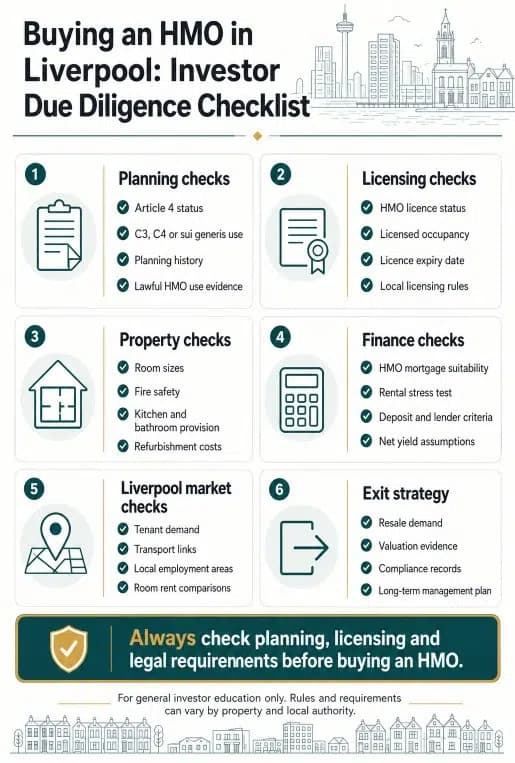
Key planning, licensing, finance and market checks to review before buying an HMO in Liverpool.
Article 4 and HMOs in Liverpool
Article 4 is one of the most important issues for Liverpool HMO investors.
An Article 4 Direction is a planning control that removes certain permitted development rights. For HMOs, this usually affects the ability to convert a standard dwellinghouse into a small HMO without applying for planning permission.
In Liverpool, investors should check whether the property is located inside an Article 4 area before buying. If a property is within a Liverpool Article 4 area and is being converted into an HMO for three or more people, planning permission may be required.
Liverpool City Council also states that HMOs for seven or more people anywhere in Liverpool are subject to planning permission.
This makes planning due diligence essential. Investors should not rely only on the estate agent description, existing floor plan, or rental listing. The planning position should be checked directly before committing to the purchase.
Useful official resource: Liverpool City Council planning permission for HMOs .
Existing HMO vs Conversion in Liverpool
There is a big difference between buying an existing Liverpool HMO and buying a standard house to convert into an HMO.
Buying an existing HMO
An existing HMO may be attractive because the property may already have a letting history, room layout, safety measures and rental income. However, investors still need evidence that the use is lawful.
Key checks include:
- Current HMO licence
- Licence expiry date
- Licensed occupancy
- Planning history
- Lawful use evidence
- Whether the HMO use predates Article 4 controls
- Room sizes
- Fire safety compliance
- Current rent roll
- Management history
The phrase “currently used as an HMO” is not enough. Investors should ask whether the property has the correct licence and the correct planning position for the number of occupants being advertised.
Buying a property to convert into an HMO
A conversion can offer more upside, but it usually carries more risk. The investor may need planning permission, licensing approval, refurbishment works and a compliant layout before the property can perform as expected.
- Whether Article 4 applies
- Whether planning permission is required
- Local HMO concentration policies
- Minimum bedroom sizes
- Fire escape routes
- Kitchen and bathroom provision
- Waste storage
- Refurbishment cost
- Finance availability
- Expected rental demand in that exact location
A conversion should only be assessed using realistic assumptions. If the business plan depends on six lettable rooms, the investor must confirm that six rooms are lawful, compliant, financeable and practically lettable.
HMO Licensing in Liverpool
HMO licensing is another key part of the due diligence process.
In Liverpool, investors should check whether the property needs an HMO licence. Liverpool City Council’s HMO licence guidance asks investors to consider whether the property is privately rented within Liverpool, occupied by five or more unrelated people, occupied by two or more separate households, and whether the occupants share a bathroom, kitchen or WC.
If those conditions apply, an HMO licence may be required.
Useful official resource: Liverpool City Council HMO licence guidance .
Investors should also check whether selective licensing applies in the property’s location. Liverpool operates selective licensing in designated areas, and private rented properties in those areas may need a licence even if they are not large HMOs.
Useful official resource: Liverpool City Council selective licensing guidance .
Why Licensing Matters for Investment Returns
Licensing affects more than compliance. It can directly affect the financial performance of the investment.
For example, if a property is advertised as a six-bedroom HMO but the council will only license it for five occupants, the actual income could be lower than the investor expected. If significant works are needed before a licence is granted, the investor may face delays, additional costs and lost rent.
Licensing can affect:
- Legal occupancy
- Gross rental income
- Mortgage valuation
- Management responsibility
- Resale value
A compliant HMO may appear less exciting than a high-yielding but uncertain opportunity, but it is usually a better long-term investment.
Minimum Room Sizes and Layout Checks
Room sizes are an essential part of HMO due diligence.
For licensed HMOs in England, national minimum sleeping room sizes are:
| Occupancy | Minimum sleeping room size |
|---|---|
| One person over 10 years old | 6.51m² |
| Two people over 10 years old | 10.22m² |
| One child under 10 years old | 4.64m² |
These are minimum standards, not necessarily best-practice investment standards. Local expectations, tenant demand and lender appetite may require better-sized rooms and a more practical layout.
Investors should measure rooms properly and check whether any areas with restricted ceiling height should be excluded from the usable room measurement.
Best Liverpool Areas for HMO Investment
The best area for an HMO in Liverpool depends on the tenant profile and investment strategy.
Student-focused HMOs may be assessed differently from professional HMOs, social housing HMOs, supported accommodation, contractor accommodation or provider-backed models.
Areas often reviewed by HMO investors include locations with access to universities, hospitals, employment centres, transport links and established rental demand.
However, investors should not choose an area based only on headline yield. The correct approach is to compare:
- Local Article 4 restrictions
- Existing HMO concentration
- Room rental demand
- Property purchase prices
- Refurbishment costs
- Mortgage availability
- Tenant profile
- Exit demand from future buyers
A high-yielding street with planning pressure, poor resale demand or weak tenant quality may be less attractive than a slightly lower-yielding area with stronger long-term fundamentals.
HMO Finance in Liverpool
HMO finance is usually more specialist than a standard buy-to-let mortgage.
Lenders may look at:
- Investor experience
- Property layout
- Number of bedrooms
- Licence position
- Valuation method
- Rental income
- Stress-test affordability
- Lease or management structure
- Whether the property is already operational
Some lenders are more comfortable with existing licensed HMOs than new conversions. Others may require evidence of planning, licensing, comparable rents and professional management before approving the loan.
For investors buying in Liverpool, it is important to speak to a broker who understands HMOs before making an offer. A property that looks attractive in cash-flow terms may not be mortgageable on the terms assumed.
For more detail, read our HMO mortgage guide .
Social Housing and Provider-Backed HMOs in Liverpool
Some Liverpool HMO investments may be structured around provider-backed accommodation, supported accommodation or social housing-style lease arrangements.
These can be attractive to hands-off investors because the provider may take responsibility for tenanting, management and rent payments under the agreed lease structure.
However, the investor should still check:
- Whether the property is classed as an HMO
- Whether an HMO licence is required
- Who is responsible for compliance works
- Who deals with council inspections
- Who pays for maintenance
- What happens if licensed occupancy changes
- Whether the lease is lender-friendly
A provider lease does not remove the need for correct planning and licensing due diligence.
For more detail, see our HMO social housing investment guide .
Liverpool HMO Due Diligence Checklist
Before buying an HMO in Liverpool, investors should complete a structured due diligence process.
Planning checks
- Is the property currently C3, C4 or sui generis?
- Is the property inside a Liverpool Article 4 area?
- Does the current or proposed use require planning permission?
- Is there evidence of lawful HMO use?
- Has the property had previous refusals or enforcement issues?
Licensing checks
- Does the property need an HMO licence?
- Is there an existing licence?
- What occupancy is the licence based on?
- When does the licence expire?
- Are there licence conditions?
- Does selective licensing apply?
Property checks
- Are all bedrooms compliant?
- Is the kitchen provision suitable?
- Are bathroom facilities adequate?
- Are fire doors, alarms and escape routes suitable?
- Is waste storage acceptable?
- What refurbishment works are required?
Finance checks
- Will the property qualify for HMO finance?
- Will the lender accept the current planning position?
- Will the rent pass the lender’s stress test?
- Is the valuation based on bricks and mortar or investment value?
- Are refurbishment costs included in the funding plan?
Market checks
- Who is the intended tenant profile?
- Are comparable room rents realistic?
- Is demand proven in that exact area?
- How much competition is nearby?
- Is the location suitable for students, professionals or provider-backed accommodation?
Exit checks
- Could the property be sold as an HMO?
- Would it appeal to other investors?
- Is the planning position clear enough for resale?
- Would a lender support a future buyer?
- Could the property return to single-let use if required?
Request Latest Liverpool HMO Investments
Make an Enquiry
Common Mistakes When Buying an HMO in Liverpool
Assuming every shared house is legally an HMO
Some properties are advertised as HMOs without clear evidence of planning status, licensing or lawful use. Investors should always verify the position.
Ignoring Article 4
Article 4 can change the investment case. A conversion that appears simple may require planning permission if the property is in the relevant area.
Relying on advertised room rents
Advertised rents are not the same as achieved rents. Investors should compare local evidence and allow for voids, bills, management and maintenance.
Forgetting licence occupancy
If the licence supports fewer occupants than expected, the return will change.
Underestimating refurbishment costs
Fire safety, layout changes, bathrooms, kitchens and furniture can materially affect the total investment cost.
Not planning the exit
A strong HMO investment should be attractive not only to tenants, but also to future buyers and lenders.
Is Liverpool a Good Place to Buy an HMO?
Liverpool can be a strong HMO investment location, but it is not suitable for every investor or every property.
The best opportunities are usually those where the investor can clearly evidence:
- Correct planning position
- Correct licensing position
- Strong local rental demand
- Compliant room sizes
- Realistic refurbishment cost
- Financeable structure
- Clear management plan
- Strong exit strategy
Liverpool is a city where local due diligence matters. The right property in the right area can work well. The wrong property, or a property bought without checking Article 4 and licensing, can create unnecessary risk.
Final Thoughts
Buying an HMO in Liverpool should never be based on headline yield alone.
Investors need to understand the planning position, Article 4 area, HMO licence requirements, property layout, finance options and tenant demand before buying.
A good Liverpool HMO investment is not just a property with multiple bedrooms. It is a property where the legal use, rental income, compliance, finance and exit strategy all work together.
At Quartico, we help investors assess HMO opportunities with both income and risk in mind.
Speak to Quartico About Liverpool HMO Investments
Frequently Asked Questions
Is Liverpool a good city for HMO investment?
Liverpool can be attractive for HMO investors because of student, professional and rental demand, but each property must be checked carefully for planning, licensing, compliance, finance and local demand.
Do HMOs in Liverpool need planning permission?
Some do. Liverpool City Council states that HMOs for seven or more people anywhere in Liverpool are subject to planning permission. Converting a property into an HMO for three or more people within a Liverpool Article 4 area may also require planning permission.
What is Article 4 in Liverpool?
Article 4 is a planning control that removes permitted development rights in defined areas. For Liverpool HMO investors, it can mean that converting a standard house into a small HMO requires planning permission.
Do I need an HMO licence in Liverpool?
You may need an HMO licence if the property is privately rented in Liverpool, occupied by five or more unrelated people, occupied by two or more households, and the occupants share facilities such as a bathroom, kitchen or WC.
Does selective licensing apply in Liverpool?
Liverpool has selective licensing in designated areas. Investors should use Liverpool City Council’s postcode checker to confirm whether a privately rented property needs a selective licence.
Can I buy an existing HMO in a Liverpool Article 4 area?
Potentially, yes. Existing lawful HMOs in Article 4 areas may be attractive, but investors should obtain evidence of lawful use, current licensing, planning history and compliant occupancy before buying.
What should I check before buying a Liverpool HMO?
Key checks include Article 4 status, planning permission, HMO licensing, selective licensing, room sizes, fire safety, refurbishment cost, rental demand, mortgageability and resale value.
Are Liverpool HMO yields higher than standard buy-to-let yields?
They can be, but headline yield is not enough. Investors should calculate net yield after finance, bills, management, maintenance, licensing, compliance works, voids and refurbishment costs.
Can overseas investors buy HMOs in Liverpool?
Yes, but overseas investors should consider finance availability, UK management arrangements, local licensing, tax, legal checks and whether the property can be managed compliantly from abroad.
What is the biggest risk when buying an HMO in Liverpool?
The biggest risks are usually unclear planning status, Article 4 restrictions, licensing problems, underestimated refurbishment costs and unrealistic rental assumptions.
