

Sheffield can be an attractive city for HMO investors, but it is also a city where planning, licensing and local HMO concentration rules need to be checked carefully before buying.
For UK and overseas investors, Sheffield HMOs can offer access to a large student population, a strong professional rental market and comparatively affordable property prices when compared with many larger UK cities. However, an HMO investment in Sheffield should never be judged on headline yield alone.
The key questions are whether the property has the right planning position, whether it falls inside Sheffield’s Article 4 area, whether it needs an HMO licence, whether the room sizes and fire safety standards are compliant, and whether the net return still works after refurbishment, finance, management and compliance costs.
This guide explains the main checks investors should understand before buying an HMO in Sheffield.
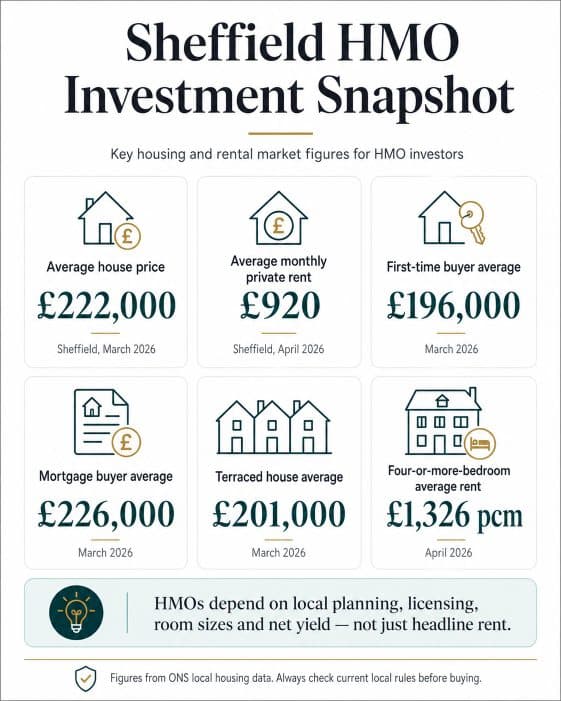
Sheffield HMO Investment Snapshot
According to the latest ONS local housing data, the average house price in Sheffield was £222,000 in March 2026 . The average monthly private rent was £920 in April 2026 , up from £882 a year earlier.
For HMO investors, two further figures are especially useful. Terraced properties in Sheffield averaged £201,000 , while four-or-more-bedroom private rents averaged £1,326 per month . These figures do not prove that a specific HMO will work, but they do help investors understand the local pricing context before comparing larger shared housing opportunities.
Sheffield market indicator
Latest figure
Average house price
£222,000
Average monthly private rent
£920
First-time buyer average price
£196,000
Mortgage buyer average price
£226,000
Terraced house average price
£201,000
Four-or-more-bedroom average rent
£1,326 pcm
Source: ONS local housing data for Sheffield .
Why Investors Look at HMOs in Sheffield
Sheffield has several features that can make it appealing for HMO investors. It is a major South Yorkshire city, has two large universities, a substantial student population, hospitals, professional employment, and established rental demand across different tenant groups.
The city is also more affordable than many southern UK markets. That can make entry prices more accessible, especially for investors comparing Sheffield with London, Bristol, Oxford or parts of the South East.
However, affordability alone is not enough. A good Sheffield HMO investment needs to be supported by:
- Strong local rental demand
- Correct planning status
- Suitable room sizes
- Compliant fire safety measures
- Realistic refurbishment costs
- Accurate mortgage assumptions
- Clear management arrangements
- A sensible exit strategy
In Sheffield, the planning position is particularly important because Article 4 and HMO density rules can affect whether a new HMO conversion is likely to be approved.
Sheffield Article 4 Rules for HMOs
Sheffield has an Article 4 Direction affecting houses in multiple occupation. Article 4 does not ban HMOs, but it removes certain permitted development rights in the defined area.
In practical terms, within Sheffield’s Article 4 area, planning permission is required to convert a standard dwellinghouse in C3 use into a small C4 HMO for three to six unrelated people.
Outside the Article 4 area, a C3 to C4 change may not require planning permission, although other rules can still apply. HMOs occupied by seven or more people are usually treated differently and normally need planning permission anywhere in the city.
For investors, the first planning question should be simple:
- Is the property inside Sheffield’s Article 4 area?
- Is the property already a lawful HMO?
- Is there evidence of continuous lawful HMO use?
- Would a new planning application be needed?
You can check Sheffield’s official HMO planning guidance on the Sheffield City Council HMO planning page .
Sheffield’s 20% HMO Density Test
One of the most important local planning points for Sheffield HMO investors is the city’s HMO concentration policy.
Sheffield City Council states that when assessing a planning application to convert a dwellinghouse into an HMO, it uses Core Strategy Policy CS41. This policy restricts HMO conversions where 20% or more of dwellings within 200 metres of the property are already HMOs .
This matters because a property can look ideal on paper but still face planning risk if the local HMO concentration is already too high.
Before buying a potential HMO conversion in Sheffield, investors should check:
- The local HMO density position
- Whether similar applications nearby have been approved or refused
- The planning history of the exact property
- Whether the property has existing lawful HMO use
- Whether evidence can be obtained from the seller
This is especially important in established student and shared housing areas, where HMO concentration may already be high.
Existing Sheffield HMO vs New HMO Conversion
There is a major difference between buying an existing Sheffield HMO and buying a standard house to convert into an HMO.
Buying an existing HMO in Sheffield
An existing HMO can be attractive because the property may already have the correct planning position, established use, and rental history. However, investors should not assume everything is correct simply because the property is tenanted.
Key checks include:
- Current HMO licence status
- Licensed occupancy
- Licence expiry date
- Planning history
- Evidence of lawful HMO use
- Room sizes
- Fire safety compliance
- Tenancy history
- Existing management arrangements
- Whether the income matches the legal occupancy
Buying a property to convert into an HMO in Sheffield
A conversion can offer upside, but it normally carries more risk. The investor is relying on future planning, future refurbishment, future licensing and future tenanting.
Before buying a Sheffield HMO conversion opportunity, investors should check:
- Whether the property is inside the Article 4 area
- Whether planning permission is needed
- Whether the 20% HMO density test may create a problem
- Whether the layout can meet room size and amenity standards
- Whether fire safety works are realistic
- Whether the mortgage lender will support the plan
- Whether the expected rent justifies the cost and risk
For many investors, an existing lawful HMO may be lower risk than a speculative conversion, even if the headline purchase price is higher.
HMO Licensing in Sheffield
Planning permission and HMO licensing are separate issues. A property can need planning permission, an HMO licence, both, or neither depending on the use, location, layout and occupancy.
Sheffield City Council states that an HMO licence is required if a property is occupied by five or more people forming two or more households , regardless of the number of floors in the property.
Important Sheffield licensing points include:
- A licence is required for qualifying HMOs with 5 or more occupiers from 2 or more households
- A separate licence is needed for each licensable HMO
- An HMO licence is not transferable
- The licence is normally valid for a maximum of 5 years
- Licensing standards cover areas such as fire safety, amenities and property management
This means that if you buy a licensed HMO, you should not assume the licence simply transfers to you. The buyer will usually need to make their own application or ensure the correct licensing process is followed.
You can check Sheffield’s official licensing guidance on the Sheffield City Council HMO licence page .
Buying an HMO in Sheffield Checklist
A good Sheffield HMO investment should be checked from several angles before purchase. The strongest opportunity is not always the one with the highest gross yield. It is usually the one where the planning, licensing, property condition and investment numbers all work together.
1. Check Article 4
- Would C3 to C4 conversion need planning permission?
- Is there evidence of existing lawful HMO use?
- Has the property ever reverted back to standard C3 use?
2. Check planning permission
- Does the property already have planning permission for HMO use?
- Would a 7+ person HMO be treated as sui generis?
- Has the council previously refused an HMO application nearby?
- Are there any enforcement issues?
3. Check HMO density
- What is the HMO concentration within 200 metres?
- Is the area already at or above the 20% threshold?
- Would Core Strategy Policy CS41 create planning risk?
- Is the location better suited to an existing lawful HMO rather than a new conversion?
4. Check licensing
- Will the property be occupied by 5 or more people from 2 or more households?
- Is a new HMO licence application needed?
- What is the licensed occupancy?
- What conditions are attached to the licence?
- When does the licence expire?
5. Check the property
- Are the bedrooms large enough?
- Are the kitchen and bathroom facilities suitable?
- Are fire doors, alarms and escape routes compliant?
- Is waste storage adequate?
- What refurbishment works are needed before letting?
6. Check the investment case
- What is the realistic gross yield?
- What is the realistic net yield after costs?
- Will the property meet lender criteria?
- Are management costs properly included?
- What is the exit strategy?
Sheffield HMO Finance and Mortgage Considerations
Financing an HMO is usually different from financing a standard single-let buy-to-let property. Lenders may look more closely at the borrower’s experience, the number of lettable rooms, the property layout, the planning position and the management structure.
For Sheffield HMOs, lenders may want clarity on:
- Whether the property is a licensed HMO
- Whether the planning position is clear
- Whether Article 4 affects the property
- Whether the property is let room-by-room or under a single lease
- Whether the borrower has previous landlord or HMO experience
- Whether the rental income passes the lender’s stress test
For overseas investors, lender choice can be more limited, so the structure should be considered early. Buying through a limited company, using specialist HMO finance, or purchasing with cash before refinancing can all have different tax, lending and risk implications.
For a wider explanation of HMO finance, see our HMO mortgage guide for UK and overseas property investors .
Social Housing and Provider-Backed HMOs in Sheffield
Some investors consider provider-backed or social housing HMO models because they may offer a more hands-off structure. However, a lease or provider agreement does not remove the need to understand planning, licensing and compliance.
Before buying a provider-backed HMO in Sheffield, investors should check:
- Whether the property legally operates as an HMO
- Whether the property needs an HMO licence
- Who is responsible for licensing and compliance
- Who pays for fire safety or amenity upgrades
- Whether the lease depends on a specific licensed occupancy
- What happens if the licence is reduced, refused or varied
Provider-backed income can be attractive, but the legal and practical details matter. The lease, licence, planning position and property condition should all support the investment case.
View HMO Social Housing Investments
Common Sheffield HMO Investment Mistakes
Assuming every large house can become an HMO
Not every large terraced house is suitable for HMO conversion. Article 4, density, room sizes, amenity standards and fire safety can all affect whether the property works.
Ignoring the Article 4 boundary
Inside Sheffield’s Article 4 area, a C3 to C4 conversion requires planning permission. This should be checked before making an offer.
Overlooking the 20% HMO concentration test
The 20% threshold within 200 metres can affect whether planning permission is likely to be granted. This is one of the most important Sheffield-specific HMO checks.
Assuming the HMO licence transfers on sale
Sheffield Council states that an HMO licence is not transferable. Investors should understand the licensing process before completion.
Basing returns on too many rooms
If only five rooms are compliant, the investment case should not be based on six. Legal occupancy matters more than the number of rooms shown on a floor plan.
Underestimating refurbishment costs
HMOs often need fire doors, alarm systems, kitchen upgrades, bathroom improvements, emergency lighting, decoration, furniture and compliance works. These costs should be built into the net return calculation.
Is Sheffield a Good Place to Buy an HMO?
Sheffield can be a good city for HMO investment, but the right property and the right compliance position are essential.
The city has clear demand drivers, including students, graduates, professionals and workers who may prefer shared accommodation. Average property prices are also lower than many larger UK markets, which can support stronger yield potential.
However, Sheffield is not a market where investors should buy blindly. Article 4, planning history, HMO density, licensing and property condition can all materially affect the outcome.
A strong Sheffield HMO opportunity is usually one where:
- The planning position is clear
- The property is already lawful or has a realistic planning route
- The layout supports compliant room sizes
- The expected rent is realistic for the location
- The refurbishment budget is properly costed
- The finance route is achievable
- The exit strategy is clear
Final Thoughts
Sheffield HMOs can offer strong potential for investors who understand the local rules. The city has real rental demand and relatively accessible property prices, but planning and licensing should come before yield projections.
Before buying, investors should confirm whether the property is inside Sheffield’s Article 4 area, whether the 20% HMO density policy is likely to affect planning, whether an HMO licence is needed, and whether the building can meet the required safety and amenity standards.
At Quartico, we help investors assess HMO opportunities with both return and risk in mind.
Frequently Asked Questions
Is Sheffield good for HMO investment?
Sheffield can be a good HMO investment location because it has student, graduate and professional rental demand, along with relatively accessible average property prices. However, each property must be checked for planning, licensing, HMO density, room sizes and net yield.
Do I need planning permission for an HMO in Sheffield?
You may need planning permission. Within Sheffield’s Article 4 area, planning permission is required to convert a C3 dwellinghouse into a C4 HMO for three to six unrelated people. HMOs with seven or more occupiers normally require planning permission anywhere in the city.
What is Sheffield’s Article 4 rule for HMOs?
Sheffield’s Article 4 Direction removes the automatic permitted development right to convert a standard C3 house into a small C4 HMO within the Article 4 area. Investors should check the official Article 4 boundary before buying.
What is the 20% HMO density rule in Sheffield?
Sheffield uses a local HMO concentration policy. Planning applications may be refused where 20% or more of dwellings within 200 metres of the property are already HMOs.
When does an HMO need a licence in Sheffield?
Sheffield City Council states that an HMO licence is required if a property is occupied by five or more people forming two or more households, regardless of the number of floors.
Does an HMO licence transfer when buying a property in Sheffield?
No. Sheffield City Council states that an HMO licence is not transferable. A buyer should check the licence position and understand whether a new application is required.
What should overseas investors check before buying a Sheffield HMO?
Overseas investors should check planning status, Article 4, HMO density, licensing, refurbishment costs, management arrangements, mortgage availability, tax structure and exit strategy before buying.
Is an existing HMO safer than a conversion in Sheffield?
An existing lawful HMO can sometimes be lower risk than a new conversion, especially inside Article 4 areas. However, investors still need to verify the licence, planning evidence, room sizes, safety compliance and rental history.