

HMO Investments Leeds: Buying an HMO in Leeds
Leeds is one of the UK’s major northern rental markets, and HMOs can appeal to investors looking for stronger income potential than a standard single-let buy-to-let.
However, buying an HMO in Leeds is not just about finding a large house and calculating room-by-room rent. Investors need to understand planning permission, Article 4 rules, HMO licensing, room layout, compliance costs, finance options and local tenant demand before committing to a purchase.
This guide explains what UK and overseas investors should check before buying an HMO in Leeds, including the key local rules that can affect whether a property is suitable as an HMO investment.
Why Leeds Appeals to HMO Investors
Leeds is a large regional city with a broad rental market, a major city-centre economy, student demand, professional renters and a range of residential neighbourhoods at different price points.
For HMO investors, that can create opportunity. A well-located, well-managed HMO can potentially generate higher gross rental income than a traditional single-let property because the property is let by room rather than to one household.
However, HMOs are more regulated than standard buy-to-let properties. The investment case depends on whether the property can legally and practically operate as an HMO.
Before relying on headline rental income, investors should check:
- whether the property already has lawful HMO use
- whether planning permission is required
- whether the property is inside a Leeds Article 4 area
- whether an HMO licence is required
- whether the layout meets room size and amenity expectations
- whether refurbishment costs have been allowed for properly
- whether the property will be acceptable to lenders
- whether the projected net yield still works after compliance and management costs
Leeds Housing and Rental Market Snapshot
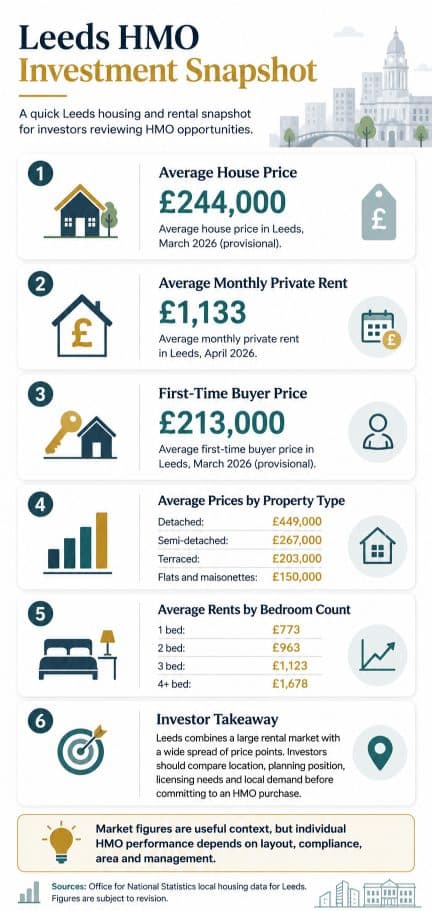
According to the Office for National Statistics, the average house price in Leeds was £244,000 in March 2026 , while the average monthly private rent was £1,133 in April 2026 . The same ONS data showed average rents varying by bedroom count, with four-or-more-bedroom properties averaging £1,678 per month .
These figures are useful market context, but they do not tell the full HMO story. HMO performance depends heavily on location, layout, compliance, tenant profile, management quality and whether the property can legally be used for the intended occupancy.
For example, two properties with similar purchase prices can produce very different outcomes if one has the right planning position, strong bedroom sizes and a compliant layout, while the other requires major works or planning permission before it can be let as an HMO.
What Counts as an HMO in Leeds?
Leeds City Council says a property is an HMO if it is rented to three or more people , the tenants do not all belong to the same family or household, and they share facilities such as a toilet, bathroom, living room or kitchen.
That means an investor should not only focus on large seven-bedroom or eight-bedroom houses. A smaller shared property may still be treated as an HMO depending on the occupancy and household structure.
The key question is not simply: “How many bedrooms does the property have?”
The better question is: “How will the property legally be occupied, licensed, managed and financed?”
HMO Licensing in Leeds
HMO licensing is separate from planning permission. A property may need one, both or neither depending on its use, location and number of occupiers.
Leeds City Council states that an HMO licence is required where:
- the property is rented to five or more people
- the tenants do not all belong to the same family or household
- the tenants share a toilet, bathroom or kitchen
For investors, this is important because the licensed occupancy can directly affect the investment calculation. If the property can only be licensed for five occupants, the return should not be calculated on six or seven rents.
You should also check the licence conditions, expiry date, room sizes, amenity requirements, fire safety expectations and management responsibilities before buying.
For a wider explanation of licensing, room sizes, planning and Article 4 rules, read our HMO licensing and Article 4 guide .
Planning Permission and Article 4 in Leeds
Planning permission is one of the most important checks when buying an HMO in Leeds.
Leeds City Council says investors will need to apply for planning permission if they are going to have:
- seven or more people living in the HMO; or
- three or more people living in the HMO and the property is located in the Article 4 Direction area
Article 4 matters because it removes certain permitted development rights. In simple terms, a property that might otherwise be converted from a normal C3 dwellinghouse into a small C4 HMO may need planning permission if it sits inside the Article 4 area.
Leeds City Council lists Article 4 areas including:
- Adel and Wharfedale
- Beeston Hill and Holbeck
- Bramley and Stanningley
- Burmantofts and Richmond Hill
- Chapel Allerton
- City and Hunslet
- Gipton and Harehills
- Headingley
- Hyde Park and Woodhouse
- Roundhay and Weetwood
This does not mean every HMO in these areas is a bad investment. In some cases, an existing lawful HMO in an Article 4 area may be attractive because new supply is harder to create. The key is proving the planning position before purchase.
Existing HMO vs HMO Conversion in Leeds
There is a major difference between buying an existing HMO and buying a standard house to convert into an HMO.
Buying an existing HMO in Leeds
When buying an existing HMO, investors should check:
- the current HMO licence
- licensed occupancy
- licence expiry date
- planning history
- lawful HMO use evidence
- whether Article 4 affects the property
- fire safety and amenity standards
- room sizes and usable floor area
- current tenancy or lease structure
- actual income against legal occupancy
- management records and maintenance history
Buying a property to convert into an HMO
When buying a property to convert, the risk is usually higher because the investor may be relying on future planning approval, future works, future licensing and future tenant demand.
Before buying, check:
- whether the property is in a Leeds Article 4 area
- whether the council is likely to support HMO use in that location
- whether the layout can meet HMO standards
- whether the rooms are large enough
- whether fire safety works are practical
- whether there is enough kitchen and bathroom provision
- whether refuse storage and parking will cause issues
- whether the lender will finance the intended use
- whether the net return justifies the added risk
Buying an HMO in Leeds: Investor Checklist
Because HMOs involve planning, licensing, finance and management considerations, due diligence should happen before an offer becomes legally binding.
Planning checks
- Is the property currently C3, C4 or sui generis?
- Is it inside a Leeds Article 4 area?
- Does the existing use have lawful HMO status?
- Are there previous planning applications, refusals or enforcement notices?
- Would the intended number of occupants require planning permission?
Licensing checks
- Does the property need a mandatory HMO licence?
- What is the licensed occupancy?
- Are there licence conditions?
- When does the licence expire?
- Would any works be needed before a licence is granted or renewed?
Property checks
- Are bedroom sizes compliant?
- Is the kitchen provision suitable?
- Are there enough bathrooms and toilets?
- Are fire doors, alarms and escape routes adequate?
- Is the property realistically manageable as an HMO?
- What refurbishment budget is needed?
Investment checks
- What is the gross yield?
- What is the realistic net yield?
- Are management, maintenance and compliance costs included?
- Will the property pass lender stress testing?
- Is the investment being bought personally or through a limited company?
- What is the exit strategy?
HMO Mortgages in Leeds
Financing an HMO is usually more specialist than financing a standard buy-to-let property.
Lenders may look at:
- whether the property is already operating as an HMO
- whether the borrower has landlord experience
- the number of bedrooms and tenants
- whether the property is licensed
- whether the property is let on individual tenancies or one lease
- the rental stress test
- the borrower’s personal or limited company structure
Investors should speak to a broker or finance adviser before assuming a normal buy-to-let mortgage will be suitable.
You can read our wider guide here: HMO mortgage guide for UK and overseas investors .
HMO Investment Returns in Leeds
HMO returns can look attractive because the property is let by room, but headline income is only one part of the calculation.
A proper HMO investment appraisal should include:
- purchase price
- stamp duty
- legal fees
- broker and mortgage costs
- refurbishment budget
- furniture and compliance costs
- licensing fees
- planning costs if required
- management fees
- maintenance allowance
- void allowance
- utilities and council tax where applicable
The strongest HMO investments are not always the ones with the highest advertised yield. A lower-risk HMO with clear planning, strong compliance and stable demand may be more attractive than a higher-yielding property with unresolved licensing or planning issues.
Social Housing and Provider-Backed HMOs in Leeds
Some investors look at provider-backed HMO models, where a property is leased to an operator, supported accommodation provider or housing organisation.
This can be attractive for hands-off investors, but it does not remove the need for due diligence.
Investors should still check:
- whether the property is legally an HMO
- whether the correct HMO licence is in place
- who is responsible for compliance
- who pays for repairs and upgrades
- how rent is paid
- what happens if the licence is refused or varied
- what happens at the end of the lease
For more on this model, see our HMO social housing investments guide.
Best Areas for HMO Investments in Leeds
There is no single “best” area for every HMO investor. The right location depends on budget, tenant profile, planning position, licence status, room layout and exit strategy.
Instead of choosing an area based only on popularity, investors should compare:
- local tenant demand
- nearby transport links
- access to employment and education destinations
- existing HMO concentration
- Article 4 status
- local comparable rents
- purchase price per square metre
- refurbishment requirements
- resale demand
In Leeds, the Article 4 position is especially important because several well-known residential areas are affected. A property in an Article 4 area may still be suitable, but the planning evidence needs to be checked carefully.
Common Mistakes When Buying an HMO in Leeds
Assuming an HMO licence means planning is correct
Licensing and planning are separate. A property can have licensing paperwork but still need planning checks.
Assuming Article 4 bans all HMOs
Article 4 does not automatically ban HMOs. It means planning permission may be required for changes of use that would otherwise have been permitted development.
Calculating yield on too many rooms
If the property is only suitable or licensed for five occupants, the investment calculation should not be based on six or seven rents.
Ignoring refurbishment and compliance costs
Fire safety, amenity improvements, furniture, decoration, licensing works and management systems can materially affect net returns.
Buying before checking lender appetite
Some lenders have strict rules around HMO size, licensing, borrower experience and tenancy structure. Finance should be checked early.
Should You Buy an HMO in Leeds?
Leeds can be a strong market for the right HMO investment, but the best opportunities are usually those where the legal, planning and licensing position is clear from the start.
A good HMO investment in Leeds should have:
- clear planning status
- the correct licence or licensing pathway
- strong room sizes and layout
- realistic refurbishment costs
- credible local rental demand
- finance that matches the intended use
- a clear management plan
- a sensible resale or exit strategy
For investors, the key is not simply finding an HMO for sale in Leeds. The key is finding an HMO investment that is legally sound, financially realistic and suitable for long-term ownership.
Frequently Asked Questions
Is Leeds a good place to invest in HMOs?
Leeds can be attractive for HMO investors because it has a large rental market and a range of property price points. However, each opportunity needs careful checks around planning permission, Article 4, licensing, layout, finance and local demand.
Do HMOs in Leeds need planning permission?
Planning permission may be required in Leeds if the property will have seven or more occupants, or if it will have three or more occupants and sits inside the Leeds Article 4 Direction area.
Does Leeds have an Article 4 Direction for HMOs?
Yes. Leeds City Council has an Article 4 Direction covering a number of areas. Investors should check whether a property is inside the affected area before buying or converting a property into an HMO.
When does an HMO in Leeds need a licence?
Leeds City Council says an HMO licence is required where a property is rented to five or more people, the tenants are not all from the same family or household, and they share a toilet, bathroom or kitchen.
Can I convert a normal house into an HMO in Leeds?
Possibly, but you need to check the planning position first. If the property is in the Leeds Article 4 area, planning permission may be required for three or more occupants. Larger HMOs with seven or more occupants usually require planning permission.
Are existing HMOs in Leeds better than conversions?
Existing lawful HMOs can be lower risk because the planning and licensing position may already be established. However, investors still need to verify lawful use, licence status, occupancy, room sizes, compliance and income.
Can overseas investors buy HMOs in Leeds?
Yes, overseas investors can buy HMOs in Leeds, but finance, tax, management and compliance should be arranged carefully. Lenders may apply stricter criteria for overseas buyers and for HMO properties.
What should I check before buying an HMO in Leeds?
Key checks include Article 4 status, planning history, HMO licence status, room sizes, fire safety, amenity provision, refurbishment costs, rental demand, finance options, management arrangements and exit value.