

London is one of the UK’s most recognised property markets, but HMO investments in London need careful borough-by-borough due diligence.
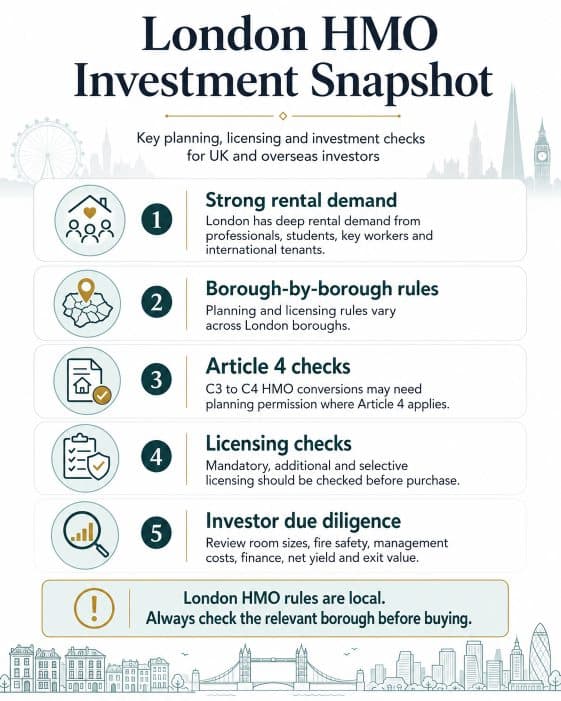
For UK and overseas investors, London HMOs can be attractive because the city has deep rental demand from professionals, students, key workers, international tenants and people priced out of self-contained accommodation. However, London is also one of the most regulated HMO markets in the country.
The key issue is that London should not be treated as one single HMO market. Planning rules, Article 4 directions, licensing schemes, local amenity standards, fees and enforcement approaches can vary from one borough to another.
That means an HMO investment that works in one part of London may not work in another. Before buying, investors need to understand the property’s planning position, licensing requirements, legal occupancy, compliance cost and realistic net yield.
Why London HMO Investments Are Different
London is different from many other UK HMO markets because it is made up of multiple local authority areas, each with its own local planning and licensing approach.
For investors, this creates both opportunity and risk.
London has strong rental demand, but it also has high property prices, tighter affordability calculations, more complex planning checks and a patchwork of local licensing rules. A successful London HMO investment usually depends on buying the right property, in the right borough, with the correct planning and licensing position already understood.
Important London HMO checks include:
- Which London borough the property sits in
- Whether Article 4 applies to C3 to C4 HMO conversions
- Whether the property is already in lawful HMO use
- Whether mandatory, additional or selective licensing applies
- Whether the property meets local room size and amenity standards
- Whether the expected rent supports the purchase price and finance costs
- Whether the property remains mortgageable and saleable as an HMO
What Counts as an HMO in London?
An HMO, or House in Multiple Occupation, is generally a property occupied by people from more than one household who share facilities such as a kitchen, bathroom or toilet.
In practical investment terms, this often includes shared houses let by the room to unrelated tenants.
Common London HMO tenant groups may include:
- Young professionals
- Key workers
- Hospital and healthcare staff
- Hospitality and retail workers
- International tenants
- Supported accommodation residents
- Provider-backed or social housing occupants
For official guidance, GOV.UK explains that a large HMO generally needs a licence where it is rented to five or more people from more than one household who share facilities. Smaller HMOs can also need licensing where a local council has introduced an additional licensing scheme.
HMO Licensing in London
HMO licensing is one of the most important checks for London investors.
There are three main licensing areas to understand:
Mandatory HMO licensing
Mandatory licensing generally applies to larger HMOs. In England, this usually means a property occupied by five or more people from more than one household who share facilities.
For London investors, this is the first licensing check. If a property meets the mandatory licensing threshold, it will normally need an HMO licence regardless of which London borough it is in.
Additional HMO licensing
Additional licensing can bring smaller HMOs into the licensing regime. This often affects shared properties occupied by three or four people from more than one household.
This is especially important in London because additional licensing schemes vary by borough. One borough may require smaller HMOs to be licensed, while a neighbouring borough may have different rules or scheme boundaries.
Selective licensing
Selective licensing can apply to privately rented properties in designated areas, not just HMOs. This means a property may need a licence even if it is not a larger HMO.
The Mayor of London provides a property licence checker to help landlords and investors check whether mandatory, additional or selective licensing may apply in a London borough.
Check London property licensing requirements
Article 4 and London HMO Planning Permission
Article 4 is a planning control that can remove permitted development rights in a defined area.
For HMO investors, Article 4 is important because it can mean that converting a normal C3 dwellinghouse into a small C4 HMO requires planning permission.
In simple terms:
- A standard dwellinghouse is usually C3 use
- A small HMO occupied by three to six unrelated people is usually C4 use
- A larger HMO with more than six residents is usually treated as sui generis
The Planning Portal explains that C4 HMOs are limited to no more than six residents, with larger HMOs falling outside the standard use class and becoming sui generis.
Read the Planning Portal use classes guide
Article 4 does not automatically ban HMOs. It means planning permission is required, and the local planning authority will assess the application under its own local policies.
Why Article 4 Matters in London
Article 4 can have a major effect on London HMO investment strategy.
If a property is already a lawful HMO, Article 4 may protect its scarcity value because new HMO supply can be harder to create in the same area.
However, if an investor buys a normal C3 house intending to convert it into an HMO, Article 4 can create planning risk, delay and uncertainty.
Before buying a potential London HMO conversion, investors should check:
- Whether the property is inside an Article 4 area
- Whether the existing use is C3, C4 or sui generis
- Whether planning permission is already in place
- Whether there is evidence of lawful HMO use
- Whether previous planning applications have been refused
- Whether local policy restricts HMO concentration
Existing London HMO vs HMO Conversion
There is a big difference between buying an existing HMO in London and buying a standard house to convert into an HMO.
Buying an existing London HMO
An existing HMO can be attractive because the planning and licensing position may already be established. However, investors still need to verify the details.
Key checks include:
- Current HMO licence
- Licence expiry date
- Licensed occupancy
- Planning history
- Lawful use evidence
- Room sizes
- Fire safety compliance
- Kitchen and bathroom provision
- Current tenancy or lease structure
- Whether income assumptions match legal occupancy
Buying a London property to convert into an HMO
A conversion can sometimes offer stronger value creation, but it usually carries more risk.
Before buying a conversion opportunity, investors should check:
- Whether Article 4 applies
- Whether planning permission is required
- Whether the floor plan works as an HMO
- Whether bedrooms meet minimum size requirements
- Whether fire safety upgrades are needed
- Whether additional bathrooms or kitchen space are required
- Whether the property will meet local amenity standards
- Whether the finance route allows for conversion works
- Whether the expected rent justifies the refurbishment cost
London HMO Room Sizes and Property Standards
Room sizes are a key part of HMO compliance.
For licensed HMOs in England, the national minimum sleeping room sizes are generally:
| Occupancy | Minimum sleeping room size |
|---|---|
| One person over 10 years old | 6.51m² |
| Two people over 10 years old | 10.22m² |
| One child under 10 years old | 4.64m² |
These are national minimums. Local councils can apply higher standards or additional amenity requirements through their own licensing policies.
London investors should therefore measure rooms carefully and check the relevant borough’s current HMO standards before relying on an advertised bedroom count.
London HMO Finance and Mortgage Considerations
London HMO finance can be more complex than standard buy-to-let finance.
Lenders may look closely at:
- The property’s planning status
- Whether the HMO licence is in place
- The number of lettable rooms
- Whether the property is already tenanted
- The borrower’s landlord experience
- Rental stress testing
- Refurbishment requirements
- Whether the property is being bought personally or through a limited company
- Whether the valuation supports the purchase price
London’s higher property values mean investors should be especially careful with net yield calculations. A property may produce strong rent, but the purchase price, finance cost, management cost and compliance cost can reduce the real return.
Read Our HMO Mortgage Guide
What Makes a Good London HMO Investment?
A good London HMO investment is not simply the property with the highest advertised rent.
The strongest opportunities are usually supported by:
- Clear planning status
- Correct licensing route
- Strong local tenant demand
- Good transport links
- Suitable room sizes
- Efficient layout
- Manageable refurbishment costs
- Realistic operating expenses
- Lender-friendly structure
- Strong exit demand
London HMOs can work particularly well where the property serves a clear tenant profile, such as professionals near transport links, students near universities, or key workers close to hospitals and employment hubs.
However, the numbers should always be assessed on a net basis, not just a headline gross yield.
London HMO Due Diligence Checklist
Before buying an HMO in London, investors should complete a full due diligence process.
1. Confirm the borough
- Which London borough is the property in?
- Does the borough have specific HMO policies?
- Are licensing schemes active in that location?
2. Check Article 4
- Does Article 4 apply to C3 to C4 conversions?
- Is planning permission needed?
- Is there evidence of existing lawful HMO use?
3. Check planning status
- Is the property C3, C4 or sui generis?
- Has planning permission already been granted?
- Are there any enforcement issues or previous refusals?
4. Check licensing
- Does mandatory HMO licensing apply?
- Does additional licensing apply?
- Does selective licensing apply?
- What is the licensed occupancy?
5. Check property standards
- Measure all bedrooms
- Review fire safety requirements
- Check bathroom and kitchen provision
- Check waste storage
- Review EPC and building condition
6. Check investment numbers
- Calculate gross and net yield
- Allow for finance costs
- Allow for management and maintenance
- Include licensing and compliance costs
- Review valuation and resale options
London HMOs and Provider-Backed Housing
Some investors consider London HMOs for provider-backed accommodation, supported housing or social housing-style lease arrangements.
These structures can be attractive because they may offer a more hands-off income model, but they do not remove the need for planning and licensing checks.
Investors should understand:
- Whether the property is legally classed as an HMO
- Whether an HMO licence is required
- Who is responsible for compliance
- Who pays for required upgrades
- What happens if a licence is refused or varied
- Whether the lease structure is lender-friendly
- How the property could be sold in the future
View HMO Social Housing Investments
Common London HMO Investment Mistakes
Assuming London rules are the same everywhere
London is not one single licensing or planning area. The relevant borough must be checked.
Ignoring Article 4
Article 4 can affect whether a standard house can be converted into a small HMO without planning permission.
Confusing licensing with planning
An HMO licence does not automatically prove the planning use is correct. Planning and licensing are separate systems.
Relying on advertised room numbers
A property may be advertised with a certain number of rooms, but only compliant and licensable rooms should be used in the investment calculation.
Focusing only on gross yield
London operating costs, finance costs and compliance costs can materially affect net return.
Not checking exit value
A properly licensed and lawful HMO may have stronger resale appeal than a property with unclear compliance.
Should You Invest in London HMOs?
London HMOs can be attractive for investors who want exposure to a deep rental market and are prepared to complete proper due diligence.
The opportunity is strongest where the property has:
- Clear lawful use
- Correct licensing
- Strong tenant demand
- Good transport access
- Realistic finance
- Clear management arrangements
- A sensible exit strategy
For overseas investors, the biggest advantage is often having an experienced UK-based team who can assess the property, borough rules, licensing position, finance route and management structure before purchase.
Final Thoughts: London HMOs Need Local Due Diligence
London can be a strong HMO investment market, but it is also highly localised and heavily regulated.
The most important point is simple: do not assess a London HMO on rent alone.
Investors should check the borough, Article 4 position, licensing requirements, planning status, property standards, finance options and true net return before committing.
At Quartico, we help UK and overseas investors review HMO opportunities with both return and risk in mind.
Frequently Asked Questions
Is London a good place to invest in HMOs?
London can be a strong HMO market because of its deep rental demand, but property prices, licensing rules, Article 4 restrictions and borough-level policies must be checked carefully before buying.
Do London HMOs need a licence?
Many London HMOs need a licence. Mandatory licensing generally applies to larger HMOs, and some London boroughs also operate additional or selective licensing schemes.
Are HMO rules the same across London?
No. London HMO rules vary by borough. Investors should check the relevant local authority before buying or converting a property.
What is Article 4 for London HMOs?
Article 4 is a planning control that can remove permitted development rights. In some areas, it means planning permission is required before changing a C3 house into a C4 HMO.
Can I convert a London house into an HMO?
Possibly, but it depends on the borough, Article 4 position, planning policy, property layout, licensing requirements and local HMO standards.
What is the difference between C3 and C4 use?
C3 usually refers to a standard dwellinghouse. C4 usually refers to a small HMO occupied by three to six unrelated people sharing facilities.
Do large London HMOs need planning permission?
Large HMOs with more than six residents are usually treated as sui generis and normally require planning permission.
What should investors check before buying a London HMO?
Investors should check borough rules, Article 4, planning history, HMO licensing, room sizes, fire safety, amenity standards, finance, net yield and resale value.
Are London HMO mortgages different from standard buy-to-let mortgages?
Yes. HMO mortgages are usually more specialist than standard buy-to-let mortgages. Lenders may assess licensing, planning status, room count, landlord experience, rental stress tests and valuation risk.
Can overseas investors buy London HMOs?
Yes, overseas investors can buy London HMOs, but they should take professional advice on finance, tax, legal structure, planning, licensing and property management before committing.