
Renters’ Rights Act 2025: Landlord Guide to the New Rules
The Renters’ Rights Act 2025 is one of the biggest changes to the private rented sector in England for a generation. For landlords, the reforms affect far more than eviction rules. They change how tenancies are structured, how rent increases are handled, how rental properties are advertised, how pet requests are considered, and how investors should think about compliance, cashflow and possession risk.
Many landlords, tenants and investors still search for the Renters Rights Bill , but the legislation has now become the Renters’ Rights Act 2025 . The main tenancy reforms came into effect on 1 May 2026 .
This guide explains what has changed, what landlords need to do now, and how the reforms may affect buy-to-let, HMO and property investment decisions in England.
Important: This article is general guidance for landlords and property investors. It is not legal, tax or financial advice. Landlords should check the latest government guidance and take professional advice before acting on possession, rent increases, tenancy documents or investment decisions.
Official sources used in this guide
This article is based on current official guidance from GOV.UK and should be read alongside the latest government publications:
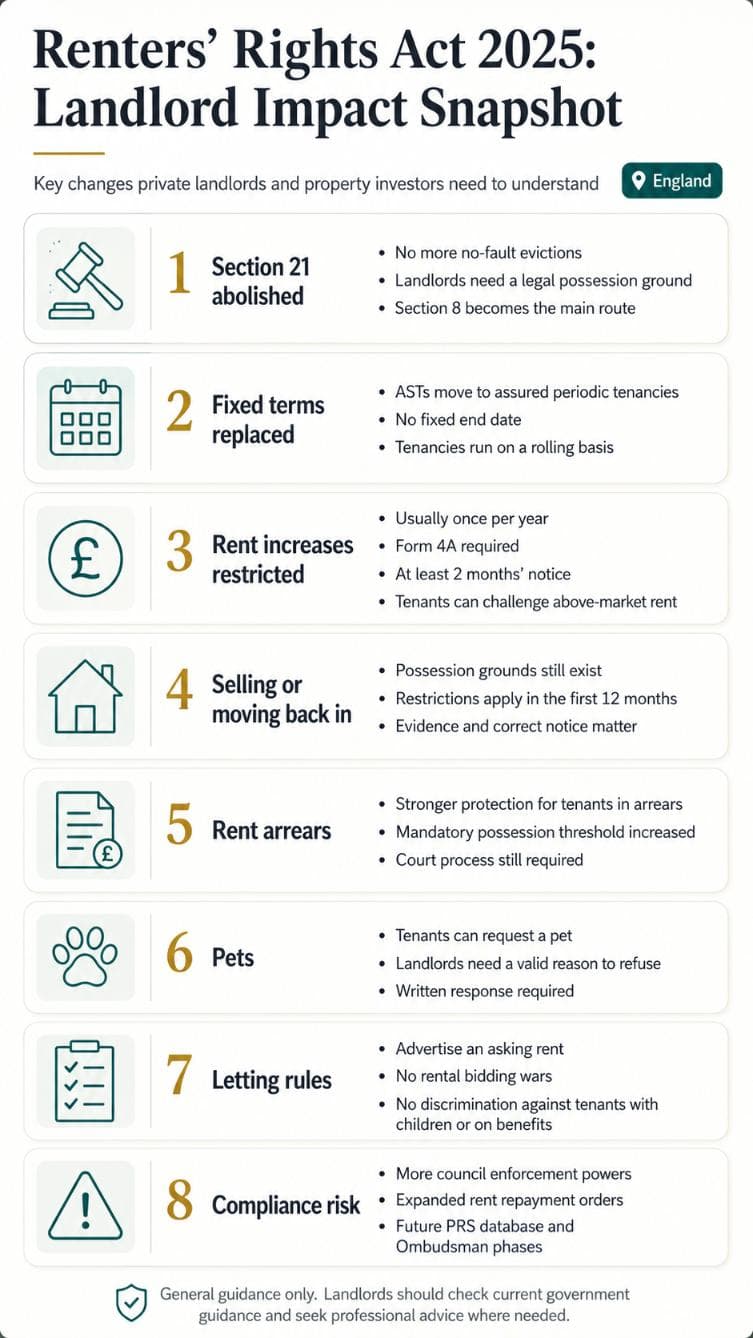
Quick summary: what changed for landlords?
The Renters’ Rights Act changes the private rented sector in several important ways. The headline reform is the abolition of Section 21 no-fault evictions, but the Act also changes tenancy structure, rent increases, rent in advance, pet requests, advertising rules and enforcement. GOV.UK’s guide to the Renters’ Rights Act gives the official overview of the reforms.
What changed?
Why it matters for landlords
No-fault eviction notices can no longer be used.
Landlords need a valid legal possession ground and evidence.
Tenancy structure
ASTs have been replaced by assured periodic tenancies.
Fixed end dates no longer work in the same way.
Rent increases
Rent increases generally use the revised Section 13 process.
Landlords need correct notices, timing and market evidence.
Tenants can request a pet and landlords need a fair reason to refuse.
Blanket “no pets” policies are much harder to rely on.
Rental bidding
Landlords and agents must not ask for, encourage or accept bids above the advertised rent.
Advertised rents and letting processes need to be controlled carefully.
Rent in advance
Large rent-in-advance requests are restricted.
Landlords need to review referencing, affordability and deposit processes.
Renters’ Rights Act 2025: landlord impact snapshot.
Is it the Renters Rights Bill or the Renters’ Rights Act?
Strictly speaking, it is now the Renters’ Rights Act 2025 . It was previously known as the Renters Rights Bill while it was passing through Parliament.
For SEO and reader clarity, both terms are useful. Many landlords still search for “renters rights bill”, “renters rights bill when does it start”, “renters rights bill pets” and “renters rights bill landlords”. However, the article should make clear that the law is now the Act, not just a proposed Bill.
Who does the Renters’ Rights Act apply to?
The main tenancy reforms discussed in this guide apply to England . Housing law is devolved, so landlords with properties in Wales, Scotland or Northern Ireland need to follow the rules that apply in those nations.
For landlords in England, the reforms are highly relevant to buy-to-let properties, professional lets, family lets, many HMO arrangements and student rental property. However, some specialist accommodation types and social housing arrangements can have different rules, so landlords should check the position for their exact tenancy type.
When did the Renters’ Rights Act start?
The main private rented sector tenancy reforms came into effect on 1 May 2026 . The government’s Renters’ Rights Act implementation roadmap confirms that the first phase introduced the new tenancy regime for both new and existing private tenancies.
From that date, landlords could no longer create assured shorthold tenancies, and existing assured shorthold tenancies automatically became assured periodic tenancies. This matters because many older tenancy agreements still contain wording about fixed terms, end dates and Section 21 notices. The agreement may still be useful as a written record of the tenancy terms, but landlords cannot assume every old clause still works in the same way after the reforms.
Section 21 has been abolished
The most widely reported change is the abolition of Section 21 no-fault evictions . GOV.UK’s guide to the Renters’ Rights Act explains that the Act abolishes Section 21 evictions and moves to a simpler tenancy structure where assured tenancies are periodic.
This does not mean landlords can never regain possession. It means landlords need a valid legal reason, known as a ground for possession , and they must follow the correct notice and court process where required.
For landlords and investors, the practical impact is significant. Possession strategy now needs to be based on evidence, documentation and correct process. A landlord who wants to sell, move back in, deal with arrears, respond to antisocial behaviour or address a serious tenancy breach must identify the correct possession ground and use the correct notice route.
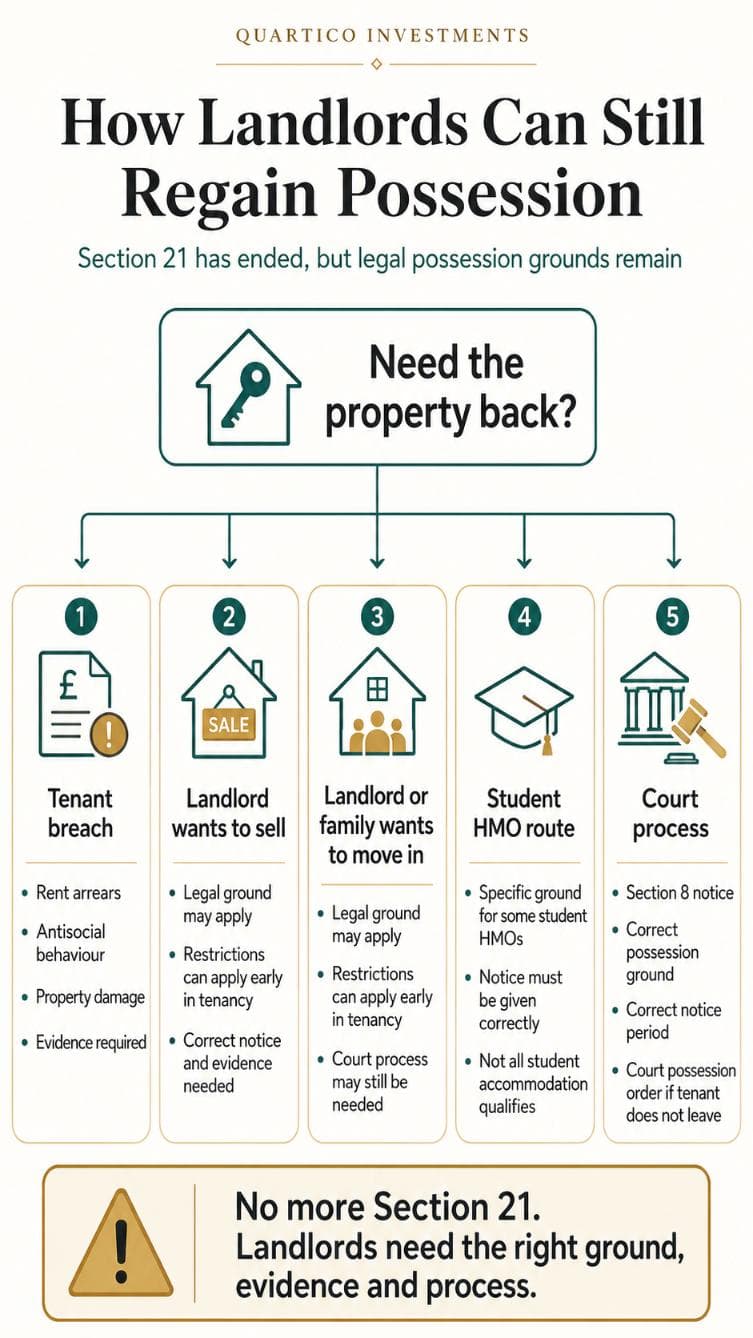
Section 8 becomes the main possession route
Under the new system, landlords usually need to use the Section 8 process if they want to end an assured periodic tenancy. GOV.UK’s ending a tenancy guidance for landlords explains that landlords must have a valid reason, give notice in the correct way and use the relevant possession ground.
Examples of possession grounds include situations where:
- the landlord wants to sell the property;
- the landlord or a close family member wants to live in the property;
- the tenant owes rent;
- the tenant has breached the tenancy agreement;
- the tenant has damaged the property;
- there has been antisocial behaviour;
- specific student HMO conditions apply.
The key difference is that landlords now need to be able to show why the ground applies. Good record keeping becomes much more important.
Section 21 has ended, but landlords can still regain possession where a valid legal ground applies.
Selling or moving back into the property
Landlords still have routes to regain possession if they genuinely need to sell the property or move themselves or close family into it. However, these routes are no longer as simple as serving a no-fault notice. The official GOV.UK possession guidance sets out the need for a valid ground, the correct notice and the correct process.
Investors should treat this as a risk and planning issue. If an exit strategy depends on selling quickly with vacant possession, the new rules could affect timing. The landlord may need to give the correct notice, rely on the correct ground and, if the tenant does not leave, go through the court process.
For buy-to-let investors, this should feed into cashflow planning, mortgage strategy, portfolio restructuring and the decision about whether a property is suitable as a long-term rental.
Rent arrears and problem tenants
The Renters’ Rights Act does not remove landlords’ ability to act where tenants are in arrears or have breached the tenancy agreement. However, landlords need to follow the correct process and gather evidence.
For arrears, this means keeping clear records of:
- rent paid;
- missed payments;
- communications with the tenant;
- payment plans offered or agreed;
- any relevant affordability or benefit payment information.
Where antisocial behaviour, damage or serious breach is alleged, landlords should keep dated evidence, photographs, inspection notes, complaints, police or council references where relevant, and copies of all tenant correspondence.
The practical message is simple: landlords can still act, but informal or poorly documented management will create more risk.
Assured shorthold tenancies have been replaced
Another major change is the end of the traditional assured shorthold tenancy model. GOV.UK’s assured periodic tenancies guidance for landlords states that landlords cannot create an assured shorthold tenancy and that all assured shorthold tenancies automatically became assured periodic tenancies on 1 May 2026.
This means private rented tenancies now generally run on a rolling basis rather than having a fixed end date. A tenancy agreement cannot simply state that the tenant must leave at the end of a fixed term.
For landlords, this changes how tenancy agreements should be drafted and explained. A written agreement may still set out key terms such as rent, payment date, repair obligations and house rules, but it should not rely on old fixed-term AST assumptions.
What happens to old tenancy agreements?
Landlords do not necessarily need to rewrite every historic tenancy agreement immediately. However, they do need to understand which parts of the agreement remain useful and which parts may no longer operate as originally intended.
Old clauses referring to fixed terms, Section 21, automatic end dates or rent review mechanisms may need careful review. The agreement may still record the rent, property, parties, deposit and other terms, but the tenancy itself now operates under the new legal framework.
Landlords should also check whether they were required to provide the official Renters’ Rights Act Information Sheet or written information to tenants, depending on the type and timing of the tenancy.
Written tenancy information and the Information Sheet
For tenancies created after 1 May 2026, landlords need to give tenants certain written information about the key terms of the tenancy before signing or agreeing the tenancy. GOV.UK’s written information guidance for landlords explains what must be provided and when.
For older tenancies, the position depends on whether there was already a written record of the tenancy terms. Where a tenancy was created before 1 May 2026 and there was already a written tenancy agreement, landlords were generally required to provide the Renters’ Rights Act Information Sheet 2026 by 31 May 2026. Where there was only a verbal agreement, landlords needed to give written information about the key tenancy terms.
This is an important compliance point. It is not just paperwork. Failing to provide required documents can expose landlords or agents to enforcement action and may create problems if possession or dispute issues arise later.
Rent increases under the Renters’ Rights Act
Rent increases are another major area of change. Landlords can no longer rely on informal pressure or old fixed-term renewal negotiations in the same way.
Under the reformed system, rent increases in the private rented sector are generally limited to once per year and must follow the revised Section 13 process. GOV.UK’s rent increase guidance for assured periodic tenancies says landlords need to use Form 4A and give the completed form to the tenant at least two months before the proposed rent increase starts.
For landlords, this means rent reviews should be planned properly. Before increasing rent, keep evidence of market comparables, local demand, property condition, size, location and any improvements. This evidence may matter if the tenant challenges the increase.
For investors, the key point is that rent growth assumptions should be realistic. A spreadsheet that assumes aggressive annual rent rises may no longer be sensible if those increases cannot be justified by the local market.
No more rental bidding wars
The Act also changes how rental properties are advertised. GOV.UK’s rental bidding guidance says landlords and letting agents cannot ask for, encourage or accept an offer higher than the advertised rent.
This is designed to stop rental bidding wars, where tenants feel pressured to offer more than the asking rent to secure a property.
Landlords should review their advertising process carefully. Property listings, email responses, viewing scripts and agent instructions should all be consistent. Avoid wording that suggests applicants can improve their chances by offering more than the advertised rent.
Rent in advance: what landlords need to know
The rules around rent in advance have also changed. GOV.UK’s rent in advance and deposits guidance says landlords and agents must not accept, ask for or encourage tenants to pay rent before the tenancy agreement has been signed. During the pre-tenancy period, after the agreement is signed and before the tenancy starts, the amount landlords can usually ask for is limited.
This matters particularly where tenants are self-employed, overseas applicants, students, retirees, or applicants with limited UK credit history. Historically, some landlords used several months of rent in advance to manage perceived risk. Under the new framework, landlords need to think more carefully about referencing, guarantors, affordability checks and risk management.
Good tenant selection remains important, but landlords should make sure their process is compliant and does not indirectly discriminate against protected or restricted groups.
Pets in rented property
Tenants now have a clearer right to request permission to keep a pet. GOV.UK’s pet request guidance for landlords says tenants need to ask in writing, landlords cannot refuse without a fair reason, and landlords normally have 28 days to respond in writing.
That does not mean every pet request must be accepted. A refusal may still be reasonable in some situations, for example where the property is unsuitable, the lease prohibits pets, there are building restrictions, or there are legitimate safety, welfare, allergy, insurance or management concerns.
Landlords should handle pet requests in writing. A sensible process would include:
- asking the tenant to make the request in writing;
- asking for details of the pet;
- checking the lease, freeholder rules and insurance conditions;
- considering property suitability;
- responding within the required timeframe;
- giving clear reasons if refusing.
For landlords of flats, leasehold properties and HMOs, pet requests may need extra care because shared areas, freeholder rules, block management policies and other occupiers may be relevant.
Discrimination against tenants with children or benefits
The Act also strengthens rules around discrimination in the rental market. The GOV.UK guide to the Renters’ Rights Act explains that the reforms make it illegal for landlords and agents to discriminate against prospective tenants because they receive benefits or have children.
This means landlords should review their adverts, enquiry responses and agent instructions. Phrases such as “no DSS”, “professionals only” or “not suitable for children” can create compliance risk if they are used as blanket exclusions.
Landlords can still carry out affordability checks, referencing and suitability assessments. The issue is that the decision should be based on legitimate property and affordability factors, not a blanket policy against certain types of tenant.
HMO landlords and student lets
HMO landlords need to pay close attention to the reforms because possession, licensing, management standards and tenant turnover can all be affected. GOV.UK’s ending a tenancy guidance includes specific information on student tenancies and ground 4A for some student HMOs.
For professional HMOs, the move to assured periodic tenancies may make tenant turnover less predictable. Landlords should review how they manage room-by-room tenancies, joint tenancies, deposits, house rules, notice periods and replacement tenants.
For student landlords, there are specific possession grounds that may help some landlords regain possession for the next academic year. However, not every student property will qualify. The details of the tenancy structure, the type of accommodation and the way the property is let can matter.
This is especially important for student HMOs, where landlords often rely on academic-year cycles. Investors should not assume that old fixed-term student letting models will continue to work automatically.
Quartico has published further HMO guidance here:
- HMO Investments Guide
- HMO Licensing and Article 4 Guide
- HMO Mortgages Guide
Enforcement risk is increasing
The Renters’ Rights Act gives local authorities stronger enforcement tools. The government’s implementation roadmap confirms expanded enforcement powers, including stronger council enforcement and changes to rent repayment orders.
Areas that may attract enforcement attention include:
- unlawful eviction or harassment;
- failing to follow possession rules;
- failing to provide required written information;
- rental bidding breaches;
- unlawful discrimination;
- poor property conditions;
- HMO licensing breaches;
- failure to comply with future database or ombudsman requirements.
For professional landlords and investors, the direction of travel is clear. The private rented sector is becoming more regulated, more process-driven and less tolerant of informal management.
Landlords should review documents, rent review processes, possession planning, adverts, pet policies and compliance records.
Future phases: PRS database, Ombudsman and property standards
Not every part of the Renters’ Rights Act arrived at once. The first phase introduced the core tenancy reforms, but further phases are expected to bring additional requirements.
The government’s implementation roadmap says the second phase, from late 2026, will introduce a Private Rented Sector Database and establish a Landlord Ombudsman for the private rented sector.
Further reforms are also expected around property standards, including the Decent Homes Standard and the extension of Awaab’s Law to the private rented sector. Landlords should treat this as part of a broader regulatory direction rather than a one-off legal change.
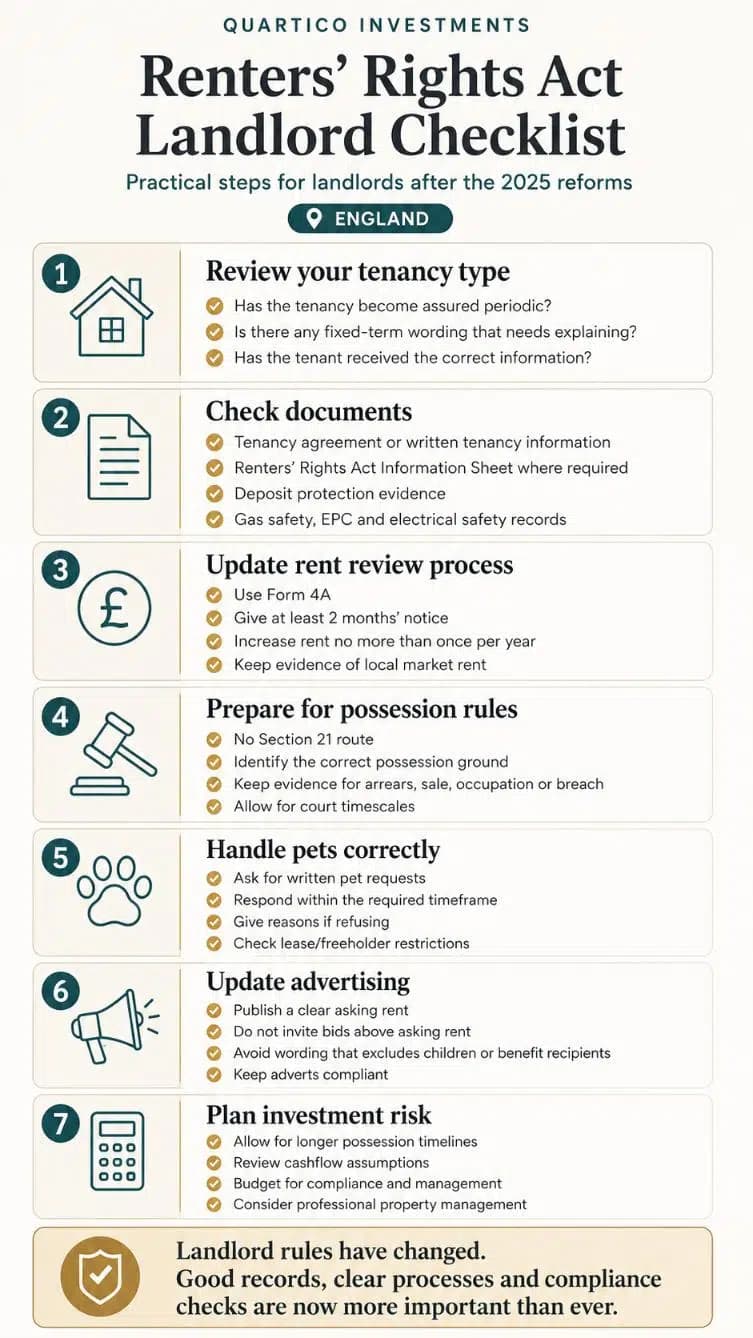
What landlords should do now
Landlords should not treat the Renters’ Rights Act as just an eviction reform. It affects the full letting process from advertising and tenancy setup through to rent reviews, management, pets, disputes and exit strategy.
A practical landlord checklist includes:
- reviewing tenancy agreements and written tenancy information;
- checking whether tenants received the correct Information Sheet where required;
- updating rent increase procedures;
- removing old Section 21 assumptions from internal processes;
- reviewing possession grounds and evidence requirements;
- checking advertising wording and rental bidding procedures;
- creating a written process for pet requests;
- checking policies around benefits and families with children;
- reviewing HMO and student letting arrangements;
- keeping better records of inspections, repairs, arrears and tenant communication;
- reviewing cashflow assumptions and exit plans.
What this means for property investors
For investors, the Act changes how rental property risk should be assessed.
Before buying a property, investors should think about:
- whether the investment works as a long-term rental;
- how quickly vacant possession might realistically be achieved if needed;
- whether the rent is sustainable and evidence-based;
- whether the property is likely to meet future standards;
- whether the local authority has active licensing or enforcement policies;
- whether HMO, student or social housing strategies are suitable for the area;
- whether management should be handled professionally.
The Act does not make property investment impossible. It does, however, reward landlords who are organised, compliant, well-capitalised and realistic about management risk.
Does the Renters’ Rights Act make HMOs less attractive?
Not necessarily. HMOs can still offer strong rental income potential, particularly in areas with sustained demand from students, professionals, key workers or supported living providers. However, the management burden is higher, and the reforms make proper compliance even more important.
Investors should look carefully at local demand, licensing, Article 4 planning controls, management requirements, room sizes, amenity standards, finance and exit strategy before buying an HMO.
In many cases, the best HMO investments will be those where the landlord can operate professionally, maintain good standards, document everything properly and avoid relying on quick or informal possession routes.
Final thoughts: landlords need better systems
The Renters’ Rights Act 2025 marks a clear shift in the private rented sector. Landlords now need stronger systems, clearer documentation and more careful decision-making.
The landlords who are most exposed are those who rely on informal agreements, weak paperwork, unrealistic rent increases, poor property standards or the assumption that they can quickly regain possession without a clear legal ground.
For serious landlords and property investors, the response should be practical rather than emotional. Review the rules, update the paperwork, improve records, assess investment risk properly and take professional advice where needed.
Quartico helps investors understand property opportunities, risk and long-term strategy in a changing rental market.
Speak to Quartico About Property Investment
Is the Renters Rights Bill now law?
Yes. The Renters Rights Bill became the Renters’ Rights Act 2025. Many people still use the phrase “Renters Rights Bill” when searching online, but the legislation is now an Act.
The main private rented sector tenancy reforms came into effect in England on 1 May 2026. See the official GOV.UK implementation roadmap for the phased rollout.
Can landlords still evict tenants?
Yes, but landlords need a valid legal possession ground. Section 21 no-fault eviction notices can no longer be used for assured or assured shorthold tenancies. GOV.UK’s ending a tenancy guidance explains the possession process.
Can landlords still sell a rented property?
Landlords can still sell a property, but if they need vacant possession they must use the correct possession ground and follow the required legal process.
Can landlords refuse pets?
Landlords must consider pet requests fairly and should provide a valid reason if refusing. A refusal may still be reasonable in some circumstances, such as lease restrictions, property suitability or insurance issues. See GOV.UK’s pet request guidance for landlords .
Can landlords increase rent?
Yes, but rent increases are generally limited to once per year and must follow the correct legal process. Tenants can challenge above-market increases. GOV.UK’s rent increase guidance explains the Section 13/Form 4A process.
Does the Renters’ Rights Act apply in Wales?
The main reforms discussed in this article apply to England. Wales has its own rental housing rules, so Welsh landlords should check the separate Welsh framework.
Are HMO landlords affected?
Yes. HMO landlords should review tenancy structures, licensing, management procedures, possession planning, student letting arrangements and compliance records.