
Why Liverpool Is One of the UK’s Strongest Property Markets in 2026

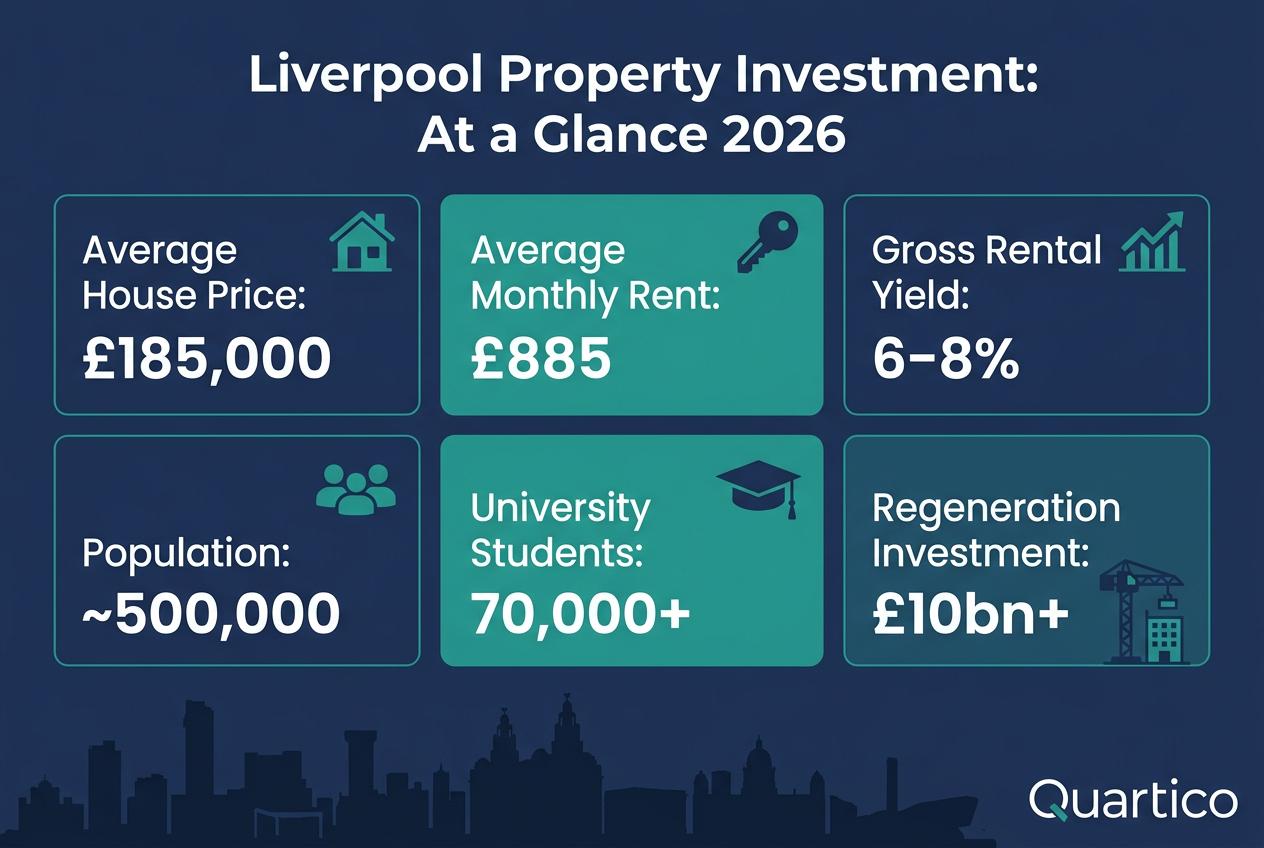
Liverpool’s property market has consistently outperformed expectations over the past decade, and heading into 2026 the fundamentals are stronger than ever. Average house prices sit around £185,000 — roughly 31% below the UK average of £270,000 — while gross rental yields of 6–8% place the city among the highest-yielding major markets in England. For investors weighing up where to deploy capital, Liverpool offers something increasingly rare: affordable entry points, rising rents, and a tenant base that spans students, young professionals, families, and specialist housing sectors.
What separates Liverpool from other regional cities is the depth of its demand drivers. This is not a market reliant on a single industry or a temporary boom cycle. The combination of three major universities, a diversifying economy anchored by life sciences, fintech and logistics, and over £10 billion in active regeneration projects creates structural demand for rental accommodation that is unlikely to soften in the medium term.
In this article, I’ll break down the specific data, trends, and local factors that make Liverpool stand out — drawing on years of experience advising investors across the Northwest, particularly in Liverpool and Manchester. If you’re comparing cities or trying to decide where your next investment should be, this should give you the picture you need. For a full overview of our Liverpool opportunities, visit our property investment Liverpool page.
Liverpool Property Market Performance: The Numbers
The most recent ONS data (January 2026) shows Liverpool’s average monthly private rent has reached £885, a 7.0% annual increase from £827 in January 2025. This outpaces the wider North West average increase of 6.0% over the same period. Meanwhile, average house prices hit £185,000 in December 2025, representing a 9.5% year-on-year rise — again ahead of the regional trend.
What makes these numbers particularly relevant for investors is the ratio between purchase price and rental income. A one-bedroom apartment in L1 (city centre) with an average price of around £207,000 and monthly rent of £1,130 delivers a gross yield of approximately 6.6%. Move to L4 (Anfield/Walton) where prices average £117,000 and yields push above 7.8%. This variation across postcodes is one of Liverpool’s key strengths — there are entry points for different budget levels and risk appetites.
Liverpool vs Other UK Cities: Price and Yield Comparison
| City | Avg Price (2025) | Avg Rent (PCM) | Gross Yield | 5-Year Price Growth |
|---|---|---|---|---|
| Liverpool | £185,000 | £885 | 6–8% | ~40% |
| Manchester | £249,000 | £950 | 4.5–5.5% | ~35% |
| Birmingham | £230,000 | £900 | 4.5–5.5% | ~30% |
| Sheffield | £195,000 | £780 | 5–6.5% | ~32% |
| Leeds | £240,000 | £870 | 4–5% | ~28% |
| London | £525,000+ | £2,190 | 3–4% | ~15% |
| UK Average | £270,000 | £1,367 | ~5% | ~22% |
Sources: ONS House Price Index (Dec 2025), ONS Private Rent Index (Jan 2026), Zoopla Rental Market Report. Yields are gross estimates based on average price/rent ratios.
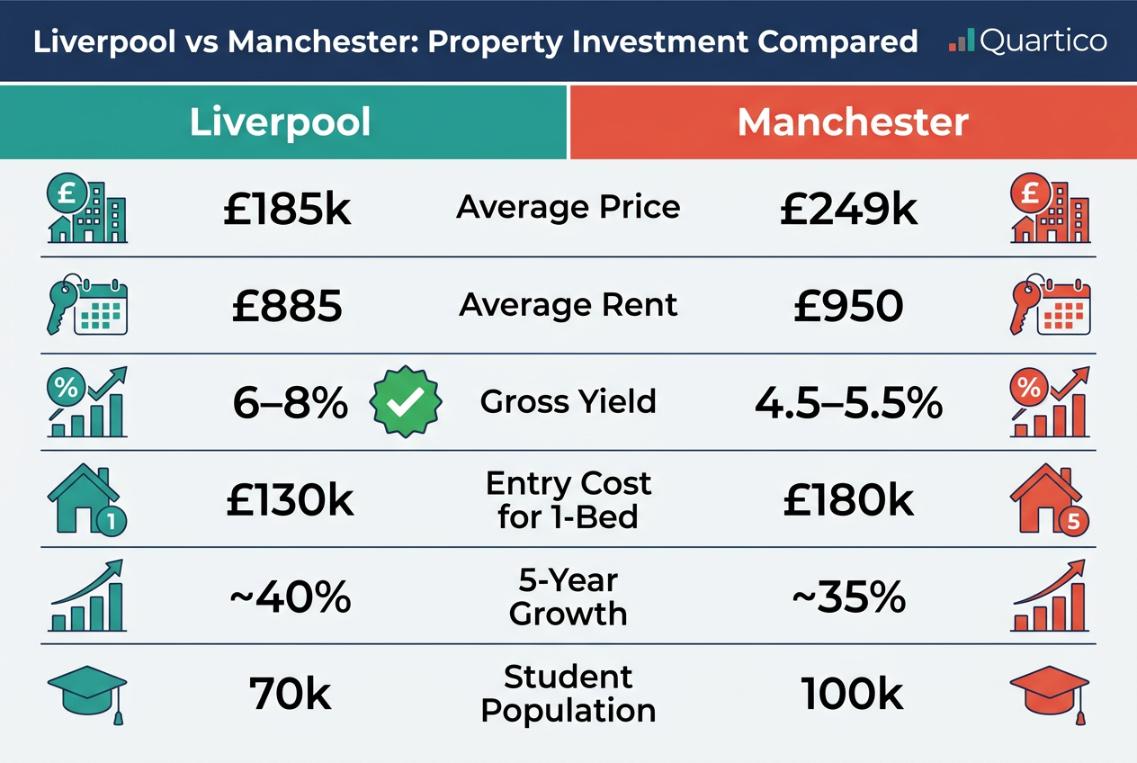
The table illustrates a point I make frequently to clients: it’s not the rent that varies dramatically between Liverpool and Manchester — Liverpool achieves around £885 per month versus Manchester’s £950. The difference is the cost of buying. With Manchester properties averaging £64,000 more, the yield compression is significant. For investors focused on income rather than capital speculation, Liverpool’s maths consistently works harder.
Liverpool Postcode Yield Map: Where the Returns Are
One of the most common mistakes I see from first-time Liverpool investors is treating the city as a single market. In reality, the variation between postcodes is dramatic — both in price and yield. Understanding this is essential to matching your investment to your strategy.
| Postcode | Area | Avg Price | Avg Rent (PCM) | Gross Yield | 5-Year Growth | Tenant Profile |
|---|---|---|---|---|---|---|
| L1 | City Centre | £207,000 | £1,130 | 6.6% | ~28% | Professionals, short-stay |
| L4 | Anfield, Walton | £117,000 | £760 | 7.8% | ~36% | Families, young workers |
| L5 | Vauxhall, Everton | £130,000 | £800 | 7.4% | ~75% | Regeneration-driven |
| L6 | Anfield, Kensington | £125,000 | £740 | 7.1% | ~42% | Students, HMO |
| L7 | Edge Hill, Kensington | £115,000 | £720 | 7.5% | ~38% | Students, young professionals |
| L8 | Toxteth, Dingle | £140,000 | £750 | 6.4% | ~45% | Mixed, regenerating |
| L13 | Old Swan, Tuebrook | £155,000 | £790 | 6.1% | ~25% | Families, commuters |
| L15 | Wavertree | £175,000 | £850 | 5.8% | ~30% | Professionals, families |
| L20 | Bootle | £120,000 | £750 | 7.5% | ~32% | Budget BTL, high yield |
Sources: PropertyData, Land Registry, Zoopla. Figures are indicative averages and will vary by property type and condition.
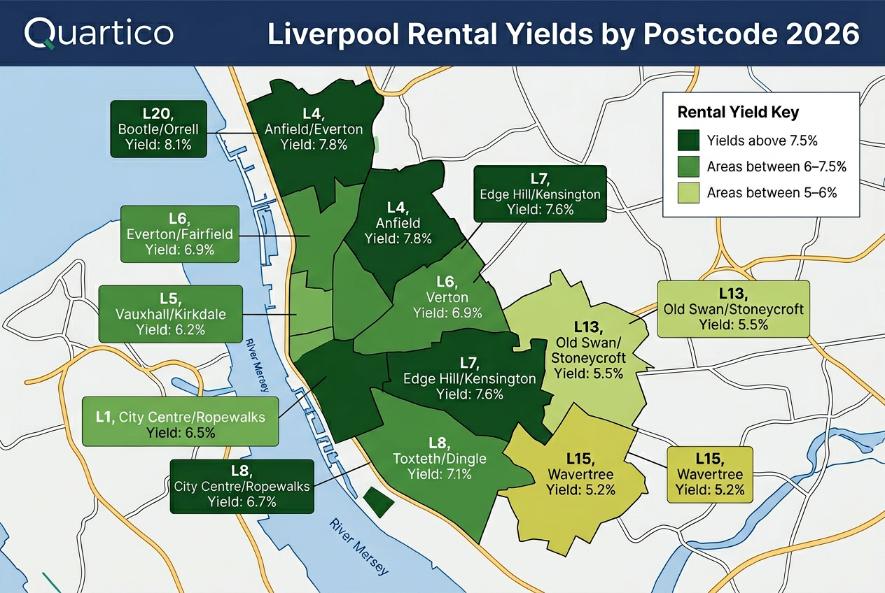
The standout for capital growth has been L5 (Vauxhall/Everton), which has seen approximately 75% price appreciation over five years. This is largely driven by the Bramley-Moore Dock development and Everton FC’s new stadium, which opened for the 2025/26 season. Properties purchased in this area three to four years ago have seen exceptional returns — but investors entering now should note that much of this uplift is already priced in. The remaining opportunity here is more likely in rental income than further explosive growth.
For pure yield, L4 (Anfield/Walton) and L20 (Bootle) consistently deliver above 7.5%. These are areas where entry prices remain below £120,000, attracting investors who prioritise cash flow over capital appreciation. The tenant demographic is predominantly working families and younger tenants, and demand tends to be steady year-round.
L7 (Edge Hill/Kensington) is worth particular attention for investors interested in HMO strategies. Its proximity to the University of Liverpool and Royal Liverpool Hospital creates strong demand for multi-let properties, and Victorian terraced houses in this area lend themselves well to conversion. Licensed HMOs here can achieve yields above 10%, though they require more active management.
Population and Demographics: Why Demand Keeps Growing
Liverpool’s demographic profile is one of its most underappreciated strengths as a rental market. The city has a population just under 500,000, with roughly 1.5 million across the wider Liverpool City Region. Over the past decade, the city has grown by 6.6%, and importantly, 68% of the population is of working age — the cohort most likely to rent.
The student population is a major structural demand driver. Over 70,000 students are enrolled across the University of Liverpool (Russell Group), Liverpool John Moores University, and the Liverpool Institute for Performing Arts. Each academic year brings a fresh wave of tenants into areas like Kensington (L7), Smithdown Road (L15), and parts of the city centre (L1/L3). Unlike some university cities where student demand is seasonal, Liverpool’s three institutions have staggered term dates and a growing international student body, which extends occupancy periods.
At the other end of the age spectrum, approximately 15% of Liverpool’s population is over 65. This is fuelling growing demand for specialist supported housing — a sector I’m seeing significantly more investor interest in. Supported housing offers a blend of independent living with on-site care services, typically let on long-term agreements with housing associations. Vacancy rates tend to be very low, and the underlying demand is demographic rather than cyclical, making it an attractive option for investors seeking stability over high yields.
Liverpool Tenant Demand by Segment
| Tenant Segment | Estimated Size | Key Areas | Typical Property | Yield Range |
|---|---|---|---|---|
| Students | 70,000+ | L7, L15, L6, L3 | HMO, shared houses, studios | 7–12% (HMO) |
| Young Professionals | Growing rapidly | L1, L2, L3, L8 | 1–2 bed apartments | 5.5–7% |
| Families | Stable | L4, L9, L13, L25 | 2–3 bed terraces/semis | 5–7% |
| Over-65s / Supported | ~75,000 (15%) | Citywide | Specialist supported units | 6–8% (long-term) |
| Short-Stay / Tourism | Seasonal peaks | L1, L2, L3 | Serviced apartments | 10–12% (managed) |
Regeneration and Infrastructure: £10 Billion in Active Projects
Liverpool is in the middle of one of the largest urban regeneration programmes in the UK. The scale of investment is worth understanding because it directly affects where property values are heading and where tenant demand will concentrate over the next five to ten years.
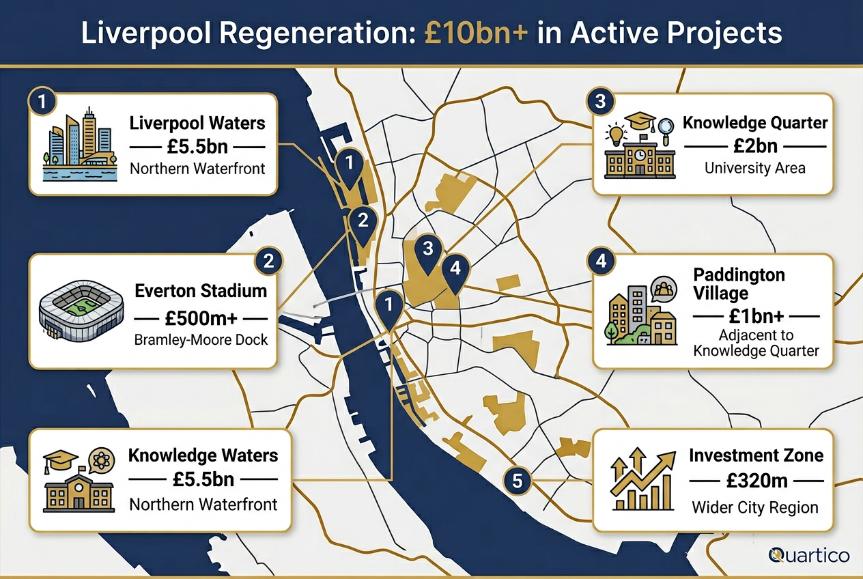
Liverpool Waters (£5.5 billion) — Led by Peel Group, this is the flagship project — a 60-hectare transformation of the northern waterfront stretching from the Albert Dock northward. The masterplan includes new residential developments, commercial space, leisure facilities, and public realm. Peel’s track record matters here. Their work on MediaCityUK in Salford and the Trafford Centre in Greater Manchester had a measurable and lasting impact on surrounding property values. I regularly advise clients who feel they missed the early-stage opportunity in Salford to look at Liverpool Waters as the closest parallel — a similar scale of investment, a similar developer, but with Liverpool’s more accessible price points.
Everton Stadium at Bramley-Moore Dock — The new 52,888-capacity stadium opened for the 2025/26 Premier League season and has already had a visible effect on property values in the L5 and L3 postcodes. Beyond matchday footfall, the stadium is designed as a year-round events venue, which strengthens the tourism and short-stay rental case for northern Liverpool.
Knowledge Quarter (£2 billion) — Centred around the University of Liverpool, Liverpool John Moores, and the Royal Liverpool Hospital, the Knowledge Quarter is positioning Liverpool as a life sciences and health innovation hub. The development is attracting employers in biotech, medtech, and digital health — sectors that bring higher-earning professionals into the rental market. For investors, this means growing demand for quality one and two-bedroom apartments in the L3 and L7 postcodes.
Other Notable Projects — The £320 million Liverpool City Region Investment Zone is driving private investment across Runcorn and St Helens. The Paddington Village development is creating new commercial and residential space adjacent to the Knowledge Quarter. And improvements to Liverpool Lime Street station are reducing journey times to London to just over two hours, strengthening the city’s appeal for remote and hybrid workers who need occasional access to the capital.
Major Regeneration Projects and Investment Impact
| Project | Investment | Developer / Lead | Affected Postcodes | Expected Impact on Property |
|---|---|---|---|---|
| Liverpool Waters | £5.5bn | Peel Group | L3, L5, L20 | 10–20% premium near waterfront |
| Everton Stadium | £500m+ | Everton FC / Laing O’Rourke | L5, L3 | Already reflected in L5 growth |
| Knowledge Quarter | £2bn | Liverpool City Council / Universities | L3, L7 | Higher-spec tenant demand |
| Investment Zone | £320m | Liverpool City Region CA | Wider region | Employment growth, rental demand |
| Paddington Village | £1bn+ | Liverpool City Council | L7, L8 | New commercial/residential demand |
Employment and Economic Diversity
A question I always encourage investors to ask about any city is: what happens if the biggest employer leaves? Cities with narrow economic bases are vulnerable to demand shocks. Liverpool performs well on this measure because its employment base is genuinely diversified.
Key sectors include maritime logistics (Peel Ports operates one of the UK’s largest port facilities), financial services (Barclays has a major Liverpool operation), technology and digital (the Baltic Triangle has become a recognised tech cluster), healthcare and life sciences (anchored by the Royal Liverpool Hospital and Knowledge Quarter), and higher education (the three universities are collectively one of the city’s largest employers).
This matters for rental demand because it means tenant income comes from multiple sources. A downturn in one sector doesn’t empty the rental market. In my experience advising across the Northwest, this economic resilience is one of the main reasons Liverpool’s vacancy rates have stayed consistently low even during periods of broader economic uncertainty.
Tourism and Short-Stay Rental Opportunity
Liverpool has established itself as one of the UK’s most visited cities outside London, and this creates a distinct investment opportunity in the short-stay rental market. The city hosts a constant calendar of Premier League football, major concerts at the M&S Bank Arena, cultural festivals, and international cruise ships — including operators like Disney Cruise Line docking at the Liverpool Cruise Terminal.
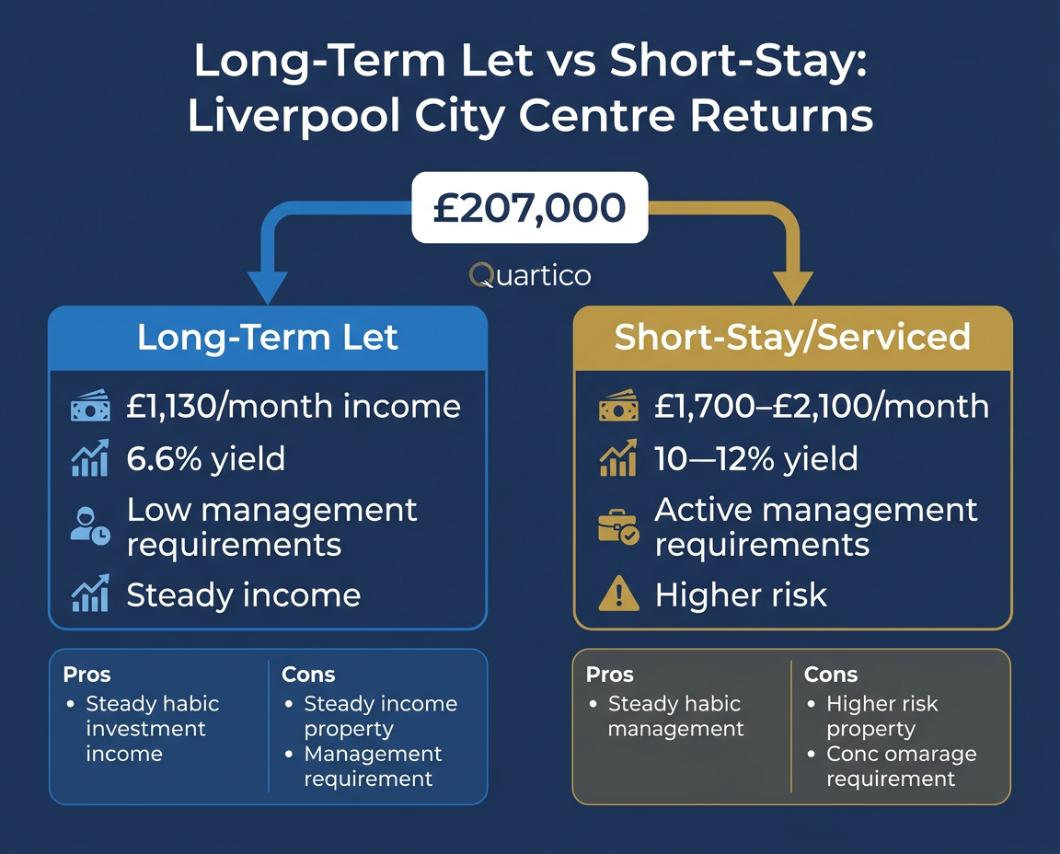
For investors, the short-stay numbers are compelling. A well-managed serviced apartment in the city centre (L1/L2) can achieve net yields of 10–12%, compared with 5.5–7% for a traditional long-term let in the same area. The lower purchase prices in Liverpool compared with cities like Manchester or Edinburgh mean the entry barrier is more accessible, and the tourism pipeline provides more consistent occupancy than many investors expect.
However, short-stay does come with regulatory considerations. Liverpool City Council operates increasingly active scrutiny of Airbnb-style lets in city-centre postcodes. Investors considering this strategy should factor in the possibility of future licensing requirements, and many of my clients are opting for hybrid models — short-stay during peak periods (football season, summer, events) and medium-term corporate lets during quieter months.
Long-Term vs Short-Stay Returns: Liverpool City Centre
| Metric | Long-Term Let (L1) | Short-Stay / Serviced (L1) |
|---|---|---|
| Avg Purchase Price | £207,000 | £207,000 |
| Monthly Income | £1,130 | £1,700–£2,100 |
| Annual Gross Income | £13,560 | £20,400–£25,200 |
| Gross Yield | 6.6% | 10–12% |
| Void Risk | Low (1–2 weeks/year) | Moderate (seasonal gaps) |
| Management | Standard letting agent | Specialist short-stay operator |
| Regulation Risk | Low | Medium (licensing possible) |
| Best For | Hands-off investors | Active/hybrid investors |
Specialist Supported Housing: An Emerging Sector
One area where I’m seeing a genuine shift in investor interest is specialist supported housing. This sector sits at the intersection of social need and investment return, and Liverpool’s demographics make it particularly relevant.
With approximately 15% of the population over 65 and an ageing profile that is projected to accelerate, the demand for supported accommodation — properties adapted for residents who need some level of care or assistance — is growing faster than supply. These properties are typically let to housing associations or care providers on long-term agreements (often 5–25 years), with rents partially or fully covered by housing benefit.
For investors, the appeal is stability. Vacancy rates are extremely low because demand is needs-based rather than market-driven. Yields typically fall in the 6–8% range, and the long lease structures provide predictable income. The trade-off is lower liquidity — these are not properties you can easily sell to an owner-occupier — and the regulatory environment requires due diligence on the housing association or care provider you’re partnering with.
This is a sector that most competing articles on Liverpool property investment don’t cover in any depth, but for investors with a longer time horizon and a preference for stability over high short-term returns, it’s worth serious consideration.
Transport and Connectivity
Good transport links are consistently one of the top factors tenants cite when choosing where to rent, and Liverpool’s connectivity has improved materially over the past decade.
The Merseyrail network provides frequent, reliable services across 67 stations covering Liverpool city centre, the Wirral, and surrounding areas. Lime Street station offers direct services to London Euston in approximately two hours and ten minutes, with connections to Manchester, Birmingham, and Leeds. Motorway access via the M62, M57, and M56 connects Liverpool to Manchester in under an hour by car. And Liverpool John Lennon Airport provides European connections, particularly to leisure destinations, which supports the tourism and short-stay rental market.
For investors, the practical implication is that tenants in Liverpool can access major employment centres both within the city and across the wider Northwest, which broadens the potential tenant pool. The ongoing improvements to Lime Street and the Merseyrail fleet upgrade (new trains are being phased in through 2026) will further strengthen this.
Risks and Considerations
No investment market is without risk, and I think it’s important to be upfront about the factors that could temper returns in Liverpool:
Oversupply in city-centre apartments: Liverpool has seen significant new-build apartment development in recent years, particularly in L1 and L3. In some blocks, multiple units compete for the same tenant pool, which can suppress rents and extend void periods. Investors should research specific developments rather than assuming all city-centre stock performs equally.
Service charges on new builds: Some newer developments carry service charges of £2,000–£3,500 per year, which significantly affects net yield. Always factor this into your calculations before committing.
Selective licensing: Liverpool City Council operates Selective Licensing Schemes in several high-density letting areas including Anfield, Toxteth, and Kensington. Landlords must register and meet defined safety and quality standards. Non-compliance can result in fines. This isn’t a barrier to investment, but it’s a cost and administrative requirement that should be budgeted for.
Lower average wages: Liverpool’s average salary (approximately £33,000–£34,000) is below the UK average of £38,000. While this supports the rental market (more people rent because buying is out of reach), it does place a ceiling on how high rents can realistically go, particularly outside prime city-centre locations.
Being transparent about these factors isn’t bearish on Liverpool — it’s practical. The strongest investors are the ones who model their returns realistically and choose the right postcode and property type for their strategy.
Frequently Asked Questions
What is the average rental yield in Liverpool?
Gross rental yields across Liverpool typically range from 6–8%, with some postcodes like L4 (Anfield) and L20 (Bootle) exceeding 7.5%. HMO properties in student areas can achieve 10%+ but require more active management.
How does Liverpool compare to Manchester for property investment?
Liverpool offers lower entry prices (approximately £185,000 vs £249,000) with rents that are surprisingly close (£885 vs £950 per month). This means Liverpool typically delivers higher gross yields. Manchester may offer stronger capital growth in premium postcodes, but for income-focused investors, Liverpool’s maths tends to work harder.
Is Liverpool a good place to invest in property in 2026?
Liverpool’s combination of affordable prices, strong rental demand across multiple tenant segments, and over £10 billion in active regeneration makes it one of the most compelling regional investment markets in the UK heading into 2026. The key is selecting the right postcode and property type for your strategy.
What are the best areas to invest in Liverpool?
For yield: L4 (Anfield), L7 (Kensington), L20 (Bootle). For capital growth: L5 (Vauxhall/Everton), L1 (City Centre). For student HMO: L7 (Edge Hill), L15 (Wavertree). For long-term stability: L13 (Old Swan), L9 (Walton/Aintree).
Are there risks to investing in Liverpool property?
Key risks include potential oversupply in city-centre apartment blocks, high service charges on some new builds, selective licensing requirements in certain areas, and lower average wages placing a ceiling on rent growth. These are manageable with proper research and realistic financial modelling.
Final Thoughts
Liverpool remains one of the strongest investment markets in the UK as we move through 2026. The combination of affordability, diversified rental demand, extensive regeneration, and a growing economy creates a market that works for a wide range of investment strategies — from traditional buy-to-let through to HMO, short-stay, and specialist supported housing.
The key, as with any market, is doing the work: choosing the right postcode, understanding the tenant profile, and modelling your returns realistically. If you’d like to explore specific opportunities in Liverpool, contact Quartico and we’ll be happy to guide you through what’s available.