
Why Hotel Rooms Deserve a Place in Your Portfolio

The UK property investment landscape has never been more varied — or more nuanced. As traditional buy-to-let strategies face headwinds from evolving legislation, changing mortgage conditions, and compressed yields in prime residential markets, a growing number of discerning investors are turning their attention to an asset class that has quietly been delivering compelling returns: individual hotel room ownership.
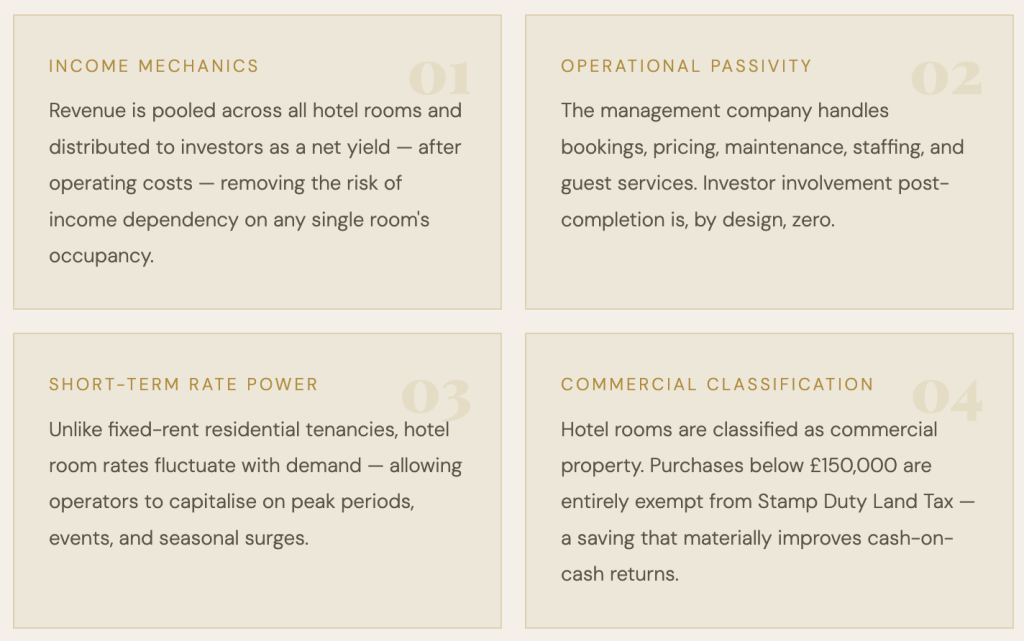
This is not a niche play for hospitality insiders. It is a structured, commercially framed investment with clearly defined income mechanics, meaningful tax advantages, and a fundamentally hands-off operational model. For investors who value passive income, capital efficiency, and simplicity of management, the hotel room investment thesis is worth understanding in full.
At Quartico, we assess assets across the full spectrum of UK property — residential, commercial, student, and operational real estate. Hotel room investments have emerged as one of the most compelling propositions in our current portfolio, not simply because of the headline yields, but because of the structural dynamics that underpin them.
“When the entry price is sub-£150,000, you eliminate stamp duty entirely. Combine that with 15% net yields and full management — and the economics become very difficult to ignore.”
-Asset Mechanics-
How Hotel Room Investment Actually Works
Purchasing a hotel room means acquiring the legal title to a single unit within a professionally operated hotel or aparthotel development. As the owner, you receive a contractually agreed share of the revenue generated by that unit — typically expressed as a net yield — while a professional management company handles every aspect of the operation: bookings, housekeeping, maintenance, front-of-house, marketing, and rate management.
Unlike traditional residential buy-to-let, you have no landlord obligations. No tenant sourcing. No void period management. No Section 21 complexities under the new Renters’ Rights Act. The operator manages all of this. Your sole role is capital provider — and income recipient.
The Aparthotel Model: A Superior Commercial Structure
The most attractive current hotel room opportunities are structured around the aparthotel model — developments that blend self-contained studio living with professional hotel-grade services. This format is specifically engineered to capture two of the UK’s fastest-growing travel demographics: the domestic staycation market and the growing digital nomad and extended-stay segment.
By operating as a commercial entity rather than a residential landlord, the investor benefits from an entirely different tax and regulatory framework — one that is, in many respects, considerably more favourable.
-Featured Opportunity-
The Crest at Newquay: A Case Study in Coastal Returns
To understand the hotel room investment proposition in practice, consider The Crest at Newquay — a Quartico-validated aparthotel development on the Cornish coast that we currently offer to investors.
Quartico Validated Asset · Newquay, Cornwall
The Crest at Newquay
A high-performance aparthotel targeting the UK staycation and digital nomad demographics, with fully equipped studio apartments and private kitchenettes optimising revenue per square foot.
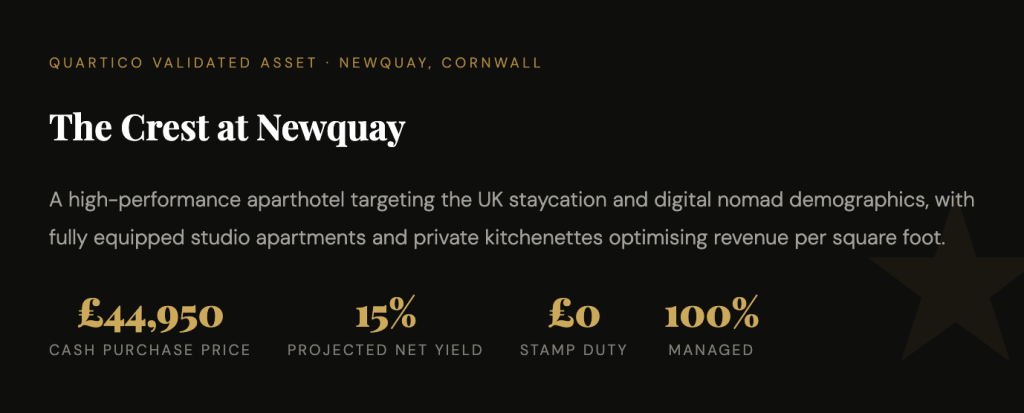
The investment logic at The Crest is built on three reinforcing pillars. First, the cash-only entry structure: at £44,950, investors deploy capital without mortgage dependency, eliminating interest rate risk entirely and ensuring that the full net operating income flows directly to the investor. Second, the structural shift in UK travel: domestic tourism has undergone a permanent behavioural realignment post-pandemic, with Newquay positioned at the forefront of the coastal staycation trend. Third, the Aerohub enterprise zone and the Nansledan urban extension are actively transitioning Newquay from a seasonal resort to a sustainable year-round economic hub — meaning the occupancy thesis is not limited to summer months.
The Crest is not a speculative development. It is an operational asset with a defined commercial profile, a professional management structure, and a clear income model. For investors seeking uncomplicated, high-yield exposure to the UK hospitality sector, it represents one of the most compelling propositions currently available.
-Asset Comparison-
Hotel Rooms vs. Traditional Buy-to-Let
The question every residential investor asks when encountering hotel room opportunities is a straightforward one: how does this compare to what I already know? The answer requires honest analysis of both models across the dimensions that matter most to income-focused investors.
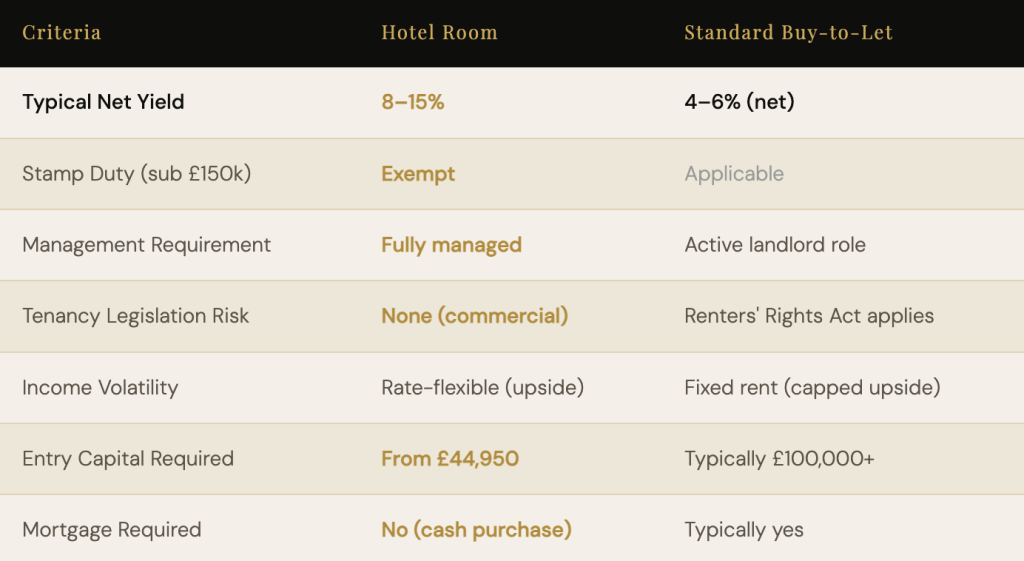
It is important to be clear-eyed about the distinctions too. Hotel room income is not guaranteed in the same way a fixed tenancy provides contractual rent. Returns are tied to occupancy performance and operator quality. The due diligence required — on the operator, the location, and the development — is therefore essential, and it is precisely the work that Quartico’s validation process is designed to deliver on behalf of our investors.
-Market Context-
The UK Staycation Economy: A Structural Tailwind
The macroeconomic backdrop for hotel room investment in the UK has materially strengthened over the past five years. What began as a pandemic-driven shift in travel behaviour has evolved into a durable structural change. British travellers are increasingly choosing domestic destinations — for reasons of cost, convenience, and a genuine deepening of appreciation for the UK’s coastal and countryside offer.
Newquay, in particular, exemplifies this evolution. Cornwall as a whole received record visitor numbers through 2023 and 2024, and Newquay’s specific investment in infrastructure — the Aerohub business park, the Nansledan residential and commercial extension, and improved transport connectivity — positions it not as a purely seasonal resort, but as a twelve-month destination economy. This is the key distinction for investors: the income model does not depend on summer alone.
The emergence of the “digital nomad” as a defined traveller segment also materially benefits the aparthotel model. Workers seeking extended-stay accommodation with kitchen facilities, workspace, and hotel-grade connectivity represent a new, higher-spending, longer-duration guest type that the traditional B&B or standard hotel room cannot adequately serve. Aparthotels are specifically designed to capture this demand.
“Newquay is transitioning from a seasonal resort to a sustainable twelve-month visitor economy — and investors who move early will benefit from the full arc of that growth.”
-Investor Considerations-
What to Assess Before You Invest
Quartico’s position on hotel room investment is emphatically positive, but it is grounded in the recognition that asset quality, operator credibility, and location fundamentals vary significantly across the market. Not every hotel room opportunity is equal. The following framework reflects the due diligence criteria we apply before validating any opportunity for our investors.
Operator Track Record
The management company’s operational history is the single most important variable in a hotel room investment. Revenue distribution depends entirely on their ability to drive and maintain occupancy. Review verified occupancy rates, guest review scores, and operational tenure before committing capital.
Location Economics
Strong hotel room investments sit in locations with multiple demand drivers — tourism, business travel, infrastructure regeneration, and year-round visitor appeal. Single-season coastal resorts without diversifying economic activity carry materially higher vacancy risk than locations with the structural profile of Newquay post-Aerohub.
Entry Price and Yield Arithmetic
The sub-£150,000 threshold for stamp duty exemption is a meaningful structural advantage. At The Crest’s £44,950 entry point, an investor generating 15% net yield receives £6,743 annually with zero stamp duty cost and zero mortgage liability. The cash-on-cash arithmetic is compelling by any reasonable benchmark — the UK average gross residential yield sits at approximately 5.9–6.0% nationally as of early 2026.
Exit Strategy
Hotel rooms trade within a defined secondary market. Understand the exit mechanism — whether resale is facilitated by the operator, managed independently, or structured through a repurchase clause — before acquisition. Quartico ensures each opportunity we present carries a clearly defined exit pathway.
Next Steps
Is a Hotel Room Investment Right for Your Portfolio?
Hotel room investment occupies a specific niche within a well-structured portfolio. It is best suited to investors who prioritise income yield over capital appreciation as the primary return driver, who value the simplicity of a fully managed, hands-off asset, and who are looking to deploy capital efficiently without the overhead of mortgage financing or residential landlord obligations.
It is particularly compelling for investors already holding residential buy-to-let assets who are seeking to diversify into a commercially structured, higher-yielding asset class without materially increasing management complexity.
If that profile describes your current investment position, or the position you are seeking to build toward, we invite you to speak directly with a Quartico specialist. Our role is not to sell you a specific asset — it is to assess your goals, your timeline, and to identify the opportunity within our validated portfolio that best serves your strategy.